The day before yesterday, Yingen announced another success.Going Overseas, and GSK onOnePotential Best-in-ClassADC Drug (DB-1324) Collaboration Achieved, Acquired$30 million upfront payment. If GSK subsequently exercises its option to obtain overseas rights, DualityBio can receive up to $975 million in development, registration, and commercialization milestones, plus sales royalties.
The press release did not disclose the target of DB-1324, and the relevant description is as follows:DB-1324 is an innovative ADC molecule developed based on the Duality Immune Toxin Antibody Conjugates (DITAC) platform, which is unique to DualityBio and has been clinically validated. It is currently still in the preclinical development stage, and its research direction may focus onGastrointestinal (GI) Cancer。There are still many unmet clinical needs for patients with gastrointestinal (GI) cancers globally, accounting for 35% of all cancer-related deaths and approximately 26% of global cancer incidence. Moreover, this ADC drug has the potential to be used in combination with multiple oncology products from GSK, strategically complementing GSK's oncology portfolio.The editor waited for two days to see if GSK's press release would reveal more clues. Unfortunately, GSK did not issue a PR. Two key points from the available information:1) "Potential Best-in-Class"”, indicating that it is not First in class, but rather a target that the pharmaceutical industry is already developing and transforming.2)Gastrointestinal Cancer", that is, esophageal cancer/stomach cancer/colorectal cancer, and if expanded a bit, liver, gallbladder, and pancreatic cancers are also included. This would involve a very broad range of targets. However, this statement also indicates that the target is mainly focused on the digestive tract, or it could be said that GSK/Duality Bio will primarily promote treatments for gastrointestinal tumors in the future. The pipeline targets disclosed by Yingen includeHER2, HER3, B7-H3, B7-H4, and TROP2, etc. None of them seem to fit quite well.Daiichi Sankyo'sB7-HADC Recently Initiated Phase 3 Study in Esophageal Squamous Cell Carcinoma(Recommended Reading:B7H3 ADC Initiates Phase 3 Study in Esophageal Squamous Cell Carcinoma),But GSK has already been introduced by Hansoh.ADC with the same target.The only remaining option is to dig into Ying'en's patents. After reviewing the information of Ying'en's publicly available patents, there are two cancer targets that have not yet been included in the official pipeline: ADAM9 andGPC3. Compare with the above standardsA little bit.The ADC targeting ADAM9 was initially co-developed by Immunogen and Macrogenics internationally. Following Immunogen's acquisition by AbbVie, the parties collectively decided to terminate the development because the first molecule, IMGC936, failed to meet the pre-set efficacy and safety standards. Subsequently, Macrogenics advanced the development of the second-generation molecule MGC028, and an IND application was just submitted to the FDA in October this year.According to the introduction on Macrogenics' official website: “ADAM9That is, "A Disintegrin and Metalloproteinase Domain 9," a member of the ADAM family of multifunctional type I transmembrane proteins, plays a role in tumorigenesis and cancer progression and is overexpressed in various cancers, making it an attractive target for cancer therapy."The listed materials include information on cancer types and animal models, covering pancreatic cancer, gastric cancer, NSCLC, triple-negative breast cancer, and colorectal cancer. If categorized broadly under the digestive tract tumor category, it accounts for more than half."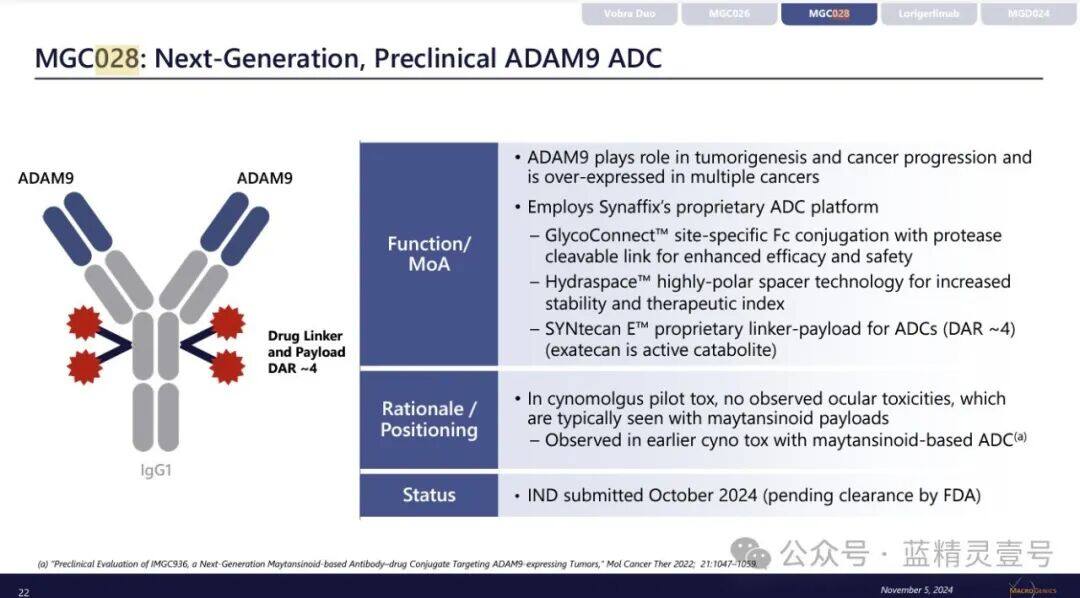
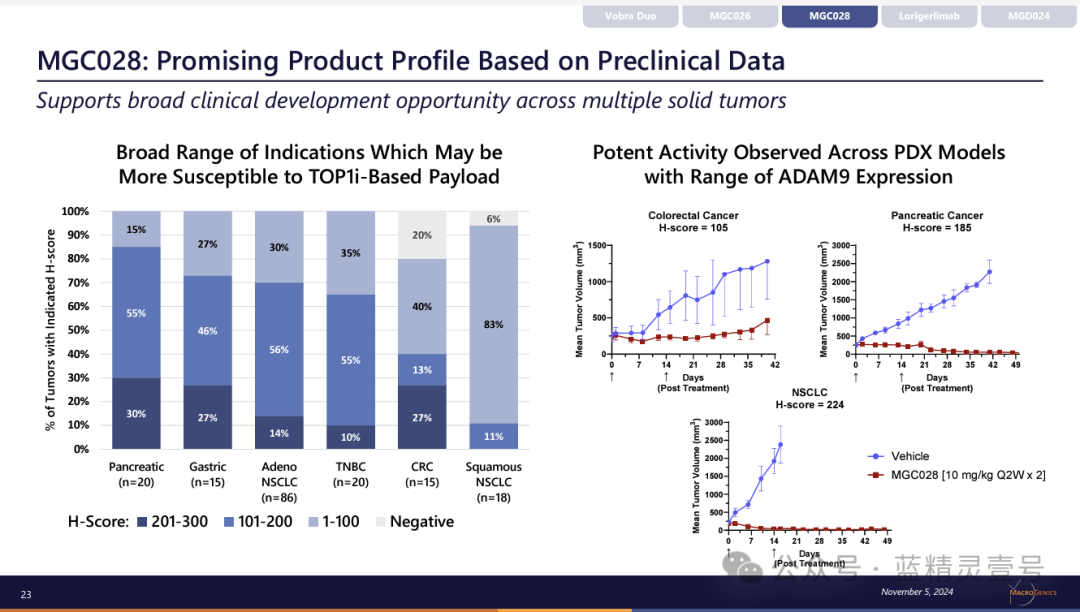
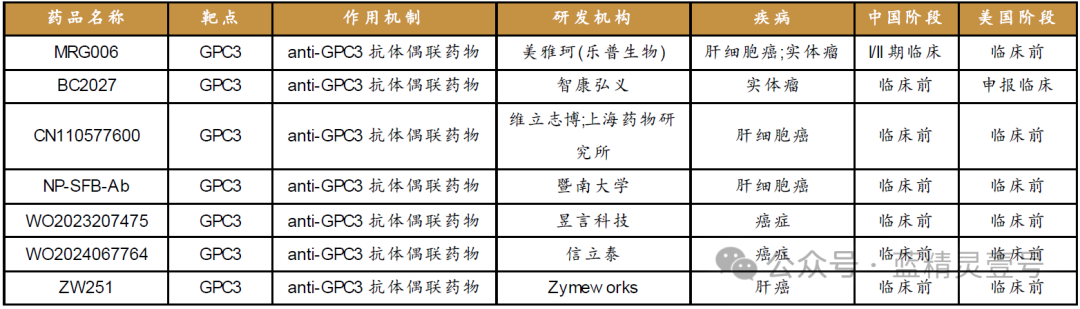
Ying'en's patent mentions that the preferred high-expression cancers are colorectal cancer and lung adenocarcinoma, and the examples also mostly select animal models related to these cancer types.GPC3 is a specific liver cancer target.SeveralDays ago, Ipsen also introducedBiomunex's Preclinical GPC3TCE Project。According to the patent description of ImmunoDeng:GPC3 plays an important role in cell growth, cell differentiation, and cell migration. The GPC3 protein is expressed in embryonic tissues (such as liver, kidney, and placenta), but due to epigenetic silencing caused by DNA methylation, there is almost no GPC3 expression in adult tissues. However, immunohistochemical studies have found that GPC3 is specifically highly expressed in >70% of hepatocellular carcinoma (HCC) tissues. Clinical studies also show that the expression of GPC3 is associated with poor clinical prognosis of HCC. Therefore, GPC3 has potential as a therapeutic target molecule for liver cancer.TargetingGPCMore than 60 cell therapy clinical trials are underway for Phase 3. The first monoclonal antibody project is from Roche.Codrituzumab, but its development was terminated in Phase 2 due to lack of efficacy.Eight bispecific antibodies have entered the clinical stage, but there are fewer ADC drugs, most of which are still in the preclinical stage.. The following are excerpts respectively.Southwest SecuritiesSummary of ADC Pipeline in July andForeign Media Summary of DecemberDual-Target Antibody Pipeline。Overview of GPC3 ADC Development (Compiled by Southwest Securities in July 2024)
Overview of GPC3 Bispecific Antibody Development (Organized by Apex in December 2024)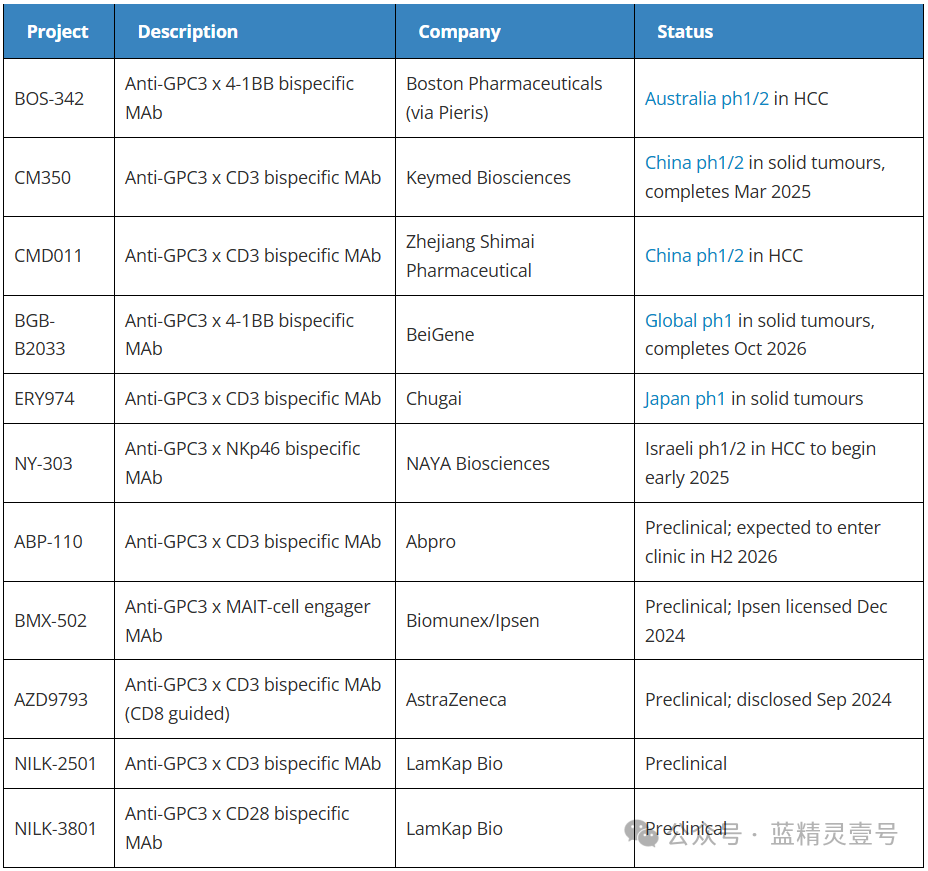
Overall, these two targets are somewhat similar but not quite a match. Of course, it’s also highly possible that GSK has introduced a new target project from Yingen that hasn’t been publicly patented yet. Some in the industry speculate that it might be CDH17, an emerging target primarily aimed at colorectal cancer.。Just wait for the answer to be revealed in the future.
Welcome to follow and share! All articles in this official account can be reproduced anywhere as long as the source is acknowledged.