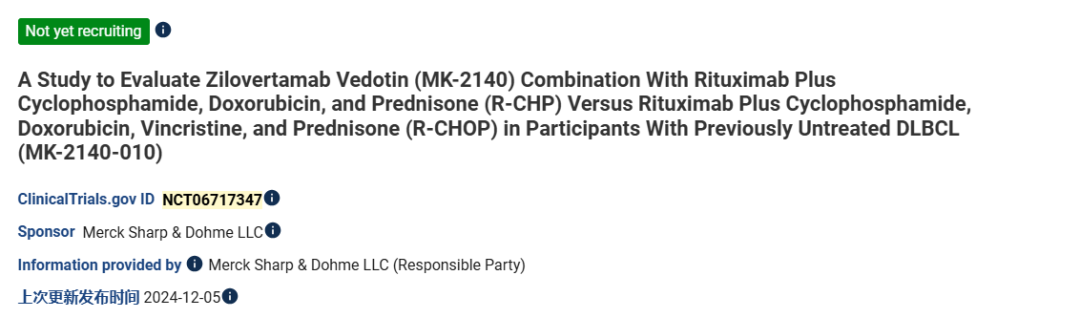
On December 5, according to the clinical trials website, MSD registered a clinical trial for the ROR1 ADC drug.Zilovertamab Vedotin (MK-2140) in combination with rituximab plus cyclophosphamide, doxorubicin, and prednisone (R-CHP))AndRituximab plus cyclophosphamide, doxorubicin, vincristine, and prednisone(R-CHOP)TreatmentPreviously untreated patients with diffuse large B-cell lymphoma (DLBCL)A randomized, open-label, multicenter, Phase 3 study (waveLINE-010).
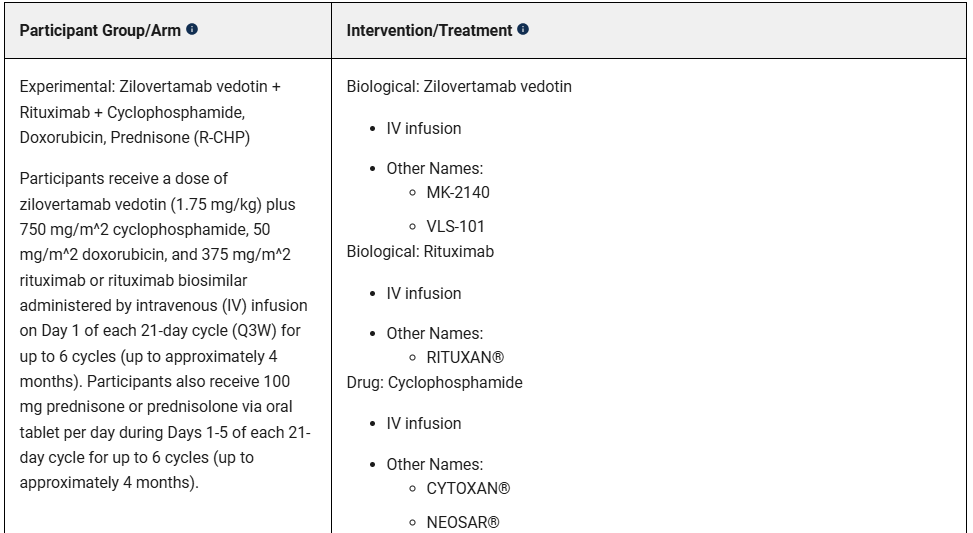
The StudyScheduled to launch in December 2025, with a planned enrollment of 1,046 cases,Evaluation compared to standard treatment aloneHuman AppearanceCompare whether standard treatment combined with zilovertamab vedotin can help people live longer without cancer growth or spread.。The primary clinical endpoint was PFS.The dose adopted in the Phase III trial of Zilovertamab Vedotin (MK-2140) is 1.75 mg/kg.
MK-2140 was previously developed by VelosBio and was acquired by Merck & Co., Inc. (MSD) for $2.75 billion in November 2020.
Public information shows,Zilovertamab vedotin injection (MK-2140, VLS-101) is a monoclonal antibody targeting ROR1 conjugated with a chemotherapy drug called monomethyl auristatin E (MMAE)., an antibody-drug conjugate (ADC) formed by linking antibodies with MMAE. After the antibody binds to ROR1 on cancer cells, it releases MMAE to destroy the cancer cells. In mouse models of human hematologic malignancies and solid tumors, MK-2140 has demonstrated potent anti-tumor activity.CurrentlyMK-2140 inOverseasMultiple trials related to hematological malignancies and solid tumors have entered the clinical Phase 2/3 stage.On October 17, 2024, the CDE official website announced,MSD's clinical trial application for "Zilovertamab Vedotin for Injection" (MK-2140) has been accepted.Receptor Tyrosine Kinase-like Orphan Receptor 1 (ROR1) is a member of the ROR receptor family. During childhood and adulthood, ROR1 is expressed at very low levels or not at all in normal tissues. In contrast to normal tissues, ROR1 is highly expressed in various cancers, including hematologic malignancies such as chronic lymphocytic leukemia (CLL), mantle cell lymphoma (MCL), and solid malignancies (ovarian cancer, breast cancer, pancreatic cancer, lung cancer, melanoma, and colorectal cancer, among others). The level of ROR1 expression is positively correlated with the degree of tumor differentiation.Despite the vast population of cancer patients covered by ROR1 and its highly promising application prospects,Currently, no drugs targeting this site have been approved for marketing.MSD's MK-2140 is one of the fastest-progressing ROR1 ADC candidate drugs. Currently, globally, the development directions for the ROR1 target include monoclonal antibodies, bispecific antibodies, ADCs, and CAR-T, among which the focus is more on the ADC direction.In China,CStone Pharmaceuticals, Huadong Medicine, CSPC Pharmaceutical GroupCompanies are also actively laying out and advancing ROR1 ADC into clinical trials.
Statement:All articles published on this official account (including original and reprinted articles) are intended to convey more information, and the source and author are credited. This official account welcomes sharing in friend circles or large groups.Reproduction in any form by media or organizations without authorization is prohibited.。Reprint/Business/Contribution| Contact WeChat15618157102(sum_Gmi)