

Muna Therapeutics Enters Alzheimer’s Drug Discovery Collaboration with GSK, Secures €33.5M Upfront

Muna Therapeutics
Small Molecule Drug Developer

GSK
Pharmaceutical R&D Manufacturer
On December 6, Muna Therapeutics announced a research collaboration with GSK aimed at leveraging Muna's MiND-MAP platform to discover and validate innovative drug targets for the treatment of Alzheimer's disease.
According to the terms of the agreement, Muna will receive an upfront payment of €33.5 million (approximately RMB 257 million) from GSK. In addition, Muna is eligible to receive up to €140 million (approximately RMB 1.076 billion) in milestone payments for each target discovered, and Muna will have the right to receive tiered royalties on any commercialized products. Muna will expand and strengthen its existing MiND-MAP dataset and lead the discovery and validation of innovative Alzheimer's disease targets. GSK will lead drug development and be responsible for preclinical activities, clinical development, manufacturing, and commercialization related to the collaboration’s discovered and validated targets.
Within a short week, GSK has密集 announced three BD collaboration deals. Previously, GSK first reached a cooperation with ImmuneOnco in the oncology field, and then quickly partnered with Rgenta in the same field. This time, it is the third BD collaboration deal announced by GSK within a week.
MiND-MAP Platform: "Comprehensive Human Target Discovery and Validation Method"
The core of this collaboration is Muna's proprietary MiND-MAP platform, a "full-human target discovery and validation approach" that utilizes single-cell spatial multi-omics and bioinformatics technologies to identify genetic, cellular, and other molecular mechanisms associated with specific diseases.
The MiND-MAP platform analyzes brain tissue samples from Alzheimer's patients, individuals with stronger cognitive abilities, healthy control groups, and centenarians with or without cognitive impairment using spatial transcriptomics technology. It focuses on the genetic, molecular, and cellular mechanisms underlying disease pathology resilience, identifying and validating potential new drug targets. Candidate drug targets discovered by the platform will be validated in a series of human cells, humanized animal models, as well as patient tissues and biofluid samples at Muna Therapeutics.
Brain resilience refers to the ability of the brain to protect core functions (such as cognitive abilities) despite facing hallmark pathological conditions of neurodegenerative diseases, such as abnormal protein misfolding, and is closely linked to the genetic, molecular, and cellular mechanisms that form the basis of disease pathology resilience.
At the genetic and molecular levels, genetic factors have a significant impact. For instance, the APOE4 subtype of the apolipoprotein E gene is a high-risk factor for Alzheimer's disease, weakening cognitive resilience in the brain; whereas the APOE2 subtype can reduce the risk of disease onset, helping the brain maintain a good state. Meanwhile, genes also indirectly participate in physiological processes such as angiogenesis and neurogenesis, ensuring the brain receives adequate nutrition and enhancing its ability to resist pathological changes. At the molecular level, neurotransmitters play a crucial role—abnormal dopamine levels lead to dysfunction in Parkinson’s disease, while serotonin imbalance is associated with the onset of depression, interfering with emotional regulation and resilience in the brain. Protein homeostasis is vital; abnormal aggregation of β-amyloid and tau proteins in Alzheimer’s disease causes neuronal damage, leading to a decline in brain resilience.
At the cellular level, neurons are crucial for information transmission in the brain. Their inherent properties determine the efficiency of information processing. When these properties change due to illness, brain function becomes disordered. The excitability and inhibitory properties of neurons can be modulated through drugs and other means to reshape brain resilience. Glial cells play a key role; astrocytes are responsible for maintaining ionic and nutritional balance in the brain, while microglia undertake immune protection duties, defending against pathogens and clearing debris. During illness, if their functions are impaired, inflammation worsens and neurons get damaged. When functioning normally, they can release neurotrophic factors, control inflammation, and enhance brain resilience.
 Source: Muna Therapeutics Official Website
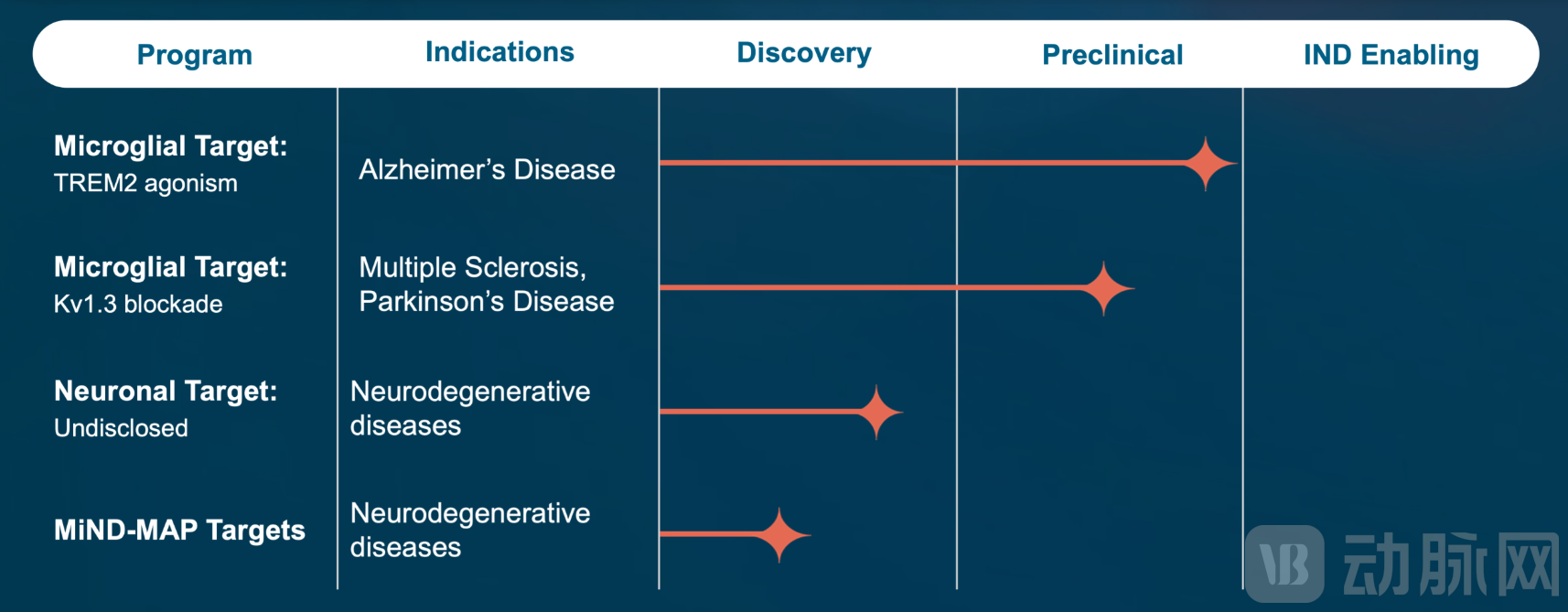
Currently, based on the MiND-MAP platform, Muna Therapeutics has disclosed four candidate pipelines. The most advanced one is a TREM2 agonist targeting early AD. Genetic studies suggest that TREM2 variants may be either protective or risk factors for AD, with microglia playing a central role in the disease. TREM2 agonists can enhance microglial function, address misfolded protein pathology, and protect neurons from degeneration. This candidate pipeline has demonstrated excellent oral and brain exposure properties in animal models.
Nearly $100 Million Spent in the First Week, GSK's Activity "Maxed Out"
Within this week, GSK has consecutively announced three BD collaborations with upfront payments exceeding 100 million US dollars, and declared an agreement to extend the commercialization period of the Shingrix shingles vaccine in mainland China with ZF Bio.
This week's three BDs are all quite noteworthy. In addition to the collaboration with Muna Therapeutics mentioned above, the partnership with China's innovative pharmaceutical company DualityBio focuses on the hottest research area in oncology—ADC, securing the global (excluding mainland China, Hong Kong, and Macau) exclusive rights to a potential best-in-class ADC drug (DB-1324), with research possibly targeting gastrointestinal (GI) cancer. Previously, DualityBio has collaborated with BioNTech, BeiGene, and Adcendo, and its ADC technology platform has been validated. Currently, GSK has built a novel ADC portfolio supported by expertise in tumor cell-targeting mechanisms through a combination of in-house R&D and licensing.
The BD collaboration with Rgenta Therapeutics, on the other hand, focuses on RNA-targeted therapeutics. This partnership involves an upfront cash payment and near-term milestone payments totaling up to $46 million, with the potential for Rgenta to achieve nearly $500 million in total revenue per target. GSK will fully leverage Rgenta's technology platform to develop novel oral RNA-targeted small molecule splicing modulators for multiple targets designated by GSK.
As of now, according to incomplete statistics, since 2022, GSK has reached three collaborations with Chinese innovative pharmaceutical companies, with upfront payments amounting to $605 million (approximately 4.354 billion RMB). These include GSK's consecutive acquisitions of two ADC drugs from Hansoh Pharma in 2022, as well as recent agreements with Enmu Biologics and Duality Bio, covering the two major fields of oncology and immunology.