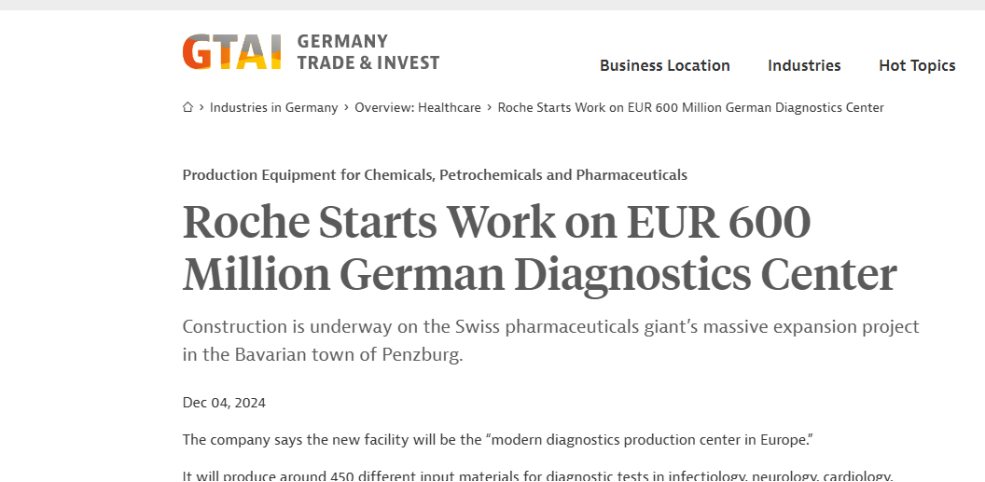
Roche Announces €600 Million Investment to Build Advanced IVD Raw Materials Production Center in Germany

Roche
Oncology Drug Research, Development, and Manufacturing
Medical Device Media Reporting Pioneer
Share Professional Medical Device Knowledge
In 2023,Roche Diagnostics, with revenue of 14.104 billion Swiss francs (approximately 16 billion US dollars), once again topped the global In Vitro Diagnostics (IVD) market, marking its tenth consecutive year in this leading position.However, the development of this Basel, Switzerland-based diagnostics giant has not been smooth sailing.Has been on the brink of bankruptcy many times.

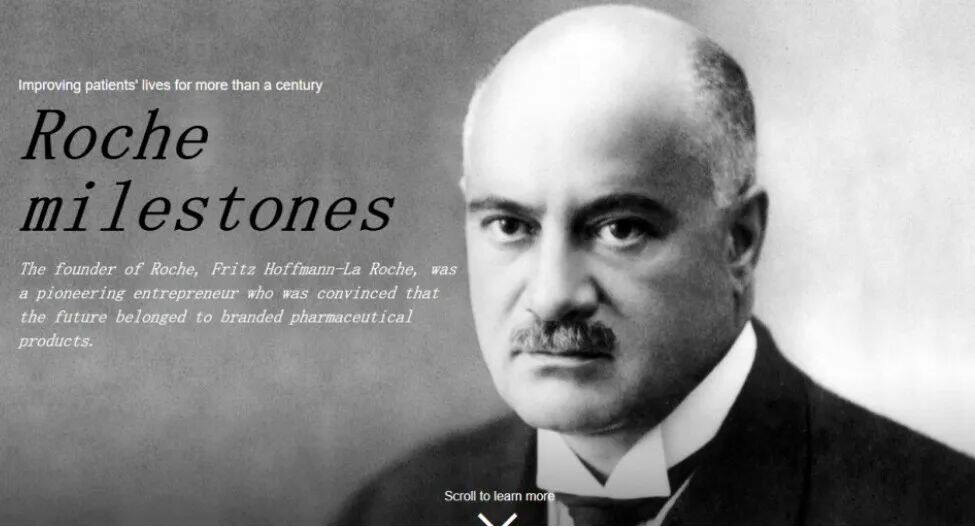
The history of Roche can be traced back to 1896, during the Second Industrial Revolution. In its early days, Roche generously funded experiments by scientists around the world but faced numerous operational difficulties and was on the brink of bankruptcy several times. Fortunately, the company's founder, Fritz Hoffmann, came from a wealthy Jewish merchant family and successfully orchestrated a capital restructuring.
In 1968, Roche Diagnostics was officially established, separating from the pharmaceutical business. With a strong talent pool, it quickly rose to prominence, and its reagents are widely used in medical immunology tests.
In 1978, Fritz Gerber became the CEO and initiated significant reforms, tightening the organizational structure. Gerber launched a "crazy" acquisition plan, the most famous of which included acquiring nearly 60% of Genentech's shares for $1.537 billion in 1990, as well as later acquiring Syntex Corporation and Boehringer Mannheim, a German diagnostics giant.The acquisition of Boehringer Mannheim enabled Roche to reach the top of the global IVD market in one move.During the 20 years of Gerber's leadership at Roche, the company's market value increased 17-fold, from 6.3 billion Swiss francs to 110 billion Swiss francs. Since then, Roche has maintained frequent acquisition activities while increasing R&D investment, with more than 20% of annual profits allocated to research and development.Through the "self-research + mergers and acquisitions" dual-driven approach, Roche continuously launches groundbreaking innovative products, covering multiple in vitro diagnostic segments such as biochemistry, immunoassays, molecular diagnostics, and POCT, becoming a global benchmark in the in vitro diagnostics field.
Currently, Roche's business includes pharmaceuticals and diagnostics.Diagnosis accounts for 24%. In the past decade, excluding the impact of COVID-19, the diagnostic business has experienced rapid growth, with a CAGR of 4.27% over the past five years.
Business Divided into Four Major Segments:
Central Laboratory and POC Diagnostics (Accounting for over 50%, strong growth in central laboratory, POC decline due to the disappearance of COVID-19 benefits)
Diabetes Management (Declined due to market contraction and pandemic impact)
Molecular Diagnostics (Declined Due to Reduced Demand from COVID-19)
Pathological Diagnosis (Continuous Growth)
Regionally, EMEA is the largest market (>30% revenue), North America saw the steepest decline, and Latin America had the fastest growth. The Asia-Pacific region accounts for over 30%, but growth in China has slowed due to policy impacts. The latest financial report shows,In the first three quarters of 2024, Roche Diagnostics' revenue in China reached 15.6 billion yuan, accounting for a significant 12%.China is Roche's second largest market globally.
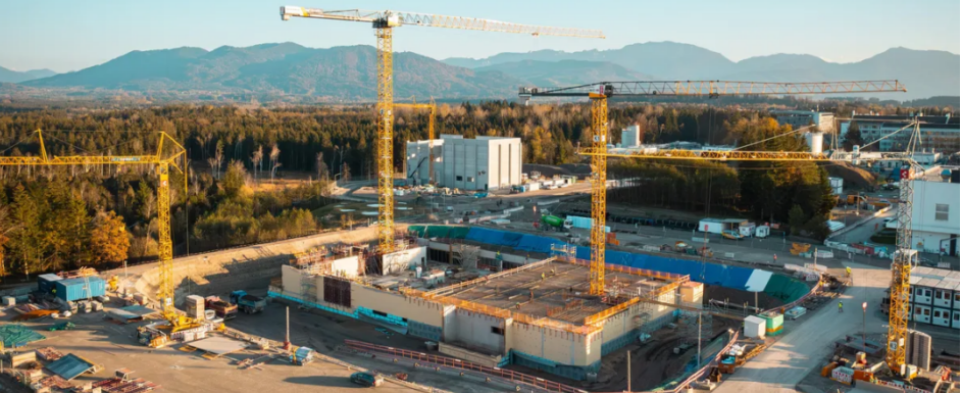
Roche has been increasing its investment in production sites across Germany in recent years to further strengthen its leading position in the global diagnostic raw materials manufacturing sector.According to the latest data, Roche has invested over 3 billion euros in total across its sites in Penzberg, Mannheim, Grenzach, and Ludwigsburg between 2019 and 2023. In 2023 alone, the total amount of all investment projects implemented or launched by Roche in Germany exceeded 1.4 billion euros.
Penzberg is particularly crucial for Roche in the production of diagnostic reagents. In 2023, approximately 29 billion test kits were delivered to customers worldwide through Roche’s IVD instruments. These kits include key raw materials such as antibodies, enzymes, and nucleotides. About 80% of the raw materials for diagnostics come from Roche's Penzberg site, which covers around 1,900 different raw materials. The approximately 450 types of diagnostic testing raw materials that will be produced in the new production center will further expand Roche's product portfolio.
The new diagnostics manufacturing building will excel in the digitization and automation of production processes to achieve faster and more efficient manufacturing. Equipped with multifunctional devices, the new production center will offer high flexibility, capable of producing various raw materials according to demand. Roche’s Penzberg site covers the entire value chain from research and development to diagnostics manufacturing. As of December 31, 2023, the site employed approximately 7,730 people, including 309 interns and students, creating numerous local job opportunities.
Roche's Continued Investment in German Site Reflects Deep Global Diagnostic Market Layout and Leadership in Biopharmaceuticals
In addition, Roche Diagnostics is also deeply cultivating the Chinese market and accelerating its localization layout.In the first three quarters of 2024, Roche Diagnostics generated revenue of 15.6 billion RMB in the Chinese market, accounting for 12% of its global total income, underscoring the central role of the Chinese market in its global business landscape.
Since entering the Chinese market in 2000, Roche Diagnostics has made Shanghai its first station, successfully introducing advanced testing technologies through an agency model. It has gradually built a strong brand image in the Chinese market and established an extensive academic cooperation network. With the continuous rise in market demand, Roche Diagnostics quickly expanded its business territory, successively setting up branches in key cities such as Guangzhou, Beijing, and Hangzhou to serve the Chinese market more comprehensively.By the end of 2023, the number of employees in Roche Diagnostics' China region had expanded to 3,300, a figure that undoubtedly serves as strong evidence of its commitment to the Chinese market.
Facing China’s largest and fastest-growing in vitro diagnostics (IVD) market globally, Roche Diagnostics has not stopped at localized sales but has further advanced its localized production strategy. In 2015, Roche invested in building an Asia-Pacific production base and R&D center in Suzhou, with a cumulative investment of 4 billion yuan to date. The facility is planned to produce over 230 types of reagents and instrument products, fully covering key areas such as immunoassay, clinical chemistry, and tissue diagnostics. Among these, 15 products have been specifically tailored to meet the unique needs of Chinese patients.
In the deep implementation of the localization strategy, Roche Diagnostics has also actively sought strong alliances with local enterprises. Through resource sharing and complementary advantages, they jointly promote the prosperous development of China's IVD market.Currently, Roche Diagnostics has established close cooperative relationships with several well-known Chinese IVD companies such as Weigao, Nine Strong,菲鹏, Hotgen,仁迈, and Oriental Gene, jointly exploring new market opportunities.
Roche Diagnostics' deep cultivation and continuous investment in the Chinese market not only demonstrate its firm confidence in China but also add strong momentum to its competition in the global IVD market.
Roche's continuous investment in its German site not only reflects its profound layout in the global diagnostics market but also demonstrates its leadership in the biopharmaceutical field. With the gradual completion and commissioning of the new production center, what will Roche's next move be? Will it be related to China? Instrument Family will keep following up.


United Imaging uAI Avatar Digital Human Makes Global Debut, Medical AI Becomes New Business Card for China's Technological Expansion Overseas
Medical Device Giant with 22,000 Employees Announces Layoffs
EP Leader Cuts 70% of Workforce
Leader in Blood Equipment, Selling Off Main Business
WIL Meta® Yuan Xiang Series 3D C-Arm by Wanxiang Technology Achieves Interconnectivity with Tianji® Orthopedic Surgery Robot by Tinavi
Philips Teams Up with Mayo Clinic for Three Major Collaborations in a Week
ECMO Giant Reaches Procurement Agreement, Covering 4,350 Hospitals
GE Healthcare Announces Major Acquisition
AI Cyclone! Siemens Healthineers, Joining Hands with "The Leader of Third-Party Imaging"
Legendary Giant Cuts Another 3,000 Jobs