In the medical device field, to become an industry giant, it is necessary to have advanced medical technology and sales channels. More importantly, one must learn to carry out large-scale merger and acquisition transactions. After all, once a company becomes large, its processes become extremely complex, decision-making efficiency becomes very low, and internal friction increases. Therefore, it becomes very difficult to develop revolutionary original technology within a large company.
In addition, the medical device field appears to be large, but it is actually composed of countless small sub-sectors. When distributed, each sub-sector becomes relatively small, and the technical commonality among these sub-sectors is very poor. For large companies, spending significant costs, time, and personnel on a project with relatively small market capacity (compared to industrial or consumer products) is simply not worthwhile. It is better to focus on managing existing markets and wait for the right opportunity to directly acquire products that have already been clinically validated, which is more feasible and even less costly.
Companies such as Johnson & Johnson, Medtronic, Abbott, and Boston Scientific have become global top ten giants through continuous mergers and acquisitions. This also provides a direction for the rapid growth of China's medical device companies. Currently, the companies doing the best in mergers and acquisitions in China are Mindray and Genius.Mindray has gradually become the leading medical device company in China and entered the global top 30 through self-research and acquisitions.Through mergers and acquisitions, Jian Shi has become one of the top medical device companies in China within just six years. As competition in China becomes increasingly fierce, various niche markets will also gradually reach their peak. To maintain rapid growth, business expansion through mergers and acquisitions will be necessary.
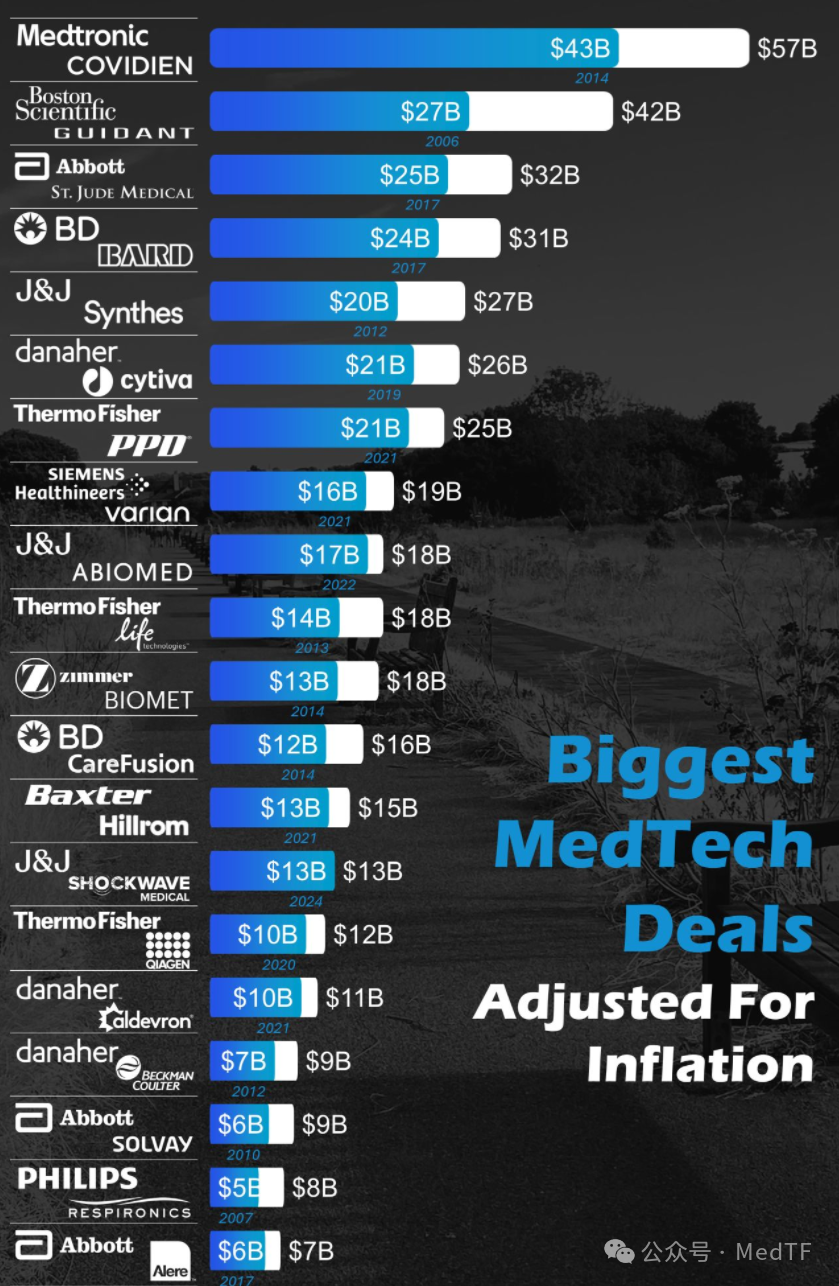
Successful acquisition cases by Johnson & Johnson, Medtronic, etc. undoubtedly provide learning examples for domestic companies that want to grow. Similarly, failed cases can also serve as references. Let’s take a look at the medical device field.GlobalThe 20th National CongressAcquisition Case.In June 2014, Medtronic announced the acquisition of Covidien for $42.9 billion, marking the largest medical device merger and acquisition case globally to date. In the global medical device rankings at the beginning of 2014, Medtronic ranked fourth with $17 billion in sales, while Covidien ranked tenth with $10.4 billion in sales.
That year, Johnson & Johnson ranked first with $28.7 billion in sales. However, after Medtronic successfully acquired Covidien, Medtronic quickly surpassed Johnson & Johnson to become the leader in the global medical device field, a position it holds to this day.
The acquisition here can be considered quite successful so far. Despite some negative news about Covidien's business in recent years, Medtronic has overall achieved rapid growth in scale after the merger, firmly maintaining its top position for a decade.
【02】 Guidant
$270 Billion
In 2006, Boston Scientific acquired Guidant for $27 billion. This acquisition is considered the biggest failure in Boston Scientific's history (and possibly the entire medical device industry), nearly causing the company to collapse—a result of impulsive decision-making.However, through this acquisition, Boston Scientific also becameLeader in the field of defibrillators and pacemakers. Forms a tripartite situation with Medtronic and Abbott.After the acquisition here, Boston Scientific completely changed its acquisition strategy. The acquisitions became more cautious, preferring to acquire relatively smaller companies to make minor enhancements to their existing business. No longer as aggressive as before. This change brought Boston Scientific back to the forefront, not only did its sales revenue place it among the top ten global companies, but its market value also far exceeded that of the medical device giant, Medtronic.
In 2017, Abbott acquired St. Jude Medical for $25 billion, which significantly strengthened Abbott's cardiovascular business. Through the acquisition of St. Jude Medical, Abbott expanded into areas such as heart failure, electrophysiology, and cardiac rhythm management. Since then, Abbott has been able to compete with Medtronic in the cardiovascular field. So far, this acquisition by Abbott has proven to be very successful.
In 2017, BD at 24BD acquired Bard for $0 billion. The businesses of BD and Bard are highly differentiated. At that time, BD's main businesses were medical and genomics research, diagnosis of infectious diseases and cancer, drug management, infection prevention, interventional treatment, and diabetes management. Bard’s core businesses were peripheral vascular, specialty surgery, oncology, urology, and electrophysiology. Through mergers and acquisitions, BD achieved business expansion and complementation, ultimately significantly improving the company's ranking.
In 2012Johnson & Johnson Acquires Synthes for $19.7 Billion: Synthes, a global manufacturer of orthopedic devices including trauma and spine products, was acquired by Johnson & Johnson. Following the acquisition, Synthes was merged with DePuy, previously acquired by Johnson & Johnson, to form the orthopedic giant DePuy Synthes, creating the world's most comprehensive portfolio of orthopedic and neurological products.
$21.4 billion
In 2019, Danaher acquired Cytiva for $21.4 billion (GEBiopharmaceutical Business in the Life Sciences Division)。cytivaIts business covers process chromatography hardware and consumables, cell culture, single-use technology, development instruments, consumables, and services. AcquisitionCytiva Greatly ComplementsDanaher's Solutions for Biologics Manufacturing Processes
$17.4 billion
In 2021, Thermo Fisher acquired PPD, the leader in clinical research services, for $17.4 billion, marking its expansion into upstream and downstream fields of the CRO industry. This enables Thermo Fisher to provide world-class services covering the entire process from drug discovery, assessment of safety, efficacy, and medical outcomes, to clinical trial management, as well as drug development and manufacturing.
In 2020, Siemens acquired Varian for $16.4 billion.Varian is the leading company in the global radiation oncology field. Varian has installed more than 8,000 radiotherapy systems worldwide, capturing over 50% of the global radiation therapy market share. This acquisition means that Siemens will enter the radiation oncology market, and the two parties will achieve a strong combination in areas such as imaging diagnostics, in vitro diagnostics, and interventional treatment, becoming a new giant in the healthcare field.Siemens and Varian’s businesses can form a strong complementarity, providing one-stop services for cancer patients from diagnosis to treatment.
In2022Johnson & JohnsonInJohnson & Johnson Acquires Abiomed for $16.6 Billion. Abiomed is a leading medical device company that provides circulatory support, including the Impella interventional heart pump for cardiac recovery. This acquisition aims to expand Johnson & Johnson's medical technology portfolio, particularly in cardiovascular care.
In 2013, Thermo Fisher acquired Life Technologies for $13.6 billion. Through the acquisitionLife TechnologiesThermo Fisher has entered the popular field of gene sequencing.
$13.35 billion
In 2014, Zimmer merged with Biomet for $13.35 billion.t, and the merged company was renamed Zimmer Biomet. After the merger, Zimmer Biomet became the second largest player in the orthopedic field, second only to Johnson & Johnson.
In 2014, BD acquired Guidant for $12.2 billion.Medtronic acquires CareFusion. Through the acquisitionConvaTec Makes BDThe breadth and depth in the field of pharmaceutical management and patient safety solutions have been greatly enhanced, while BD's global ranking has also significantly improved. This prepares BD to enter the first tier of global medical device companies.
【13】Hillrom
$12.5 billion
In 2021, Baxter acquired it for $12.5 billionAcquisition of HillroHillrom and Baxter have very little product overlap. Hillrom's connected care and patient monitoring businesses can complement Baxter's hospital care portfolio. This made Hillrom an attractive acquisition target for Baxter, which was eager to transform at the time. However, after the acquisition, things did not turn out as well as expected. The post-acquisition performance fell short of expectations, leaving Baxter with a significant debt burden. To pay down the debt, Baxter had to sell its renal care business.
【14】Hillrom
$13.1 billion
In 2024, Johnson & JohnsonWith 131Billion US dollarsJohnson & Johnson has regained a top-four position in the cardiovascular field by acquiring Shockwave, expanding its leadership in the cardiovascular intervention space and complementing its previous acquisitions of Abiomed and Biosense Webster.
【15】Qiagen
In2020Thermo Fisher Acquires Qiagen for $13.6 Billion. Qiagen is a global leader in providing life science and molecular diagnostic solutions. Through the acquisition of Qiagen, Thermo Fisher can not only strengthen its leadership position in the health diagnostics and biotechnology products fields but also reduce costs through consolidation, making Thermo Fisher more competitive.
【16】Aldevron
$9.6 billion
In 2021, Danaher$9.6 billionPrice Acquisition of Aldevron.Aldevron is aA company specializing in the production of biological agents such as plasmid DNA, mRNA, and proteins for pharmaceutical and biotechnology enterprises, while providing CDMO services to related companies. Danaher has expanded its capabilities through acquisitions.The integration of Aldevron and PNI businesses enables them to simultaneously address the two most critical issues in mRNA: the delivery system and mRNA production. Going forward, there will no longer be any technical obstacles hindering the production and development of mRNA drugs.$9.6 billion
In 2011, Danaher acquired Beckman for $6.8 billion, thereby gaining control of Beckman's deeply cultivated IVD technology and IVD market.
【18】Solvay
In 2010, Abbott acquired Solvay for $6.6 billion, gaining best-selling products such as Udiliv (ursodeoxycholic acid), Duphaston (dydrogesterone), and Creon (pancreatic enzymes).
In 2007, Philips acquired Respironics for $5.1 billion. At the time, it was a highly successful acquisition; for instance, during the pandemic, Philips profited immensely from Respironics. However, the good times didn’t last due to quality issues, leading to repeated recalls. Eventually, Philips could no longer bear the burden and had to shut down its ventilator business, even closing its headquarters in Pittsburgh. Thus, what was once an industry benchmark turned into a pariah. Not only did the $5.1 billion investment go down the drain, but the company also faced massive compensation claims.
【20】Alere
$5.3 billion
In 2017, Abbott acquired Alere for $5.3 billion. Through the acquisition of Alere, Abbott laid the foundation for becoming the global king of POCT and also helped Abbott become a global leader in point-of-care diagnostic technology.