

Qilu Pharmaceutical Secures China's First Generic Approval for Apalutamide, Challenging Janssen's Blockbuster Drug

Qilu Pharmaceutical
Specialty Formulations and Active Pharmaceutical Ingredients (API) Developer

Johnson & Johnson
Medical Device R&D and Manufacturer
The billion-dollar prostate cancer drug market is seeing an influx of more leading local pharmaceutical companies.
Recently, Qilu Pharmaceutical's Apalutamide Tablets, submitted as a Category 4 generic drug, have been approved for marketing and are deemed to have passed the evaluation. Notably, this makes Qilu Pharmaceutical the first company in China to successfully produce a generic version of Apalutamide Tablets and receive approval for market launch.

Apalutamide as a new generation of oral androgen receptor (AR) inhibitor, which has shown significant efficacy in the treatment of non-metastatic castration-resistant prostate cancer. Public data indicates that apalutamide can effectively prevent androgen from binding to its receptor, thereby blockingARTransfer to the nucleus of tumor cells, thereby inhibiting the growth-promoting effect of androgens on tumor cells. This unique mechanism of action provides a new treatment option for patients with prostate cancer.
It is widely believed in the industry that the approval and market launch of Qilu Pharmaceutical's Apalutamide Tablets have undoubtedly brought more options to patients in China. It is worth emphasizing that domestic pharmaceutical companies such as Kelun Pharmaceuticals, Yuandong Biologics, and Nanjing Chia Tai Tianqing are also accelerating their efforts to develop generic versions of Apalutamide Tablets, striving to become the second China-produced company to gain approval. This indicates that competition in the market for this blockbuster drug will become increasingly intense.

Prostate cancer is one of the most common malignant tumors in the male urinary and reproductive systems, with its global incidence rate climbing year by year, drawing significant attention from the industry.According to the data published by the World Health Organization (WHO) Cancer Today, the number of new cases of prostate cancer in men worldwide reached 1.4143 million in 2020, accounting for 14.1% of all malignant tumors, second only to lung cancer, becoming the second largest threat to men's health.
In China, according to statistics from Frost & Sullivan, the number of prostate cancer patients in China increased from 170,000 in 2016 to 440,000 in 2020, with an average annual growth rate as high as 26.8%. It is estimated that by 2025, the number of prostate cancer patients in China will further increase to 1.08 million. In the face of this severe situation, finding more effective and economical treatment methods is particularly important.
Notably, prostate cancer predominantly occurs in elderly men, with a low incidence before the age of 50. However, as age increases, the incidence gradually rises, and 80% of cases occur in men over 65. Due to the slow progression of prostate cancer, early screening and diagnosis are particularly crucial. Currently, for localized prostate cancer, radical surgery or radiotherapy are effective treatment options. However, when the disease recurs or metastasizes, the difficulty of treatment significantly increases.
With the in-depth research on the pathogenesis of prostate cancer, the important role of non-steroidal androgen receptor (AR) in the development of prostate cancer has been gradually revealed, and AR inhibitors have thus become one of the important means for the treatment of prostate cancer.
Apalutamide, as a new generation of oral AR inhibitor, also has a rather legendary development history. The drug was initially developed by the University of California, and in 2009, it was exclusively licensed to Aragon Pharmaceuticals in the United States for further development. In June 2013, Johnson & Johnson acquired Aragon Pharmaceuticals for $1 billion, thereby bringing apalutamide under its wing. Subsequently, Janssen, a subsidiary of Johnson & Johnson, took charge of the drug's research, market launch, and production. In February 2018, apalutamide tablets were approved for marketing in the United States, becoming the first anti-tumor drug approved by the FDA based on the clinical endpoint of metastasis-free survival. It also became the world’s first marketed drug for treating non-metastatic castration-resistant prostate cancer.
Subsequently, in 2019, apalutamide was approved for marketing in China for the treatment of non-metastatic castration-resistant prostate cancer with a high risk of metastasis. It was later approved in 2020 for the treatment of adult patients with metastatic endocrine therapy-sensitive prostate cancer. In 2021, apalutamide successfully entered the Class B category of the National Medical Insurance Drug Catalog through national medical insurance negotiations, and its sales in China have continued to grow.
According to Johnson & Johnson's 2023 annual report, the global annual sales of Apalutamide reached $2.387 billion (approximately 17 billion yuan). Against this backdrop, Qilu Pharmaceutical, with its keen market insight and strong R&D capabilities, was the first to submit a Class 4 generic drug marketing application for Apalutamide tablets in 2023. By securing the first generic version of Apalutamide tablets in China, Qilu Pharmaceutical not only gained a competitive edge in the market but also laid a solid foundation for its subsequent strategic positioning in the field of prostate cancer.
Industry insiders believe that currently, the competition for AR inhibitor drugs in the Chinese market is fierce, with second-generation AR inhibitors such as enzalutamide and apalutamide already dominating the market. Following the approval of Qilu Pharmaceutical's first generic version of apalutamide tablets, the treatment landscape for prostate cancer in China is set to undergo a new competitive dynamic, providing patients with more high-quality and affordable treatment options.

Southwest Securities research report points out that the global prostate cancer drug market size has now exceeded 10 billion US dollars.With the global emphasis on early screening and diagnosis of prostate cancer, as well as continuous advancements in treatment technology, the prostate cancer treatment market will continue to maintain its growth momentum.Currently, prostate cancer has also become a disease area targeted by leading pharmaceutical companies in China.
Based on significant clinical advantages, apalutamide tablets are becoming a highly sought-after major product. Research results show that, compared with the placebo group, patients in the apalutamide treatment group experienced significantly improved time to metastasis, median metastasis-free survival, and progression-free survival, with overall survival also showing more favorable outcomes. Compared with similar second-generation selective AR inhibitors, apalutamide has been proven to have stronger anti-tumor activity in mouse models. These clinical data provide strong support for the widespread application of apalutamide tablets in the market.
Since apalutamide tablets were approved for marketing in China in 2019, the drug has quickly risen in the domestic market due to its excellent clinical efficacy, becoming an important option in the field of prostate cancer treatment.
Data from Menet shows that in 2023, the sales of Apalutamide Tablets in China's three major terminals and six major markets have climbed to 760 million yuan, with significant year-on-year growth, demonstrating strong market demand. In the first half of 2024, the sales of Apalutamide Tablets achieved a growth of 15.61%, ranking it as the TOP9 product in endocrine therapy drugs.
Facing this market with huge potential, many well-known pharmaceutical companies in China have accelerated the pace of developing generic Apalutamide tablets. After Qilu Pharmaceutical became the first to submit a generic version of Apalutamide tablets, other leading domestic pharmaceutical companies such as Sichuan Kelun Pharmaceutical, Chengdu Yundong Biopharmaceutical, and Nanjing Chia Tai Tianqing Pharmaceutical also joined the competition.
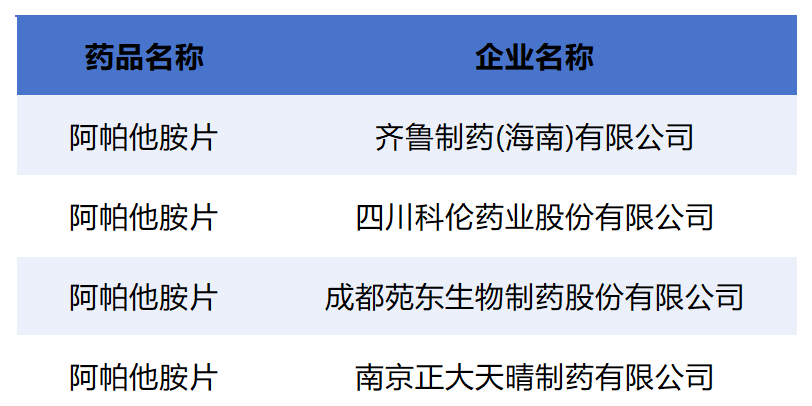
Among them, Kelun Pharmaceutical as early as2023Year11As early as last month, Qilu Pharmaceutical submitted the generic drug marketing application for Apalutamide Tablets. Yudong Biotech and Nanjing Chia Tai Tianqing also successively submitted their own generic drug marketing applications this year. Although the competition for the first generic version of Apalutamide Tablets has come to an end, the subsequent market competition remains fierce.
In addition, according to the company's previous announcements, Aorui Te also plans to collaborate with Hangzhou Baicheng Pharmaceutical for research and development, expanding into the downstream formulation market for Apalutamide active pharmaceutical ingredients (API). Similarly, Zhendong Pharmaceutical also mentioned in its annual report that it would develop API and formulation products for Apalutamide.
It is reported that the compound patent for Apalutamide will expire in 2027, at which time generic versions of the drug can officially enter the Chinese market. For patients, the availability of generic Apalutamide tablets will bring more treatment options, potentially reducing treatment costs and improving therapeutic outcomes. However, the entry of several well-known pharmaceutical companies will undoubtedly intensify market competition.
In the industry's view, who can stand out in this market and become the track leader will depend on multiple factors such as the company’s R&D strength, production capacity, and marketing capabilities. On the other hand, fierce market competition will also drive companies to continuously enhance their R&D capabilities, accelerate the development and market launch of innovative products, thereby promoting the entire industry's technological progress and innovative development.
Editor: Vanilla


www.yyjjb.com.cn
Insight into Industry Trends

"Pharmaceutical Economy Herald"
Academic Official Account
Focus on the Frontiers of Oncology Academia

Terminal Official Account