AbbVie’s JAK Inhibitor Upadacitinib Receives Priority Review Designation in China for Giant Cell Arteritis

AbbVie
Innovative Drug Developer
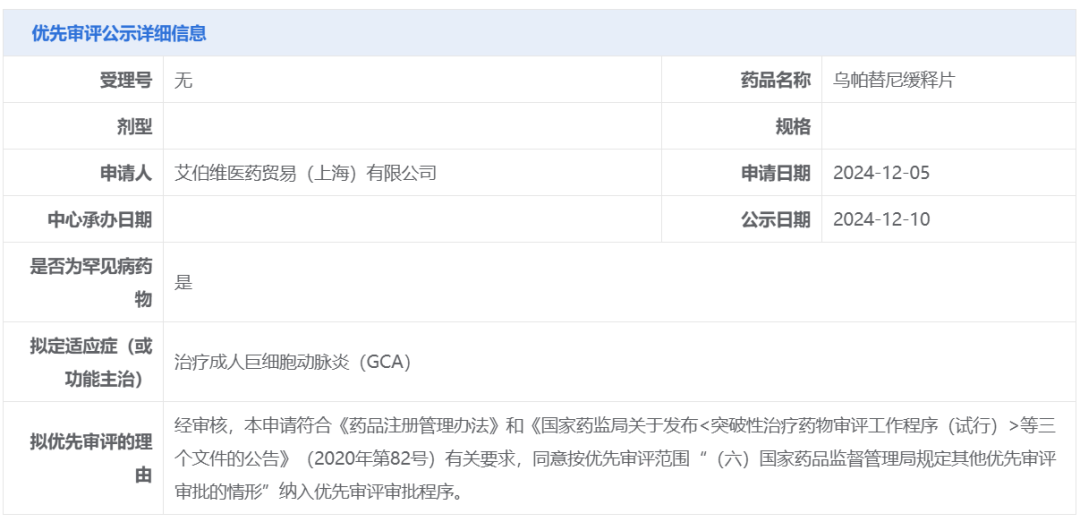
Screenshot source: CDEOfficial Website
GCAIt is an autoimmune disease that causes inflammation of the temporal arteries and other intracranial arteries, the aorta, and other large and medium-sized arteries.GCACommon Impact50Elderly patients aged above, the most common age group is in70To80Between the ages. Women are at the highest risk of this disease, and symptoms may include headache, jaw pain, and changes or loss in vision, with possible sudden and permanent vision loss.
Upadacitinib Sustained-Release TabletsPositive results have already been achieved in a Phase 3 study named SELECT-GCA. SELECT-GCA (M16-852) is a Phase 3, multicenter, randomized, double-blind, placebo-controlled study designed to evaluateUpadacitinib Sustained-Release TabletsSafety and efficacy in 428 patients with GCA. The study consists of two phases. The first phase evaluatedUpadacitinib Combined with a 26-Week Steroid Taper RegimenThe efficacy of upadacitinib in combination with a 26-week steroid tapering regimen compared to placebo. In addition, the study evaluated the safety and tolerability of upadacitinib in these patients. The second phase will assess the safety and efficacy of continued use of upadacitinib versus withdrawal of upadacitinib in maintaining sustained remission among participants who achieved sustained remission in the first phase.

In April this year, AbbVie announced the positive results of SELECT-GCA. Based on the Phase 3, multicenter, randomized, double-blind, placebo-controlled study, the results showedUpadacitinib Sustained-Release Tablets(15mg, once daily) combined with a 26-week steroid taper regimen, from Week 12 to Week 52, adult patients with Giant Cell Arteritis (GCA) achieved the primary endpoint of sustained remission.In this study,46% of Patients Treated with Rinvoq and a 26-Week Steroid Taper Regimen Achieved Sustained Remission, in contrast, this value was 29% for patients receiving placebo combined with a 52-week steroid tapering regimen. (Sustained remission was defined as the absence of GCA signs and symptoms from week 12 to week 52, while adhering to the protocol-defined steroid tapering regimen during the study period.)
This study also met multiple key secondary endpoints, including receivingUpadacitinib Sustained-Release TabletsPatients treated with the 26-week combined steroid taper regimen achieved a significantly higher proportion of sustained complete remission from week 12 to week 52 compared to the control group (37% vs. 16%). Compared with the placebo group, 15mgUpadacitinib Sustained-Release TabletsThe proportion of patients in the group who experienced at least one disease episode by Week 52 was lower (34% vs. 56%).During the 52-week placebo-controlled period,Upadacitinib Sustained-Release TabletsThe overall safety of 15mg is consistent with what has been observed in the approved indications, with good overall tolerance and no new safety signals identified in GCA patients.
AbbVie's previous press release introduced that GCA is a large artery inflammatory disease that mainly affects the elderly. To date, only one treatment method has been approved, which is usually used in conjunction with hormones. According to the research results,Upadacitinib Sustained-Release TabletsCould potentially become the first oral treatment option for GCA patients。
Upadacitinib sustained-release tablets are a selective JAK inhibitor. Early studies have shown that this product exhibits greater inhibitory potency against JAK1 than against JAK2, JAK3, and TYK2. In China, upadacitinib sustained-release tablets have previously been approved for the treatment of various indications, including atopic dermatitis, rheumatoid arthritis, active psoriatic arthritis, ulcerative colitis, Crohn's disease, active radiographic negative axial spondyloarthritis (nr-axSpA), and active ankylosing spondylitis (AS).
The inclusion of Upadacitinib Extended-Release Tablets in the CDE’s priority review for another new indication means that this product is expected to accelerate and benefit more patients in China.
References:
[1] Center for Drug Evaluation, National Medical Products Administration of ChinaWebsite. Retrieved Dec 10, 2024, from https://www.cde.org.cn/main/xxgk/listpage/da6efd086c099b7fc949121166f0130c
[2]Upadacitinib (RINVOQ®) Achieves Positive Results in Phase 3 SELECT-GCA Study in Patients with Giant Cell Arteritis. Retrieved Apr 23 , 2024, from https://mp.weixin.qq.com/s/temI2BNBAScovGl0rERJzg
[3]AbbVie Submits Regulatory Applications to FDA and EMA for Upadacitinib (RINVOQ®) in Giant Cell Arteritis. Retrieved July 12, 2024 from https://www.prnewswire.com/news-releases/abbvie-submits-regulatory-applications-to-fda-and-ema-for-upadacitinib-rinvoq-in-giant-cell-arteritis-302195344.html
This ArticleCompiled and edited by the WuXi AppTec content team based on publicly available information. Feel free to share with your circle of friends. For authorization to repost or other collaboration inquiries, please contact wuxi_media@wuxiapptec.com.
Disclaimer: The content team of WuXi AppTec focuses on introducing the research progress in global biopharmaceuticals and health. This article is for information exchange purposes only, and the views expressed in the article do not represent the position of WuXi AppTec, nor does it imply that WuXi AppTec supports or opposes these views. This article is not a recommendation for treatment plans. For guidance on treatment options, please visit a正规 hospital.