

Cradle Bio B.V. Files for IPO: AI-Powered Protein Design Platform Attracts Over $100M in Funding Within Three Years

Cradle
Biotechnology Researcher
In October 2024, the Nobel Prize in Chemistry was awarded to David Baker, Demis Hassabis, and John Jumper for their groundbreaking contributions to the field of protein structure prediction and design. In this area, VCBeat has noticed an emerging biotechnology company named Cradle (Cradle Bio B.V.), which has gained prominence in the biotechnology industry with its innovative AI-powered protein design platform and successfully broken through.
Cradle, founded in 2021, is a biotechnology company focused on utilizing artificial intelligence technology for protein design. The company aims to streamline the protein design process through AI technology, enhance R&D efficiency, reduce costs, and accelerate the development of new drugs and materials.
Cradle was awarded in 2022A $5.5 million seed round led by Index Ventures and Kindred Capital, with participation from Feike Sijbesma and Emily Leproust.
In November 2024, Cradle completed a $73 million Series B financing round led by IVP, with existing investors Index Ventures and Kindred Capital also participating. To date, Cradle's total financing has exceeded $100 million.
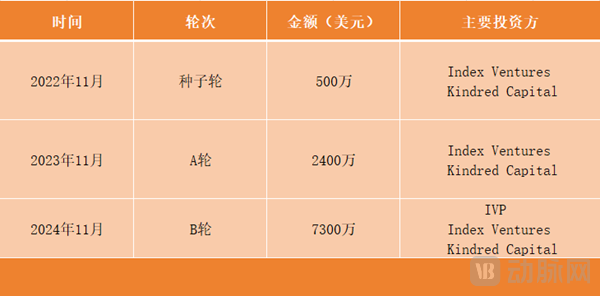
Cradle Financing History Source: VCBeat
Seven-Year Google Engineer Dives into Protein AI Field
Stef Van Grieken, co-founder and CEO of Cradle, worked at Google for seven years as a senior product manager before founding Cradle, where he was involved in multiple projects including Google AI (Google Brain) and Google X. During this time, he also served as a policy advisor to the European Parliament, an entrepreneur-in-residence at Startupbootcamp, and the chairman of the board of Open State Foundation.
Stef van Grieken's experience working at Google gave him a profound understanding of the powerful potential of artificial intelligence, especially in the biotechnology field. He realized that while we are at ChatGPT 4.0 in the artificial intelligence world, our ability to understand and manipulate the language of life is at Biology 0.5.
In 2021, Stef left his job at Google and co-founded Cradle with Jelle Prins. Both Stef and Jelle were former employees of Google. After establishing Cradle, Jelle Prins initially led the product design team, but as the company grew, he focused on positioning the brand in the market—how people perceive Cradle and what resonates with them. As the CEO and co-founder of the company, Stef van Grieken primarily oversees the strategic direction and operational management. Together, they founded Cradle with the aim of leveraging artificial intelligence to accelerate biologists' processes of designing proteins and optimizing enzymes, thereby promoting faster drug development.

Stef Van Grieken Image source: University of Groningen
Stef Van Grieken's inspiration comes from applying AI to DNA sequence research and development to reduce costs and improve R&D efficiency. He once imagined: "With individual effort, the marginal cost of knowledge production could be reduced to zero. AI has already demonstrated tremendous potential in the audio, video, and text fields. What if we apply LLM (Large Language Models) to DNA sequence R&D and reduce the R&D cost by 60%?"
Stef van Grieken hopes that through Cradle's technology platform, scientists will be able to design and optimize proteins faster and more efficiently, thereby accelerating the development of new drugs, sustainable materials, and animal-free foods. He believes that AI-driven protein engineering can discover new treatments and materials more cheaply and quickly than traditional methods.
Increase R&D speed by 1.2-12 times, reduce costs by 90%
The challenges facing protein engineering are obvious. Developing new protein products through traditional methods is not only time-consuming, costly, and prone to errors. Scientists often spend years conducting experiments, using millions of dollars in resources, with no guarantee of success.
To this end, Cradle aims to create a platform akin to "Photoshop for biologists," enabling biologists to utilize machine learning models to design and optimize proteins as easily as using Photoshop to process images.
In order to achieve this goal, Cradle first established its own wet lab, generating billions of protein sequences and laboratory data. It then used this data to train its proprietary generative AI model. The model, built on a cloud-based AI platform, is designed for creating DNA protein sequences, enabling biologists to more easily carry out protein design and optimization tasks.
Specifically, this cloud computing AI platform can predict the three-dimensional structure of proteins using deep learning algorithms and design novel proteins with specific functions, which can be applied in areas such as new drug development, the synthesis of sustainable chemicals, and crop protection.
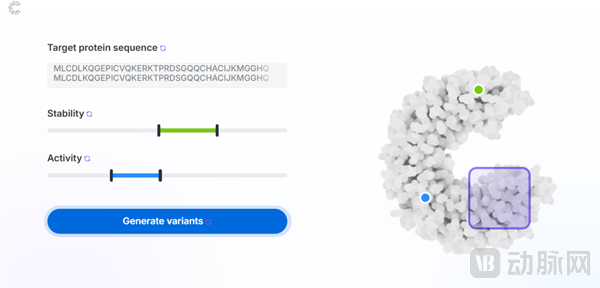
Protein AI-generated interface. Image source: Cradle official website
As an AI protein design product aimed at being accessible to anyone, Cradle's technology can significantly accelerate protein design and optimization with fewer, more successful experiments. According to the Cradle official website, compared to industry benchmarks,Most projects using the Cradle platform progress twice as fast, with companies utilizing Cradle experiencing significantly accelerated R&D project speeds, increasing by 1.2 to 12 times, while costs are reduced by up to 90%.
To this end, CradleDesigned a system that aligns with existing protein generation and design workflows, covering the entire process from goal setting to final product delivery. The system begins with target analysis and setting, progresses through protein sequence generation and laboratory testing, and finally imports lab results back into the system. Cradle's operational interface has been meticulously designed to simplify the user experience as much as possible, making it easy to use and more compatible with users' existing workflows.
When using the Cradle platform, users only need to provide the data parameters they plan to measure and the desired outcomes. Once the protein sequences are generated, corresponding tests will be conducted in the wet lab. After each round of experiments, the user's experimental data will be fed back into the Cradle system. This process not only helps optimize the user’s private Cradle model but also enables more accurate performance expectations for subsequent experimental rounds.
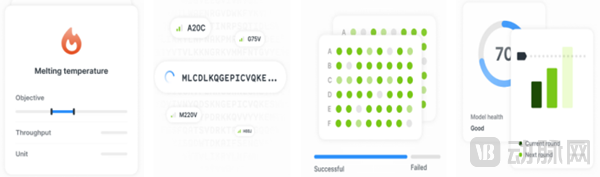
Cradle Operating Procedures Image Source: Cradle Official Website
In addition, Cradle also provides a series of functions to facilitate users in protein design. These include:
Intelligent Protein Sequence Optimization: Cradle analyzes existing protein sequences, proposes improvement plans, and predicts optimized performance. Integrated with other data science software throughDependent on expert knowledge, complex experimental data, or protein structure informationIn a different way, Cradle provides design suggestions through AI, offering biologists profound insights and recommendations for protein design optimization.
Structure Prediction: Cradle can predict the three-dimensional structure of proteins based on sequences and provide visualized displays. Compared with I-TASSER(Hierarchical Approach to Protein Structure Prediction and Structure-Based Functional Annotation)In comparison, the latter requires multiple fragment assembly simulations to construct a three-dimensional structure, whereas Cradle's processing speed is faster.
Function Prediction: Cradle evaluates the potential functions of designed proteins and predicts their interactions with other molecules. This is similar to the μProtein framework developed by Microsoft Research, as both possess strong protein sequence optimization capabilities.
Database Integration: Cradle connects to large protein databases, enabling rapid retrieval of relevant information. Similar to platforms like DTiQ (a global leading provider of intelligent video surveillance and loss prevention solutions), which offer real-time KPI tracking and customizable reporting features to help users monitor key performance indicators.
Collaboration Platform: Cradle supports team members in sharing design plans, discussions, version control, and project management. Similar to the project management and team collaboration functions provided by other online collaboration platforms, it aims to improve team efficiency.
Unlike traditional methods, Cradle can handle multiple attributes and optimization tasks in a single round, including enzymes, vaccines, peptides, and antibodies.
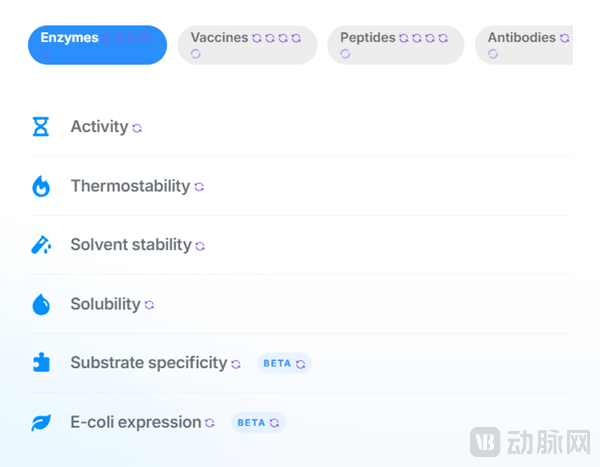
Cradle Interface Image Source: Cradle Official Website
In terms of data security and protection, the Cradle platform adopts industry-leading bank-level security measures to protect user data, ensuring that only the users themselves and their authorized personnel can access the relevant protein sequences and experimental data. The company promises that users' data will not be used to train models for other users, thereby guaranteeing the privacy and exclusivity of user data. Meanwhile, Cradle also employs a Software as a Service (SaaS) business model, which simplifies commercial transaction processes and avoids potential issues such as complex royalties, revenue sharing, and intellectual property rights, providing users with a clear and efficient collaborative environment.
Partnering with MNC, Developing 31 Proteins
Cradle's AI protein design platform brings new opportunities to biopharmaceutical companies, enabling them to potentially break the long-standing "double ten rule" in new drug development ——That is, new drug development requires more than 10 years and an investment of 1 billion US dollars.
By leveraging AI, Cradle assists scientists in not only learning from successful cases but also extracting valuable insights from failed experiments, uncovering new possibilities.This brings the prospect of better drugs, more sustainable materials, and animal-free food — all of which are discovered cheaper and faster than traditional methods.
At its inception in 2021, Johnson & Johnson signed a cooperation agreement with Cradle and successfully utilized Cradle's model to optimize proteins, enhancing their efficacy. Subsequently, within the past year, Cradle further expanded its partner network by signing new partnerships with MCN Novo Nordisk and Ginkgo Bioworks, a leading company in the field of synthetic biology, extending its customer base to multiple industries including pharmaceuticals, chemicals, food, agriculture, and materials.
Since the commercial launch of its software platform earlier this year, Cradle's customer base has exceeded 21, and it is developing 31 protein projects.
In this year's Protein Engineering Championship organized by Align to Innovate (a non-profit international organization for open science), more than 30 teams from both industry and academia participated in benchmarking the latest computational methods in enzyme engineering. Among the four supervised enzyme property prediction challenges, models automatically generated by Cradle achieved first place twice and tied for first place twice.
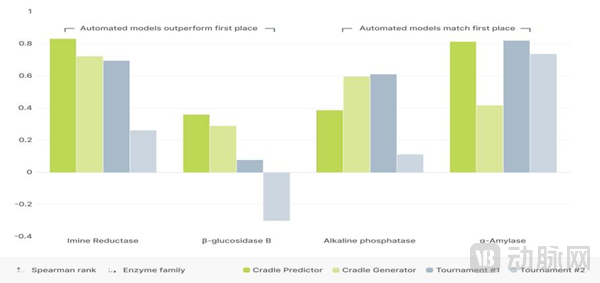
"Align to Innovate" Enzyme Optimization Challenge. Image Source: Cradle Official Website
In addition, Cradle recently recruited Sam Partovi to join the company as Chief Business Officer. Sam has over 20 years of experience in expanding cloud-based platforms for the life sciences industry, having built go-to-market teams at Medidata (a global leader in clinical data and analytics platforms), Benchling (a global leader in cloud laboratory informatics platforms for large molecule R&D), and Veeva Systems (a global leader in cloud software for the life sciences industry). Currently, the company’s team consists of 43 members.