Targeted Protein Degradation (TPD) Market Surges Past $10 Billion in 2026 as Novartis, Novo Nordisk, and Takeda Enter the Arena

Novartis
Drug Development and Manufacturing

Takeda
Biopharmaceutical Manufacturer
Novo Nordisk
Insulin Developer and Manufacturer
PREFACE
Preface
Targeted Protein Degraders (TPD), a field that has seen explosive growth in research and development in recent years, including PROTACs and molecular glue degraders, have ushered in a golden age of transactions this year.
According to incomplete statistics, since the beginning of the year, Biogen, Novartis, Pfizer, and BMS have respectively reached significant collaborations with companies in the molecular glue field.The total number of transactions has exceeded ten, with the total transaction value surpassing 10 billion US dollars.
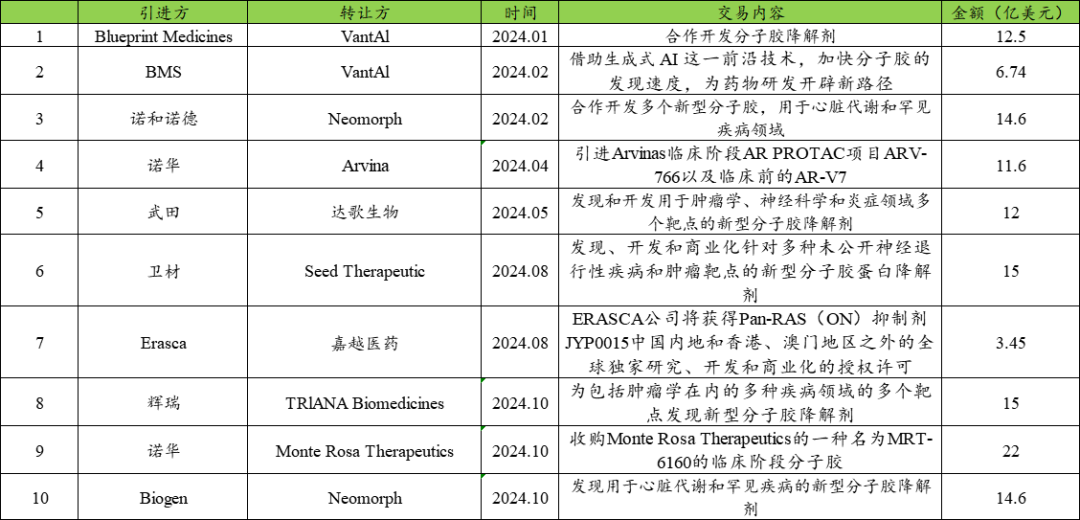
Source: Collated from public data
Overall, molecular glue, as an emerging drug design concept, has broad application prospects and tremendous market potential. Data from GlobalData shows,The total amount of venture capital flowing into the TPD field increased from $33 million in 2017 to $707 million in 2022, growing by over 2000% in five years.
In the biopharmaceutical field, MNCs, as trendsetters for new technologies and emerging sectors, have always been highly sensitive to actions that facilitate drug development. Their simultaneous investment in molecular glue degraders serves as a testament to this perspective.
Tackling "Undruggable" Targets

One of the greatest appeals of molecular glue degraders lies in their potential to venture into areas where small molecules have never tread.
In terms of mechanism, most traditional small-molecule drugs exert their function by binding to specific target proteins, meaning their pharmacological effects are achieved through a one-drug-to-one-target binding approach. However, this also leads to...90% of disease-causing proteins lack binding sites for small molecules to target.,resulting in a situation of "difficult to develop into a drug".
However, molecular glue degraders have broken this deadlock. As small molecules capable of inducing or stabilizing protein-protein interactions, they can specifically induce interactions between E3 ubiquitin ligase substrate receptors and target proteins, leading to their ubiquitination and subsequent degradation by the proteasome, thereby achieving therapeutic effects.And it has a smaller molecular weight, simpler chemical structure, less spatial interference, and better drug-like properties.
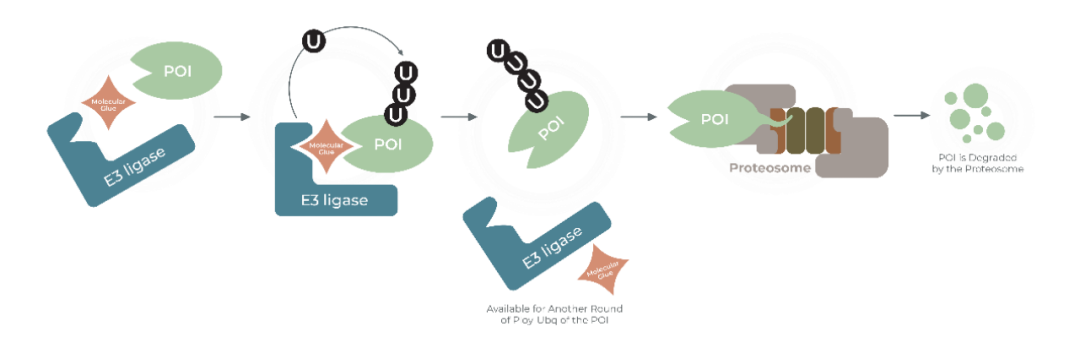 Mechanism of Action of Molecular Glues [1]
Phil Chamberlain, CEO of Neomorph, which has partnered with Novo Nordisk, also stated in public media that for many years, due to the limited number of available targets, biotech companies have had to work according to traditional drug mechanisms.But the emergence of molecular glues has given small-molecule drugs the opportunity to adopt a completely different mechanism to target the most impactful sites.
In TPD, molecular glue degraders are not the only option. PROTAC's bifunctional molecules have two distinct binding sites, one for the target protein and one for the E3 ubiquitin ligase. They can also act as molecular glues, targeting proteins for degradation. However, the smaller size advantage of molecular glue degraders makes them more favored by MNCs compared to PROTACs, especially in the field of neuroscience.
Overall, whether it is PROTAC or molecular glue degraders,Their mechanism of action essentially involves different structures within the molecule binding complementarily to two proteins, thereby inducing and promoting their proximity to trigger an effect.In this way, the challenge of undruggable drug targets is resolved. Moreover, since the disease-causing target is cleaved, there naturally won't be any issue of drug resistance.
The transactions reveal that Biogen’s collaboration will focus on developing molecular glue degraders for Alzheimer's disease, rare diseases, and immune disorders, while Novo Nordisk’s partnership will prioritize cardiometabolic conditions and rare diseases. Neomorph also has its own pipeline of glue degraders aimed at treating solid tumors.
It can be seen that,Molecular glue shows broad application prospects in the treatment of cardiovascular diseases, autoimmune diseases, ophthalmic diseases, and cancer due to its unique properties.
Domestic Rising Star

Notably, similar to the recent surge in TCE transactions, the wave of deals in the molecular glue sector is not limited to overseas markets; the domestic market in China is equally heated.
As can be seen from the transaction details at the beginning of the article,The molecular glue overseas development process of local biotechs is proceeding steadily.. In May this year,Dagene BioIn collaboration with Takeda Pharmaceutical Company Limited, the protagonist of this transaction is the GlueXplorer® platform, which was developed based on research from Dr. Cang Yong's laboratory.
This technology platform discovers new disease targets that can be degraded by molecular glues in its library through screening methods such as phenotypic, proteomic, and induced proximity approaches. These include targets considered "undruggable" by traditional small-molecule inhibitors or monoclonal antibodies. It also predicts potential molecular glue targets by analyzing a proprietary database of compounds and targets, and identifies specific degraders for selected targets by screening its unique molecular glue library.
In addition, there are still many promising newcomers in China focusing on the TPD field that deserve further attention.
HaiChuang PharmaceuticalsAs an innovative pharmaceutical company based on technology platforms such as deuterium substitution technology and PROTAC-targeted protein degradation, it has gradually independently built and perfected four core technology platforms: a deuterium-substituted drug research and development platform, a PROTAC-targeted protein degradation technology platform, a targeted drug discovery and validation platform, and a lead compound optimization and screening platform. Based on the PROTAC platform, a total of three products have been developed.
The most advanced project among them - HP-518, is of the same type as the project for which Novartis reached a $1.1 billion deal with Arvinas., is an orally administered PROTAC drug for the treatment of prostate cancer that degrades AR. The first patient enrollment in Phase I clinical trials was completed in January 2022. It is initially being developed for second-line or third-line treatment of mCRPC with AR point mutations, with plans to expand its indications to earlier stages of prostate cancer treatment.Make it a BIC drug.
In addition,Kintor Pharmaceuticals is also one of the earliest companies to focus on and layout PROTAC technology.Among them, GT20029 is a topical compound developed by Kintor Pharmaceutical based on PROTAC technology, andThe World's First Topical PROTAC Compound to Complete Phase I Clinical Trials in Both China and the United StatesAccording to currently available data, GT20029 has demonstrated good safety, tolerability, and pharmacokinetic characteristics in healthy subjects, androgenetic alopecia subjects, and acne subjects.
References
[1]https://mp.weixin.qq.com/s/12IYPSZMTGBj_QxRxpRQAA
Disclaimer: The publication/reproduction of this article is solely for the purpose of information dissemination, and does not represent the views of this official account or confirm the authenticity of its content. Any judgment made based on this content will be at your own risk.If there is any infringement, please inform us and we will delete it immediately!
Long press to follow this official account