Daiichi Sankyo Submits IND Application in China for DS-3939a, a Novel TA-MUC1-Targeting ADC, Entering Clinical Development for Solid Tumors

Daiichi-Sankyo
Pharmaceutical R&D Developer
▎WuXi AppTec Content Team Report
 Screenshot Source: CDE Official Website
MUC1 is an emerging target for cancer immunotherapy.MUC1 is a highly glycosylated transmembrane protein that plays a crucial role in the lubrication and protection of normal epithelial cells. MUC1 undergoes hypoglycosylation due to alterations in the expression patterns of certain sialyltransferases, exposing new epitopes on MUC1 in tumors, referred to as tumor-associated MUC1 (TA-MUC1).It is highly expressed in various human epithelial cancers, making it an attractive target for cancer therapy.
DS-3939a is an ADC targeting TA-MUC1, composed of a humanized anti-TA-MUC1 antibody, an enzymatically cleavable tetrapeptide linker, and a DNA topoisomerase I inhibitor (DXd) with a high drug-to-antibody ratio (DAR).
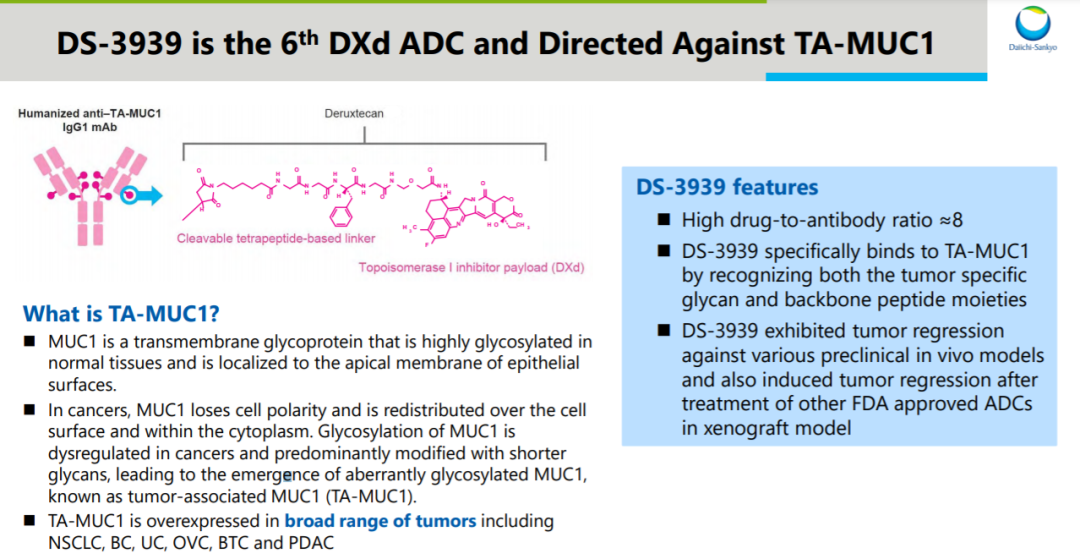 ▲Introduction to DS-3939a (Screenshot source: Daiichi Sankyo 2024 R&D Day Materials)
According to the research results published by researchers at the 2024 American Association for Cancer Research (AACR) Annual Meeting, DS-3939a inhibited in in vitro experiments.TA-MUC1The growth of positive cancer cells, whileTA-MUC1Negative cancer cells have no inhibitory effect.In vitro studies have shown that DS-3939a exhibits TA-MUC1-dependent cell growth inhibition through DXD-mediated cytotoxic effects.In addition, DS-3939a demonstrated significant antitumor effects in several TA-MUC1-positive cancer cell line-derived xenograft models and various PDX models. In several xenograft models, DS-3939a induced strong tumor regression even after treatment with other cytotoxic ADCs.
Currently, Daiichi-Sankyo is conducting a Phase 1/2, first-in-human, open-label, multicenter, two-part, dose-escalation and dose-expansion study to evaluateDS-3939aA Phase 1/2 Clinical Study on the Safety, Tolerability, and Efficacy in Patients with Advanced Solid Tumors. This studyPlan to recruit up to 430 adult patients, the first part (dose escalation) includes patients with locally advanced, metastatic, or unresectable urothelial carcinoma, non-small cell lung cancer, breast cancer, ovarian cancer, biliary tract cancer, or pancreatic cancer, and the second part (dose escalation) includes various advanced solid tumors.TA-MUC1Expressing tumor patients.
This articleFrom the WuXi AppTec content team, individuals are welcome to share to their WeChat Moments. Unauthorized republication by media or organizations in any form to other platforms is strictly prohibited.For reprint authorization and other cooperation requests, please contact wuxi_media@wuxiapptec.com.
Disclaimer: The content team of WuXi AppTec focuses on introducing the research progress in global biopharmaceuticals and health. This article is for information exchange only, and the views expressed in the article do not represent the position of WuXi AppTec, nor does it indicate that WuXi AppTec supports or opposes the views mentioned. This article is not a recommendation for treatment plans. For guidance on treatment options, please visit a正规 hospital.