


Artificial intelligence is reshaping the landscape of the entire technology industry, while quantum computing has recently begun to show its potential to change the world. Between these two major trends, there is a company striving to bridge them together.
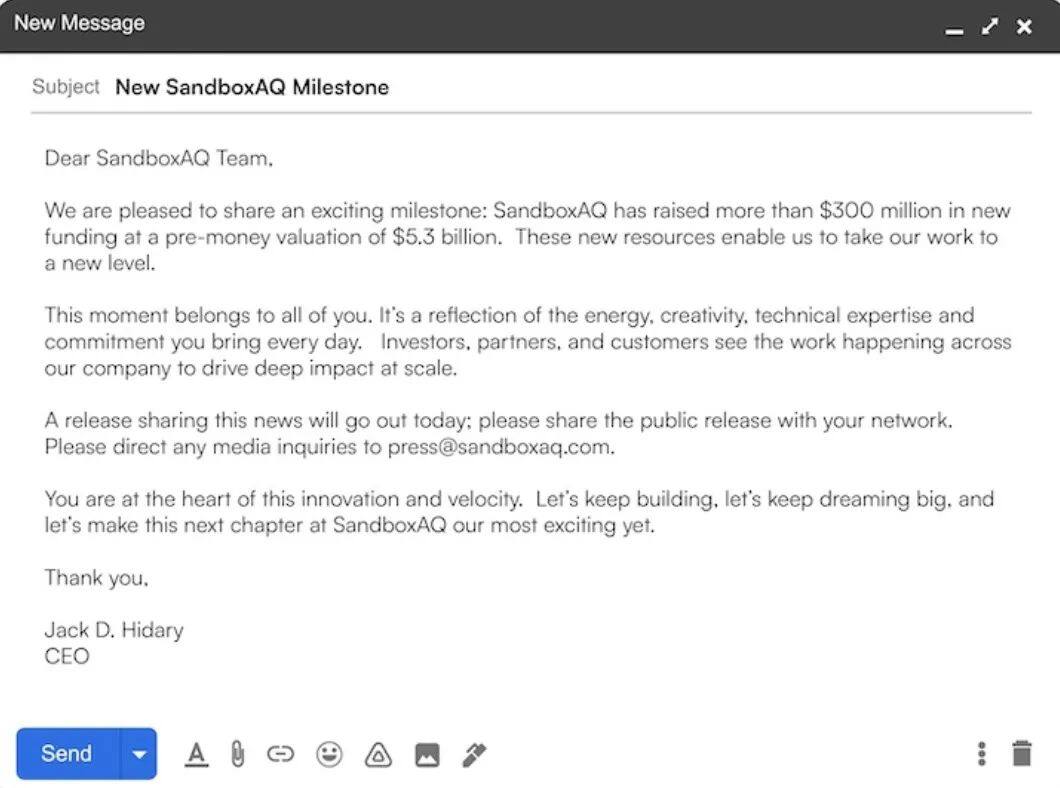
On December 18, SandboxAQ announced the completion of over $300 million in financing, with a valuation reaching $5.6 billion. The round was led by Alger, with participation from existing investors such as T. Rowe Price and Breyer Capital, as well as Yann LeCun.
 (Source: SandboxAQ)
The story of this company dates back to 2016. At that time, Google co-founder Sergey Brin quietly initiated an ambitious project within Alphabet aimed at exploring the possibilities of combining quantum computing with AI. This project was initially part of Alphabet's Moonshot Factory X, led by Jack Hidary, who is also a long-time board member of the X Prize.
Eric Schmidt, former CEO of Google and then-chairman of Alphabet, paid special attention to this project. By March 2022, after completing its first round of financing worth $500 million, the project spun off from Alphabet and officially established SandboxAQ. Eric Schmidt became the company’s chairman, while Hidary took on the role of CEO. “At SandboxAQ, AQ stands for AI and Quantum,” Hidary explained in an interview with Bloomberg. Behind this simple naming lies an ambitious technological vision—unlike the currently mainstream large language models, SandboxAQ develops Large Quantitative Models (LQMs).
 Figure丨Two leaders of SandboxAQ (Source: SandboxAQ)
To understand SandboxAQ's innovation, we first need to recognize the challenges currently faced in the AI field. Mainstream large language models learn language understanding and generation capabilities by processing vast amounts of text from the internet, which performs well in handling natural language tasks. However, when it comes to areas requiring precise scientific calculations, material design, or drug development, this approach falls short. This is because these fields demand not an understanding of language, but rather an accurate grasp of underlying physical laws and mathematical relationships.
It is precisely with this pain point in mind that SandboxAQ developed their Large Quantitative Models (LQMs). Unlike large language models, which learn and generate content by processing unstructured text data from the internet, LQMs start from mathematical equations and physical principles to generate their own training data.
The technical architecture of LQMs is fundamentally different from traditional transformer models. It employs a combination of neural network models and knowledge graphs, allowing the model to not only generate data through equations but also accept input from sensors or other quantitative data sources. More importantly, it can accurately capture causal relationships and constraints within physical systems.
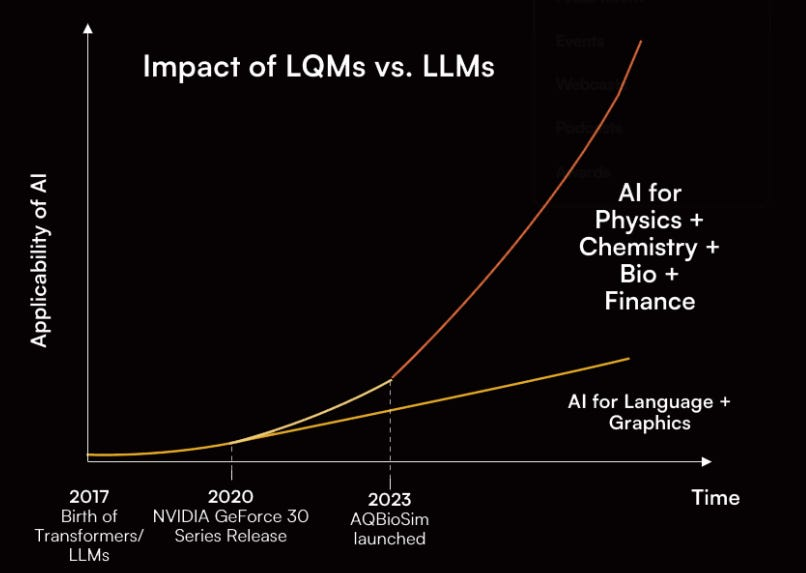
This unique technical approach has already demonstrated significant advantages in the financial sector. Traditional financial risk assessment relies on the Monte Carlo simulation method, which derives results through random sampling. However, when faced with modern complex structured financial instruments, this method has begun to show its limitations. "If we want to understand the tail risk of a portfolio under various market conditions, traditional methods fall short. What our LQM aims to do is create 300 to 500 million slight variant versions of that portfolio and then systematically analyze the risk profile in each scenario," said Hidary.
Quantum computing can indeed directly simulate these systems using the language of quantum mechanics, but its true realization may still be decades away. This is because current quantum computing still faces a series of challenges, such as error rate control of qubits. Although Google's recently released Willow chip has made significant breakthroughs in this area, there are still many issues to be resolved before large-scale quantum computers can be built.
To address these issues, SandboxAQ has developed new algorithms based on Tensor Networks. Originally derived from the field of quantum many-body physics, these algorithms leverage a fundamental characteristic of nature — Locality. In simple terms, locality means that distant parts of a system, such as two remote atoms in a long molecule, do not significantly influence each other. By utilizing this property, tensor network algorithms can efficiently represent quantum states through the "entanglement area law."
Through a deep technical collaboration with Nvidia, SandboxAQ has expanded the functionality of the CUDA library, enabling ordinary GPUs to support quantum computing. This allows them to perform quantum simulations on existing hardware without waiting for actual quantum computers, while also being able to integrate quantum processing units (QPUs) in the future. In one study, SandboxAQ's research team used Google’s tensor processing units (TPUs) to complete a complex high-dimensional optimization involving over 600 billion parameters within 24 hours, setting a world record for the largest-scale tensor network computation.
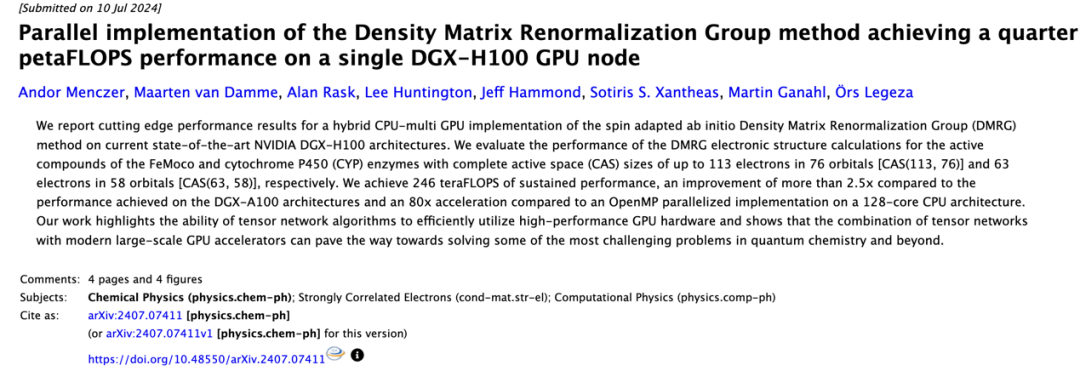 Figure | Related paper (Source: arXiv)
In practical applications, SandboxAQ's technology has demonstrated unique value across multiple fields. Taking pharmaceutical R&D as an example, for traditionally difficult-to-treat diseases like cancer or Alzheimer's, clinical data is often very limited, making data-driven AI methods hard to apply. However, SandboxAQ's quantum-inspired algorithms can start from the fundamental physical properties of molecules to accurately simulate the interactions between drug molecules and human receptors.
The system first generates a large number of molecular structure variants based on quantum chemical equations. Each variant is tested using a quantum-inspired algorithm to predict its behavior in real-world environments. These predictions are then fed into a neural network, combining with information from sensors and other quantitative data sources to form a more comprehensive understanding of the target system. This allows for the screening of the most promising candidate molecules before laboratory synthesis, accelerating the drug development process and significantly reducing R&D costs and risks.
In terms of cybersecurity, materials science, and other fields, it also has very broad prospects.
With the completion of this round of financing, the company, which is committed to combining two revolutionary technologies, is preparing to continue its journey on the path of technological innovation. The company plans to use part of the funds to expand its R&D team, which currently includes more than 80 Ph.D.s and over 70 software engineers. The integration of quantum computing and AI has only just begun.
"Use LLMs to do what LLMs are good at, and use LQMs to do what LQMs are good at," Hidary concluded, "It's not an either-or choice." Allowing quantum computing and AI to each operate in their respective domains may very well be the future landscape of their development.
References:
1.https://www.bloomberg.com/news/articles/2024-12-18/ai-startup-sandboxaq-raises-funds-at-over-5-6-billion-valuation
2.https://venturebeat.com/ai/beyond-llms-how-sandboxaqs-large-quantitative-models-could-optimize-enterprise-ai/
3.https://www.sandboxaq.com/post/quantum-algorithms-meet-ai-chips-a-breakthrough-in-simulation
4.https://techcrunch.com/2022/03/22/alphabet-spins-out-a-new-subsidiary-and-in-a-sign-of-the-times-its-focused-on-quantum-tech/
Typesetting: Liu Yakun