BrainCo and RealMan Forge Strategic Partnership to Advance Embodied Intelligence and Human-Robot Interaction

BrainCo
Non-invasive brain-computer interface technology solution provider


In the era of embodied intelligence, when people are marveling at the multimodal large models endowing humanoid robots with a smart "brain," they often overlook a key element in the robot's action execution process—the seamless coordination between robotic arms and dexterous hands. Only when humanoid robots possess a pair of hands with "tactile" sensing capabilities and arms capable of precise cooperative control can they achieve friendly integration with humans, work, and living environments, enabling robots to enter various industries and households across the nation.
Recently, BrainCo, a leading brain technology company, signed a strategic cooperation agreement with Ruierman Company. Both parties will fully integrate their technical products and industry experience to engage in in-depth collaboration within the field of embodied intelligence, jointly promoting the further evolution of human-computer interaction models in embodied intelligence.
Further Evolution: The "Tactile Perception" Interaction Capability Behind a Pair of Dexterous Hands
Embodied intelligence is an effective approach to achieving general artificial intelligence, and humanoid robots are considered the best carriers of embodied intelligence. As an important end effector of humanoid robots, the dexterous hand is also one of the most core technologies for humanoid robots to move towards generalization.
From perception to touch, humanoid robots will have more autonomous and richer interactive capabilities. Touch is the key to fine operation; to create a robot with fine operational skills, it needs a pair of dexterous hands with tactile perception, allowing the robot to...
Explore, learn, and master skills on your own.
If embodied intelligence is referred to as the brain, then the cerebellum is responsible for recognition, localization, and joint control, with fine motor operations being the "tiny brain," which requires support from hardware, learning methods, and data. In the future, embodied intelligence robots will need to adapt to general scenarios and perform general tasks, making this support unavoidable.In contact with physical scenarios, robots can only be equipped withFine tactile perception ability is required to ensure reliable safety.
BrainCo, a company previously dedicated to the research and application of non-invasive brain-computer interface technology, has enabled users to freely control finger movements through this technology, completing actions such as grasping, pinching, and lifting heavy objects. After five years of mass production, commercial application, and iteration, in early 2024, BrainCo's intelligent bionic hand began to be applied to robots and robotic arm dexterous hands, entering the field of embodied intelligence.
The BrainCo Intelligent Bionic Dexterous Hand, equipped with the "TS-F+ Multimodal Tactile Sensor," achieves higher sensitivity, unique material recognition capabilities, and spatial perception dimensions. It can adaptively grasp flexible and fragile objects and precisely perform delicate tasks such as holding a pen, pouring water, and grabbing an egg.
More perceptual dimensions:Pressure, friction, force direction, proximity distance, surface material and other multi-dimensions can identify more than 30 different materials.
Greater Load Capacity:Single-handed load capacity: 30KG, single-handed active grip strength: 6KG.
Better Industrial Design:More bionic and in line with hand movement needs, featuring an anti-collision finger design to prevent injuries from hard impacts during use.
Multidimensional Tactile Perception:Human-like 3D surface modeling and tactile layout, with three tactile sensing points on each finger. Each sensing point can detect 3D force and proximity, enabling real-time collection of 11-channel multi-dimensional tactile perception data.
Higher Sensitivity:Minimum recognition force ≤1g, accuracy up to 0.01N.
Base Building: The "Precision Synergy" Control Capability of Ultra-lightweight Humanoid Robotic Arms
Realman's goal is to create a solid "base" for embodied intelligent robots. In this regard, Realman's ultra-lightweight humanoid robotic arm is designed with reference to the length, thickness, flexibility, and load-bearing capacity of a human arm. From appearance to performance, it achieves friendly integration with humans, work, and the living environment, striving for "whatever humans can do, it can do," fully showcasing the advantages of "ultra-lightweight humanoid technology."
Compared with traditional robotic arms, the Ruierman ultra-lightweight humanoid robotic arm reduces weight by about 3/4 under the same load capacity, better meeting the needs for precise, flexible, and lightweight operation in daily life. Taking the RM65 series robotic arm as an example, its self-weight is 7.2KG, rated load is 5KG, peak load can reach 10KG, and the load-to-weight ratio is as high as 1:1.44.
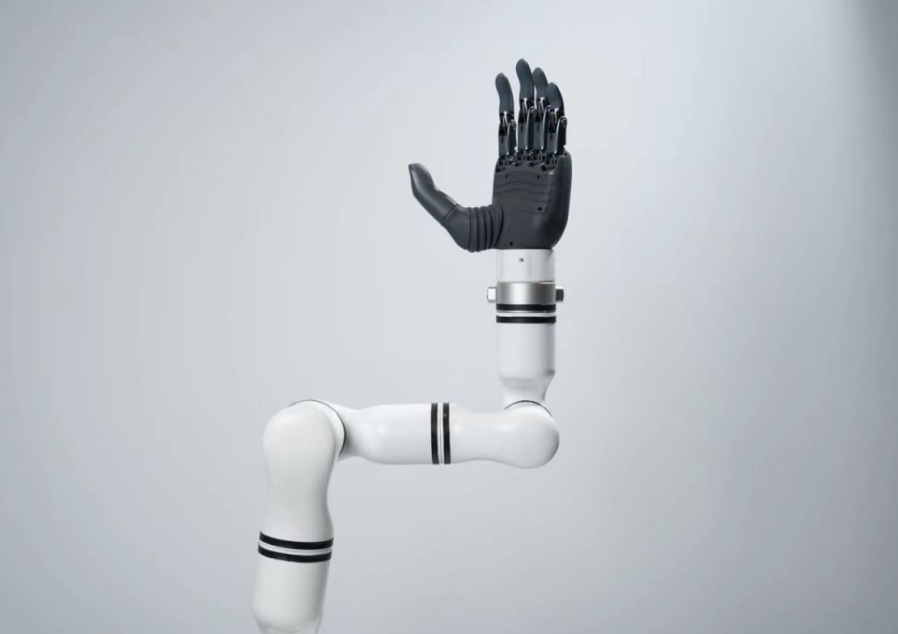
While ensuring "flexibility and lightness," Realman places greater emphasis on the synergy of overall performance. The robotic arm has achieved independent R&D breakthroughs in core components such as the controller, driver, servo motor, and harmonic reducer. In terms of control precision and response speed, it boasts rapid response frequency and precise control capabilities thanks to its leading control system. The integration of the controller and robotic arm ensures accuracy and efficiency during task execution.
With the precise cooperative control capability of Ruilman's ultra-lightweight humanoid robotic arm and the multi-modal tactile sensing ability of BrainCo's intelligent bionic dexterous hand, the practical application scenarios of embodied intelligence can be more extensive.
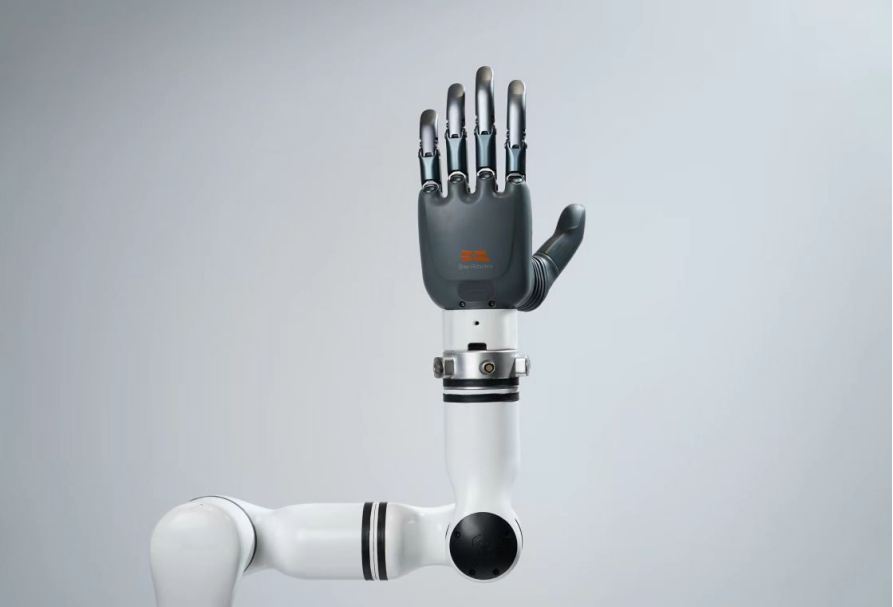
It can be said that the collaboration between BrainCo and Ruierman not only pushes the boundaries of embodied intelligence technology but also represents a further evolution in the interaction models of robots with humans, workplaces, and living environments. It is believed that the efficient and precise synergy between the ultra-lightweight humanoid robotic arm and the intelligent bionic dexterous hand will ultimately unlock more unknown potential in the era of embodied intelligence, accelerating the integration of robots into various industries and households across China.

Scan for market and business cooperation inquiries