Novartis Submits Third Indication Application in China for Brolucizumab, a Next-Gen Anti-VEGF Therapy Administered Every Three Months

Novartis
Drug Development and Manufacturing
▎WuXi AppTec Content Team Report
Today (December 21), the official website of the Center for Drug Evaluation (CDE) of the China National Medical Products Administration announced that the new indication application for marketing authorization of Novartis' Brolucizumab Injection has been accepted, with the specific indication yet to be disclosed.Public information shows,Brolucizumab isNext-Generation Retinal Disease Treatment Drugs Targeting VEGF Inhibition。This is the third marketing application for this product in China. According to publicly available information, the indication for this marketing application is speculated to be for the treatment ofProliferative Diabetic Retinopathy (PDR)。
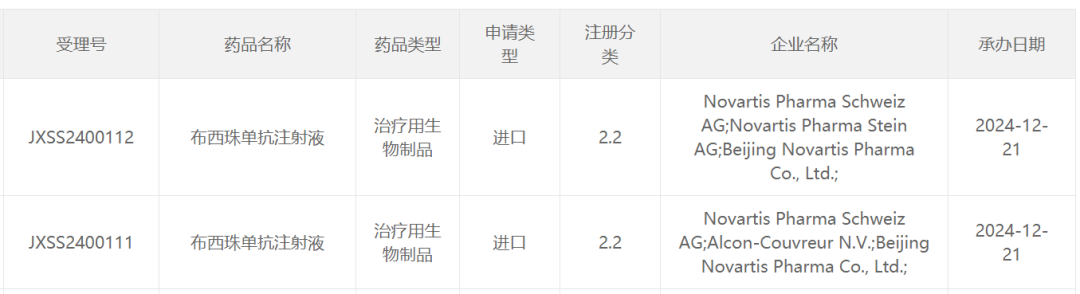
Screenshot source:CDE Official Website
Brolucizumab (Brolucizumab, also known as RTH258)Developed by NovartisFull VEGF-A Inhibitor, a novel humanized single-chain antibody fragment, has a molecular weight of only 26kDa, high affinity, strong tissue penetration, and minimal systemic side effects.According to the introduction in the previously published materials by Novartis, compared with existing treatment methods,BrolucizumabCan absorb retinal/retinal fluid earlier, only needs to be injected once every 3 months after the loading period., which has certain advantages in continuously improving anatomical structure, fornAMD and DME and other fundus diseasesThe patient showed better control of effusion.BrolucizumabCurrently approved for treatment in more than 70 countries worldwideNeovascular Age-Related Macular Degeneration (nAMD) and Diabetic Macular Edema (DME).

In China,BrolucizumabPreviously, there were two listing applications accepted by the NMPA.Based on the progress of clinical research and the registration classification for marketing application, it can be inferred that,The two marketing applications previously submitted in China targeted the indications ofDME andnAMD. The indication for which this marketing application is being submitted mayFor Proliferative Diabetic Retinopathy (PDR)。
Diabetic retinopathy is the leading cause of irreversible vision loss in the working population.PDR is the advanced stage of diabetic retinopathy, marked by the presence of abnormal new blood vessels in the retina., and complications such as vitreous hemorrhage, tractional retinal detachment, and neovascular glaucoma may occur, posing a serious threat to the patient's visual function.。
In May this year, Novartis announced for the first time the Phase 3 clinical study (CONDOR Study)Results at 54 weeks.ThisIs a global Phase 3 registration study,Study Confirms the Efficacy of Brolucizumab in PDR PatientsMaintain VisionSignificantly superior to traditional therapies (Panretinal Laser Photocoagulation Treatment, itsCanRollbackDiabetic Retinopathy,The proportion of patients without PDR at Week 54 was in the control group.Nearly three times (63.8% vs 22.4%).
Notably, the Chinese population constitutes a significant portion of the CONDOR study cohort, accounting for more than a quarter of the overall population. In the Chinese population, compared to the panretinal laser photocoagulation group, the brolucizumab group demonstrated advantages inBest Corrected Visual Acuity (BCVA)AndDiabetic Retinopathy Severity Scale (DRSS)Better improvement effects with a lower proportion of patients experiencing PDR, DME involving the macular center, and vision-threatening complications.Brolucizumab in the Chinese population relativelyPanretinal Laser PhotocoagulationThe improvement effect of BCVA (6.1 letters) was better than that of the overall population (4.4 letters)., improving vision by more than one line. Additionally, the incidence of adverse events in the Chinese population is consistent with the overall population, and safety is controllable.
In the study, participants in the brolucizumab groupLoading period receiving every 6 weeks (q6w)Treatment with Bevacizumab, 3 times in total;During the maintenance period, the treatment interval was extended to every 12 weeks (q12w).,The treatment interval may be extended (by 6 weeks each time) based on disease activity assessment after 48 weeks, with a maximum extension of up to 24 weeks.If the condition worsens during the maintenance period, the treatment interval will be shortened again to q6w.
We hope that the subsequent research and registration process of Brolucizumab will proceed smoothly, bringing new treatment options to patients as soon as possible.
This ArticleFrom the WuXi AppTec content team. Individuals are welcome to share this article on their social media feeds, but unauthorized republication by media or organizations in any form on other platforms is strictly prohibited.For reprint authorization and other cooperation needs, please contact wuxi_media@wuxiapptec.com.
Disclaimer: The content team of WuXi AppTec focuses on introducing the research progress in global biopharmaceuticals and health. This article is for information exchange only, and the views expressed in the article do not represent the position of WuXi AppTec, nor does it mean that WuXi AppTec supports or opposes the views in the article. This article is not a recommendation for treatment plans. If you need guidance on treatment options, please visit a regular hospital.