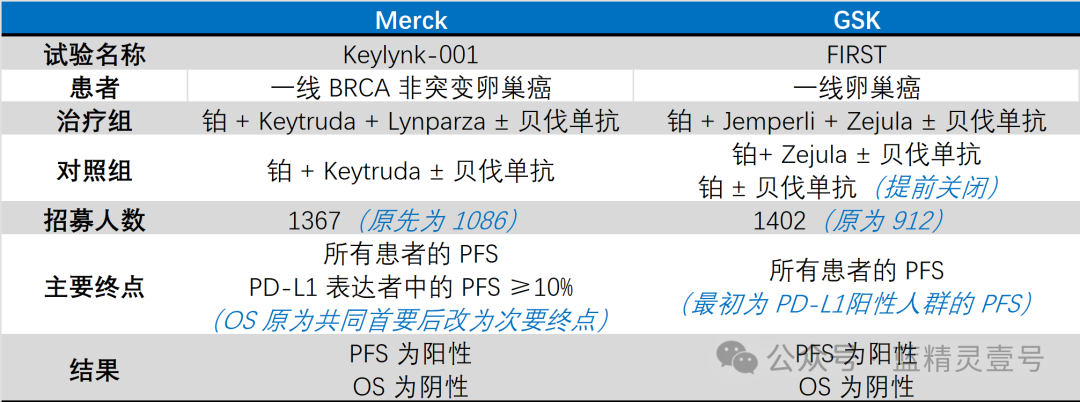
GSK Last FridayIndicates that adding the PD-1 drug Jemperli to standard chemotherapy and the PARP inhibitor Zejula (niraparib) for first-line treatment of ovarian cancer.Phase 3 FIRST Trial Meets Primary Endpoint of PFS, but the key secondary endpoint OS did not reach statistical significance.This follows the announcement made two weeks ago by Merck regarding the Phase 3 trial of its PD-1/PARP combination therapy, Keytruda and Lynparza (Olaparib), for first-line treatment of ovarian cancer.KEYLYNK-001 StudyFollowing the results, the same outcome awaited the identical combination of targets—both PFS primary endpoints were met, while OS secondary endpoints were missed. The difference between the two trials is...Merck Focuses on BRCA Non-Mutated Tumors, While GSK Trials Make No Distinction; SecondlyMerck used Keytruda as a control, while GSK used Zejula or a placebo as a control.Currently, no anti-PD-(L)1 drugs have been approved for the treatment of ovarian cancer, with Pfizer and Roche experiencing consecutive failures in earlier years. The failure of GSK also follows a discernible pattern:In a media interview in January 2023, GSK's CBO Luke Miels said that the possibility of success for the FIRST study was very low,Because ovarian cancer is not immunogenic, it may respond poorly to Jemperli's immune checkpoint inhibition.Zejula and Lynparza are both approved for ovarian cancer maintenance therapy (in patients who respond to first-line platinum-based chemotherapy), but the former can be used in all patients, while the latter is only approved for BRCA-mutated patients. DespiteThe approved label for Zejula does not need to differentiate the patient's BRCA mutation status.But due to limited efficacy,The acceptance of Zejula in BRCA non-mutated patients has been consistently low.。For GSK and Merck,BRCA non-mutated patients are the main targets for the two companies conducting ovarian cancer trials with PD-1 inhibitors.To demonstrate the benefits of using PARP inhibitors in treating BRCA non-mutated ovarian cancer, while potentially expanding its coverage for PD-1 inhibitors.Merck seems to be trying to expand Lynparza to patients without BRCA mutations by adding Keytruda, while GSK aims to make its PD-1 combination outperform Zejula in every aspect.MerckIn the statement, it was noted that the role of Keytruda in a PD-L1 expression-agnostic population "remains uncertain."GSK stated in its announcement that it is conducting further analysis and plans to share the data with health authorities and the scientific community at upcoming meetings.Notably, the protocol in the FIRST study underwent multiple revisions.Initially, the study only set PFS endpoint for PD-L1 positive patients, but in 2020, it was split into PFS for the entire population and PFS for PD-L1 positive patients; later, the primary endpoint was changed toAll populations PFS。FIRST StudyThe number of recruits was also expanded twice, increasing from 912 to 1228 and then to 1402, causing a delay in the reading of results by several years. Additionally, the FIRST study originally had two control cohorts—Zejula or placebo alone; the latter was closed early due to PARP inhibitors being approved for first-line maintenance therapy, as giving patients only a placebo in this context would be unethical. However, removing the standalone placebo control group may further weaken the results.Comparison of KEYLYNK-001 and FIRST Studies
Source: Apex
GSK's shares were down about 1% Friday morning, according to a summary by Fierce reporters.Perhaps PD-1 inhibitors are simply not suitable for treating ovarian cancer.
Welcome to follow and share! All articles in this official account can be reproduced freely as long as the source is acknowledged.