AstraZeneca and Daiichi Sankyo Voluntarily Withdraw EU Marketing Authorization Application for Datopotamab Deruxtecan in Non-Squamous NSCLC

AstraZeneca
Biopharmaceutical Manufacturer

Daiichi-Sankyo
Pharmaceutical R&D Developer
▎Traceability
On December 24, 2024, AstraZeneca and Daiichi Sankyo announced the voluntary withdrawal of the Marketing Authorization Application (MAA) for datopotamab deruxtecan (Dato-DXd) submitted in the EU. The drug is intended for the treatment of adult patients with locally advanced or metastatic non-squamous non-small cell lung cancer (NSCLC). The application was based onTROPION-Lung01Phase III clinical trial.
The decision to withdraw the MAA was made based on feedback from the European Medicines Agency (EMA) Committee for Human Medicinal Products. AstraZeneca and Daiichi Sankyo will continue their efforts to bring datopotamab deruxtecan to lung cancer patients in the EU, enabling them to benefit, and are committed to unlocking the potential of this drug in lung cancer treatment through our robust clinical development program, which includes seven pivotal trials conducted across different lung cancer settings.
AstraZeneca and Daiichi Sankyo based on TROPION-Breast01The Phase III clinical trial application for datopotamab deruxtecan in the EU, intended for the treatment of hormone receptor (HR)-positive, HER2-negative metastatic breast cancer, is still under review.
Datopotamab deruxtecan is a specially designed TROP2-directed DXd antibody-drug conjugate (ADC), discovered by Daiichi Sankyo and co-developed by AstraZeneca and Daiichi Sankyo.
AstraZeneca Presented TROPION-Lung01 Clinical Study at 2024 WCLC and Published an Article in the ASCO Journal: "Datopotamab Deruxtecan Versus Docetaxel for Previously Treated Advanced or Metastatic Non–Small Cell Lung Cancer: The Randomized, Open-Label Phase III TROPION-Lung01 Study," Revealing Its Clinical Data.
In this clinical trial, 299 patients and 305 patients were randomly assigned to receive Dato-DXd or docetaxel, respectively. The median progression-free survival (PFS) was 4.4 months (95% CI, 4.2 to 5.6) in the Dato-DXd group and 3.7 months (95% CI, 2.9 to 4.2) in the docetaxel group (hazard ratio [HR], 0.75 [95% CI, 0.62 to 0.91]; P = 0.004). The median overall survival (OS) was 12.9 months (95% CI, 11.0 to 13.9) and 11.8 months (95% CI, 10.1 to 12.8), respectively (HR, 0.94 [95% CI, 0.78 to 1.14]; P = 0.530). No statistical significance was reached.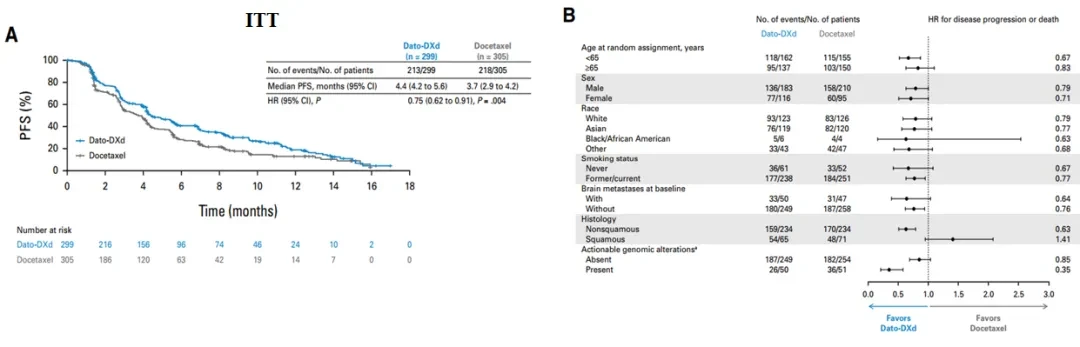
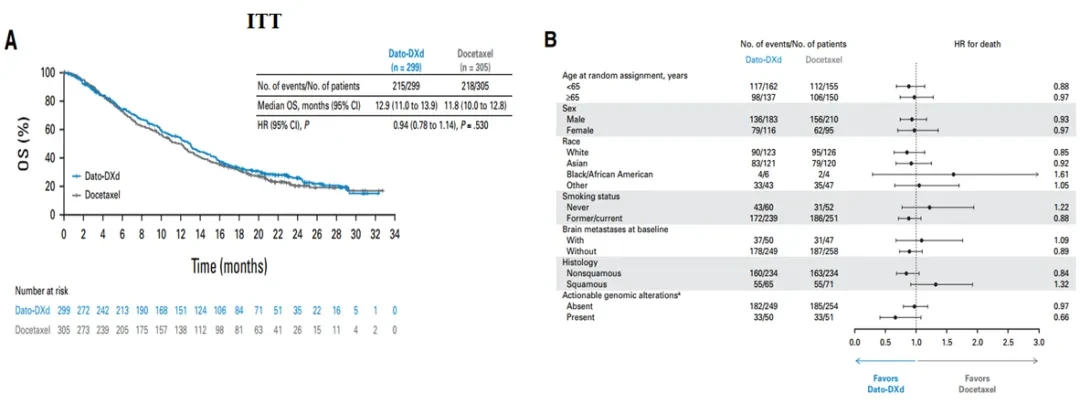
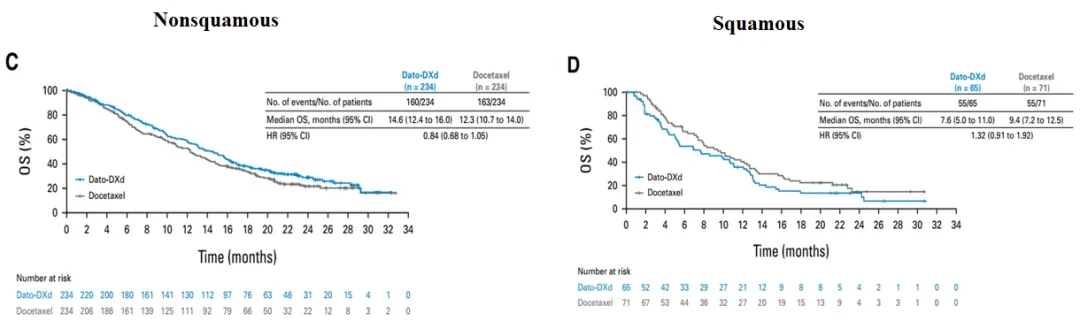
In the pre-specified non-squamous histology subgroup, the median PFS was 5.5 months vs. 3.6 months (HR, 0.63 [95% CI, 0.51 to 0.79]), and the median OS was 14.6 months vs. 12.3 months (HR, 0.84 [95% CI, 0.68 to 1.05]). In the squamous histology subgroup, the median PFS was 2.8 months vs. 3.9 months (HR, 1.41 [95% CI, 0.95 to 2.08]), and the median OS was 7.6 months vs. 9.4 months (HR, 1.32 [95% CI, 0.91 to 1.92]).