

Danish Biotech Adcendo Expands ADC Pipeline with Chinese Partnerships and Secures $135M Series B Led by Novo Holdings

Biocytogen
Antibody Drug Developer

ADCendo
Developer of Novel Anti-Cancer Drugs
Novo Nordisk
Insulin Developer and Manufacturer
Recently, Biocytogen Pharmaceuticals (Beijing) Co., Ltd. announced that Danish pharmaceutical company Adcendo ApS (hereinafter referred to as Adcendo) has exercised its option to further expand its ADC (Antibody-Drug Conjugates) pipeline using Biocytogen's fully human antibodies.Developing novel therapies for cancers with high unmet medical needs.
ADCendo ApS, founded in 2017, is committed to developing transformative first-in-class ADC therapies for cancers with unmet medical needs. Previously, ADCendo has reached ADC drug-related development collaborations with Chinese biotech companies such as DualityBio and Puzhong Discovery.
In August this year,ADCendo has introduced a core ADC pipeline from Chinese biotech Puzhong Discovery with milestone payments totaling over $1 billion. Just three months later, AdcenBiocytogen announces the completion of a $135 million oversubscribed Series B financing round led by TCGX, with participation from Novo Holdings and others. This marks the third investment by Novo Nordisk.
25+ Years of Development Experience, Participated in the Development of 8 ADC Drugs
ADCendo was founded by a team of scientists from the University of Copenhagen and Rigshospitalet, Copenhagen University Hospital. These scientists are affiliated with the Finsen Laboratory (Finsen laboratoriet, formerly the Danish National Laboratory) at the University of Copenhagen. They have previously published proof-of-concept research results on uPARAP-directed ADCs: in CDX models, the first-generation anti-uPARAP ADC effectively modulated therapeutic effects.
According to the official website, ADCendo's current leadership team has decades of experience in preclinical and clinical development, covering multiple areas such as regulatory, CMC (Chemistry, Manufacturing, and Control), and commercialization, and has participated in the development of eight currently approved ADC drugs.
Michael Pehl, the current CEO of the company, has over 25 years of international biotechnology and oncology leadership experience. He has held key positions at Celgene (acquired by BMS for $74 billion in 2019), Amgen, and GEMoaB, a subsidiary of Cellex. As CEO of GEMoaB, Pehl led collaborations with Blackstone Life Sciences, a venture capital firm under the Blackstone Group, and Intellia Therapeutics, a genomic editing company. He also co-founded Allogene Therapeutics, which focuses on developing allogeneic universal CAR-T cell therapies for immuno-oncology and autoimmune diseases.
At Celgene, Pehl served as President of Oncology for three years, with responsibilities including overseeing global clinical programs and the commercial launches of multiple drugs, such as lenalidomide, pomalidomide, enasidenib, nab-paclitaxel, and luspatercept. Additionally, he held commercial leadership roles in oncology and nephrology at Amgen.

From the left: Michael Pehl, Lone H. Ottesen, Dominik Mumberg. Image source: ADCendo official website
Dr. Lone H. Ottesen, the current Chief Medical Officer, has over 20 years of clinical development experience in the fields of oncology and immuno-oncology. Dr. Ottesen has held senior positions in oncology development at GSK and Eisai, and served as the head of late-stage clinical development at AstraZeneca. Prior to joining Adcendo, she was the Chief Medical Officer and Chief Development Officer at Circio, a company focused on circular RNA therapies.
Dr. Dominik Mumberg is the Chief Scientific Officer of Adcendo, with over 25 years of experience in therapeutic innovation, translational science, and preclinical and clinical development. Before joining Adcendo, he held several leadership positions at Bayer, including Head of Oncology Therapeutic Research, Vice President of Targeted Alpha Therapies, and Head of Technology Translation. Additionally, Dominik has extensive experience in advancing more than ten innovative New Molecular Entities (NMEs), including ADCs, targeted radiopharmaceuticals, biologics, and small molecules, into preclinical and clinical development.
Novo Nordisk Invests Consecutively, One Pipeline Originates from China
In 2021, Adcendo secured a €51 million Series A financing round led by Novo Seeds, the early-stage venture fund managed by Novo Holdings, the majority shareholder of Novo Nordisk, and the Spanish venture capital firm Ysios Capital.
Immediately in 2023, Adcendo expanded its Series A financing to 98 million euros. This round was led by Pontifax Venture Capital, a leading healthcare-focused venture capital firm, along with existing investors Novo Holdings, the holding and investment company of the Novo Nordisk Foundation, and Ysios Capital. The funding aims to ensure the broad pan-sarcoma development of its lead pipeline, uPARAP ADC, and further strengthen the development of ADC-related pipelines.
As of November this year, with Adcendo announcing the completion of a $135 million oversubscribed Series B financing round, the company has raised over $200 million in funding.
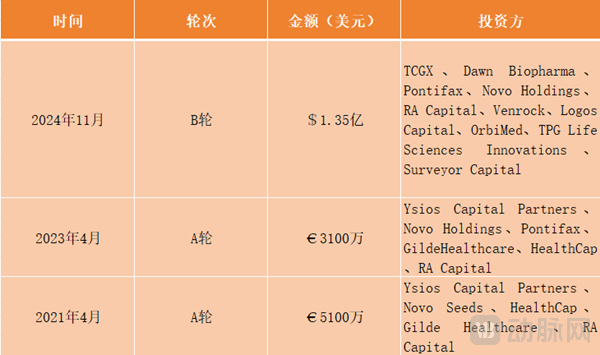
ADCendo Financing History VCBeat Mapping
The reason why Novo Nordisk has taken frequent actions lies not only in the determination of MNC to lay out the ADC track, but also in the high recognition of Adcendo's technology and platform. Currently, by combining a deep understanding of new targets with optimized ADC technology for selected solid tumor indications, Adcendo has established a pipeline of four First-in-Class ADC products.
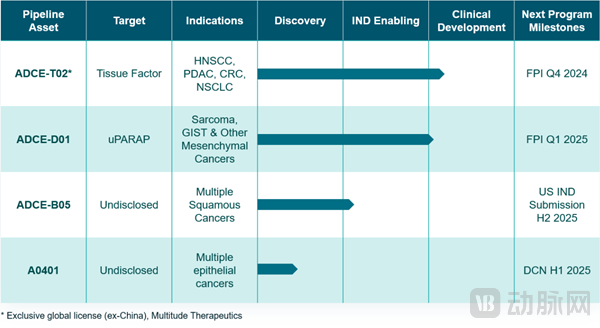
ADCendo Pipeline Source: ADCendo Official Website
Among them, ADCE-T02 (targeting tissue factor) and ADCE-D01 (targeting uPARAP) are about to enter the clinical development stage, while other projects are currently in the IND application and discovery stages.
ADCE-D01 is a first-in-class ADC targeting uPARAP. uPARAP is a recycling endocytic receptor involved in collagen homeostasis and turnover, highly expressed in various stromal cancers, including soft tissue sarcoma (STS), osteosarcoma, gastrointestinal stromal tumor (GIST), and malignant gliomas such as glioblastoma (GBM). According to clinical model data, ADCE-D01 demonstrated cytotoxicity against GBM cancer cells in vitro and showed strong in vivo anti-tumor activity in glioblastoma PDX models. This suggests that a uPARAP-targeting ADC could be a potential novel therapeutic option for GBM patients.
In October this year, the FDA has approved the IND application for the Phase I/II study of ADCE-D01 in patients with metastatic and/or unresectable soft tissue sarcoma (STS) (ADCElerate-01 trial).
ADCE-T02, the ADC candidate pipeline introduced this year from ADCendo, is a novel, highly differentiated Anti-TF ADC. It is also the first ADC with a linker/payload based on a topoisomerase I inhibitor.
According to the announcement, its unique antibody design can reduce the impact on the coagulation pathway. Meanwhile, the T1000-exatecan linker-payload technology platform has been proven by research to amplify the "bystander effect," enhance linker stability, and possess the potential to overcome drug resistance mechanisms. These differentiated characteristics are expected to translate into higher clinical response rates, longer duration of efficacy, and better safety, offering a superior therapeutic window.
TF, also known as coagulation factor III, is a transmembrane single-chain glycoprotein composed of 263 amino acid residues. Multiple studies have shown that TF is positively expressed in various solid tumors, including cervical cancer (100%), non-small cell lung cancer (34%-88%), endometrial cancer (14%-100%), ovarian cancer (75%-100%), etc. The high expression of TF may contribute to the growth and survival of tumor cells, angiogenesis, and metastasis. Therefore, it is considered a highly promising target for cancer therapy.
Partnering with Multiple Chinese Companies, China's ADC Has Become a "Hot Commodity"
Adcendo's interest in China's biotechnology pipeline is not limited to its collaboration with Puzhong Discovery. As early as 2023, ADCE-D01, another pipeline product from Adcendo, reached a cooperation agreement with Duality Biologics on the ADC technology platform.
In January 2023, Adcendo ApS signed a technology licensing agreement with DualityBio. According to the terms of this agreement, Adcendo will obtain a technology license for DualityBio's proprietary DITAC platform, to be used in its development project for uPARAP ADC to treat mesenchymal tissue tumors.
In May 2023, Adcendo announced the expansion of its collaboration with DualityBio. According to the new agreement, Adcendo will evaluate novel targets under the MTA using DualityBio's linker-payload platform, which is designed to generate ADCs with superior safety, sustainable payload delivery and release within tumors, and effective bystander killing of antigen-low and antigen-negative cells. After evaluation, Adcendo can opt to access its next-generation ADC platform.
In the global biotechnology field, Chinese Biotech is gradually becoming an international focus with its unique innovation capabilities and cooperation potential. According to statistics from PharmaCube, China ranked first in the number of ADC transaction assignors globally in 2022-2023. According to incomplete statistics from VCBeat, currently, domestically produced ADCs have reached collaborations with more than 17 multinational corporations (MNCs).
According to Sullivan, the global market size of ADCs has rapidly increased from US$1.6 billion in 2017 to US$7.9 billion in 2022, with a compound annual growth rate (CAGR) of 37.3%. It is projected to reach US$64.7 billion by 2030, with a CAGR of 30.0%, far exceeding the growth rate of the biopharmaceutical market during the same period. The share of ADCs in biologics will increase from 2.2% in 2022 to 8.3% in 2030.
A report by Huajin Securities shows that China's ADC market has been growing rapidly since the National Medical Products Administration approved the first ADC drug, Kadcyla, in 2020. It is expected to grow from RMB 8 billion in 2022 to RMB 66.2 billion in 2030, with a compound annual growth rate of 72.8%.
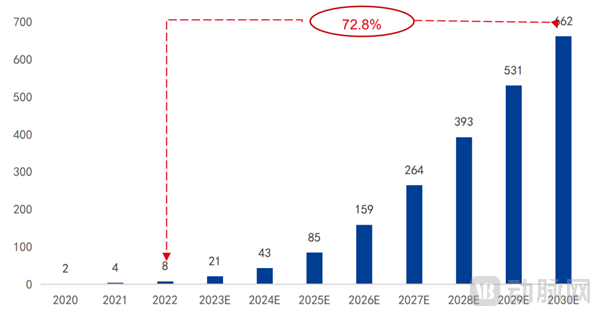
China ADC Market Size Source: Huajin Securities
With the continuous penetration of the global market and the expanding indications, ADC drugs will unleash an even larger market space in the future.