

OSSIO Submits IPO Filing Following FDA Approval of Next-Gen Smart Bone Regeneration Technology and $276M Funding

Ossio
Orthopedic Medical Device R&D Manufacturer
With the aging population, increasing patient awareness and acceptance of implants, and technological innovations in materials, the orthopedic implant medical device sector is facing broader development prospects.
Forward Industry Research Institute estimates that the global orthopedic implant medical device industry market size reached 45.8 billion U.S. dollars in 2023, with a five-year compound annual growth rate (CAGR) of 4.08%. Preliminary estimates suggest that the global orthopedic implant medical device industry market size will reach 48.6 billion U.S. dollars in 2024.
As a key player in the orthopedic implant medical device sector, OSSIO is committed to becoming the gold standard in the field of orthopedic fixation by promoting natural bone healing, ultimately eliminating the need for surgical procedures to remove implants, reducing implant-related complications, and alleviating pain. Founded in 2014 and headquartered in Woburn, Massachusetts, USA, the company is developing alternatives to orthopedic metal implants and has established a next-generation intelligent bone regeneration technology platform.
1Creating a New Category of Fixation with Intelligent Bone Regeneration Technology
Developing an orthopedic material platform capable of fully restoring to native anatomical structure after fixation holds the potential to significantly impact patient care and broader healthcare system stakeholders. Currently, many companies and research institutions are attempting to achieve this goal through various types of materials such as bioresorbable materials, biocomposites, polyetheretherketone (PEEK), and allografts. However, the application and in vivo performance of these materials have notable limitations, including insufficient mechanical properties, long-term stability yet to be validated, poor bioresorption, and limited supply.
Therefore, despite the drawbacks of metal implants, such as unnecessary removal surgeries, associated complications, and an unnatural healing environment, metal fixation remains the standard fixation material in orthopedics.
Currently, the scientific community has developed a framework to describe the ideal bone fixation implant materials, and the main criteria include:
● The degradation of the material should be controllable and consistent with the speed of bone integration;
● The material should maintain sufficient strength during the biological bone integration process;
● The material should not cause long-term adverse inflammatory responses when inside the body;
● After the material is completely absorbed, the body should fully restore its native physiological state;
● The material should be capable of being manufactured into various implant geometries.
The performance of orthopedic implants is influenced by material selection and internal structure. Developing an implant that fulfills all the aforementioned conditions requires a fundamental shift in both material choice and implant design without compromising proven surgical techniques. Thus, to date, the industry has hardly developed a non-permanent fixation material that offers robust support and fixation while also promoting natural bone regeneration.
And this is also the technical difficulty that OSSIO渴望突破 in the field of bone fixation. After ten years of research, the company successfully built a new intelligent bone regeneration technology platform OSSIOfiber™.The company innovatively adjusts the material composition and internal structure of the implant to give it the mechanical strength required for insertion and secure fixation, while also enabling integration with native bone without triggering adverse inflammatory responses.With this, OSSIOfiber Intelligent Bone Regeneration Technology has created a new category of fixation — "Bio-integrators."
2Hybrid integration mechanism provides high mechanical strength and leaves no residue after recovery
OSSIOfiber implants are designed with a fibrous matrix structure and reinforced with absorbable polymers, allowing bones to naturally regenerate to full strength. Made from proven natural materials, the implants fully integrate into the native anatomy without leaving any residue.As the first-of-its-kind implant material, it has a strength higher than cortical bone, enabling bone regeneration and renewal without the need for permanent metal hardware, with early bone attachment achievable in as little as 2 weeks.
Specifically, OSSIO orthopedic implants are composed of approximately 50% continuous reinforced natural mineral fibers and 50% poly(lactic-co-D,L-lactide) (PLDLA). The former is similar to the mineral component in bones, providing the necessary mechanical strength and biocompatibility for the implant; the latter is a biodegradable polymer widely used in medical devices, capable of degrading in the body and being replaced by new bone growth.
Notably, natural mineral fibers are composed of various elements found in native bone, such as calcium, silicon, magnesium, and others. Reinforced mineral fibers are primarily made up of silica (SiO₂), sodium oxide (Na₂O), calcium oxide (CaO), magnesium oxide (MgO), boron oxide (B₂O₃), and phosphorus pentoxide (P₂O₅). According to company disclosures, OSSIOfiber is the first non-permanent implant material that combines an enhanced matrix structure with the highest mineral content.
OSSIOfiber achieves hybrid integration mechanism by leveraging the degradation mechanisms and internal microstructures of its two material components, integrating with native anatomy in the following ways:
First, the high mineral content of OSSIOfiber supports high mechanical strength and progressive bone integration.The mineral content level in OSSIOfiber (approximately 50%) is significantly higher than that in biocomposite implants, which typically contain only 10-30% mineral components, such as hydroxyapatite (HA), β-tricalcium phosphate (B-TCP), and calcium particles. The higher mineral content enables OSSIOfiber to provide significant biomechanical advantages while better supporting the natural bone healing process.
Second, a balanced pH environment promotes a healthy environment for bone healing.In previous bioresorbable and biocomposite implants, the degradation characteristics were primarily dominated by the bioabsorption of biopolymers, which produce acidic degradation products, leading to an increase in local environmental acidity (decreased pH), potentially triggering inflammatory responses. Moreover, the absence of interconnected channels within the implant prevents the gradual removal of degradation products. Large biopolymer chains progressively weaken and may eventually result in the sudden release of acidic degradation products in certain cases. Due to the larger volume of polymer chains, this sudden release can occur years later, causing severe localized inflammatory reactions at the implant site several years after implantation.
In OSSIOfiber implants, two biointegration mechanisms occur simultaneously: the absorption of the polymer and the replacement of mineral fibers with new bone. Moreover, the α-hydroxy acid degradation products of the biopolymer are balanced by the alkaline degradation products of the mineral fibers, ensuring a pH-balanced absorption process for the OSSIOfiber implants through this blended material's degradation mechanism.
Third, the interconnected channels gradually and continuously allow fluid flow and the removal of degradation byproducts.As the implant degrades, interconnected channels form within the implant, allowing fluid to flow through and promoting physiological bone tissue regeneration to replace the implant.
The controlled degradation characteristics of OSSIOfiber are synchronized with the healing speed of fractures or osteotomies. Preclinical studies show that full integration of OSSIOfiber occurs approximately within 18 to 24 months, eliminating the need for implant removal surgery. The low overall polymer content of OSSIOfiber ensures that the polymer degradation properties of the reinforced biocomposite are balanced and progressive. As a result, the degradation products of the biopolymer can be gradually cleared by the body, avoiding polymer accumulation and subsequent foreign body reactions during the degradation process of traditional bioresorbable materials.
3Approved by FDA, Internal Structure of Implant Can Be Adjusted as Needed
The uniqueness of OSSIO's enhanced biointegration technology lies in the ability to adjust the internal structure of each implant according to the needs of the indication, achieving optimal biomechanical properties. This is accomplished by designing implants that contain thousands of continuous natural mineral fibers.
These fibers are arranged into fiber bundles and then constructed into an ordered layered structure. Each layer of fibers is oriented to provide mechanical properties (such as resistance to bending) along different mechanical axes. These layers are combined into a matrix structure that can be individually adjusted to ensure biomechanical characteristics meet specific clinical indications.
In one implant, there are dozens or even hundreds of layers of fiber with different orientations, providing mechanical properties to the implant. A biopolymer resin binds the fibers and layers together, aggregating the mechanical contributions of each fiber and all layers to form a biomechanically optimized implant.
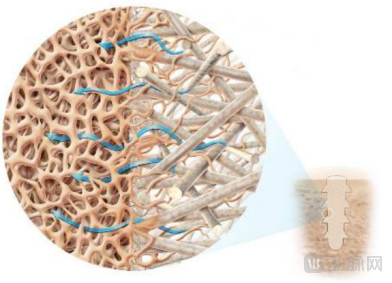
Schematic Diagram of the Integration Mechanism of OSSIO Fibers (Right) and Bone (Left)
When the OSSIOfiber implant is placed in the human body, it quickly integrates with the surrounding bone, promoting the natural healing process. Patient bone cells rapidly infiltrate the bio-integrative fiber matrix structure, facilitating early bone growth and attachment. Throughout the healing and rehabilitation process, new bone continues to grow and gradually integrates with the native bone without the risk of a foreign body reaction.
Currently, based on OSSIOfiber intelligent bone regeneration technology, OSSIO has developed a series of product lines:
OSSIO fiber ®Suture AnchorUsed in surgery to fix sutures (soft tissue) onto bones in the shoulder, foot, knee, hand, and elbow. The product is specifically designed for soft tissue repair, offering strong initial tensile strength and sustained strength. The company’s proprietary DURAlink™ technology incorporates OSSIOfiber.®The ring is connected to the anchor, forming a stable unit that enhances structural stability and reduces suture slippage.
OSSIOfiber®Compression NailCan provide fixed support for bones, has good biocompatibility, and is available in various sizes. This product offers a nickel-free solution for patients sensitive to metals, allowing doctors to see the healing bone without the obstruction of metal implants. Notably, OSSIOfiber®The length of the compression nail can be trimmed as needed to accommodate different surgical requirements or individual patient conditions.
OSSIOfiber®Compression ScrewSuitable for maintaining the alignment and fixation of comminuted fractures, fracture fragments, osteotomies, arthrodesis, and bone grafts in the upper limbs, fibula, knee, ankle, and foot under appropriate bracing and/or fixation conditions. This product increases the surface area available for bone integration by five times, providing more surface area for bone cells to attach and grow.
OSSIOfiber®Trimming Fixation PinAchieves full natural healing in a wide range of surgical applications and offers the convenience of sterile, single-use instruments. The product excels in initial stability and fixation strength and outperforms traditional metal cannulated headless compression screws in anti-rotational performance.
OSSIO fiber®Threaded Trim-Fix NailCompared with the widely used fully threaded screws, it can provide greater compression force. This product combines self-tapping functionality with the company's unique adjustable driver and offers precise fluoroscopic visibility. Additionally, the nail length can be customized during surgery, reducing the need for extensive inventory.
OSSIO fiber ®Hammer Toe Fixation ImplantCan provide reliable fixation for proximal interphalangeal (PIP) joint fusion, utilizing bone regeneration technology, and is available in a variety of sizes.
Currently,OSSIOfiber Bio-integration Fixation Technology Receives FDA ApprovalU.S. health authorities have approved the technology for orthopedic surgeries in children and adolescents requiring fracture fixation, osteotomy, or fusion. The approval permits the use of OSSIOfiber compression screws and trimmable fixation tacks in standard clinical practice for children and adolescents aged two to twenty-one.
On December 2, 2024, OSSIO completed a new round of financing., with a financing amount reaching 27.6 million US dollars(Approximately RMB 201 million). The financing will be mainly used to accelerate commercialization efforts, such as expanding the new product pipeline, sales channels, and medical education, as well as establishing a flagship U.S.-based manufacturing plant and surgeon training center in Florida.
4In conclusion
The development of China's orthopedic medical device industry started relatively late but has grown rapidly. Especially since 2022, several bone repair materials have been approved for marketing in China, significantly enhancing the market competitiveness of local enterprises and gradually changing the competitive landscape previously dominated by foreign-funded leading companies. Leading enterprises such as Hangzhou Jiuyuan Gene, Yantai Zhenghai Bio, Shanghai Kailit Medical, Beijing Chunli Zhenda Medical, and Wego Orthopaedics have emerged.
China's orthopedic medical device industry is currently in an era of market expansion and import substitution. According to statistics from VCBeat, the market size of orthopedic implant medical devices in China grew from 16.4 billion yuan in 2015 to 36.7 billion yuan in 2020, with a compound annual growth rate of 17.48%.
In the bone defect repair materials market, Lixin Science's Nüwa Stone® GAIABONE® regenerative artificial bone fills a global market gap. As the world's first artificial bone that simultaneously meets the requirements of being malleable, resistant to liquid dispersion, and highly efficient in inducing regeneration, the product has received FDA 510(K) approval for marketing. GAIABONE® exhibits excellent osteoconduction and osteoinduction capabilities, achieving bone regeneration within 3-6 months post-implantation.
In February 2024, Dazhou Medical's globally first 3D-printed bone-like structure tantalum metal bone filling and reconstruction rod (TANREGEN®) obtained the NMPA Class III medical device registration certificate. The product achieves 100% three-dimensional connectivity of the porous structure, with an average pore size of 400-800 microns and a porosity greater than 70%, providing a three-dimensionally connected ultra-large space for bone integration, bone ingrowth, and vascular ingrowth, promoting bone and vascular regeneration.
Suzhou Senfeng Medical Instrument Co., Ltd. is dedicated to developing high-end implantable medical devices with independent intellectual property rights, primarily focusing on orthopedic implants. The company utilizes innovative medical metal materials with biofunctional properties to fundamentally address issues of infection and healing following implant surgeries. Its groundbreaking biofunctional antibacterial metallic medical implant material promotes bone formation, enhances vascularization, exhibits strong broad-spectrum antibacterial properties, and prevents bacterial infections, offering extensive application prospects in the medical field.