As 2024 comes to an end, the medical device industry in China remains bleak. Although there were two eye-catching deals at the beginning and the end of the year (in early 2024, Mindray acquired a controlling stake in Huitai Medical for 6.652 billion yuan, and at the end of the year, Entai took a 200-million-yuan controlling stake in Weiqiang),Medical device professionals see another exit path emerging in China's innovative medical device sector. However, exiting through acquisition by large companies remains a minority approach domestically.
In Europe and America, through being acquired by large companiesAcquisition is one of the most common methods, and there are many reasons for the huge gap between domestic and international markets. One reason is the lack of real intellectual property rights among domestic innovative companies, coupled with weak protection of intellectual property rights. In Europe and America, however,Intellectual property is well protected, and large companies basically monopolize market channels, making it very difficult for innovative companies to break through the existing market structure.
Of course, as competition intensifies among domestic airports in China, the market will become increasingly monopolized. Ultimately, smaller companies will need to rely on larger corporations or state-owned enterprises to survive. Mergers and acquisitions within the domestic market in China are also expected to become more active in the future. There are good targets available, but the question remains whether prices can be lower, similar to...OnlyJohnson & Johnson Medical (China) Ltd. is selling at a discounted price due to stock clearance.
However, compared to the low-price acquisitions in China, overseas acquisitions are definitely at a high price. For instance, Johnson & Johnson's two acquisitions this year were both over one billion US dollars. In contrast, domestic mergers and acquisitions of high-quality enterprises can be considered as cheap as "cabbage prices," and by next year, the prices may even be lower. On the contrary, according to predictions by overseas analysts, overseas mergers and acquisitions will become more active next year, with even larger deals expected than this year.
Let's take a look at M&A deals exceeding one billion US dollars in 2024:In April this year, Johnson & Johnson acquired Shockwave Medical for $13.1 billion. This is the second billion-dollar acquisition announced by Johnson & Johnson in its return to the cardiovascular field, and also the largest acquisition of the year. Through acquisitionsShockwave Medical, Acquires IVL Technology and Angioplasty Stent Technology, Also Brings Johnson & Johnson Back to Global Cardiovascular TOP3.Johnson & Johnson Cardiovascular has currently formedForming a tripartite situation among Biosense Webster, Abiomed, and Shockwave. BesidesBiosense Webster外,AbiOMED andShockwave basically has no competitors in the overseas market; it all depends on Johnson & Johnson's own ambition.If Johnson & Johnson can make another big deal next year, surpassing MedtronicReturn toThe leading cardiovascular and device companies are not a dream.
In June this year, BD acquired Edward's Critical Care product line for $4.2 billion. Facing aggressive competition from Medtronic, Edward has gradually lost its reputation as the king of valves this year. In order to maintain its position in the field of valvular disease (and also to increase its market value), Edward...Hua had to cut off its least relevant intensive care business in order to provide "ammunition" support for its core business and make a comeback.Since the sale of CriticAfter al Care, Edward successively acquired J-valve (a shining example of Chinese production) from健适, Trilogy from JenaValve Technology, Kalios (mitral valve annuloplasty ring) from Affluence Medical, and Cordella (remote heart failure monitoring technology) from Endotronix.J-valve andTrilogy was developed to compete against Medtronic, because Medtronic'sThe Evolut series is not indicated for the treatment of patients with aortic regurgitation.
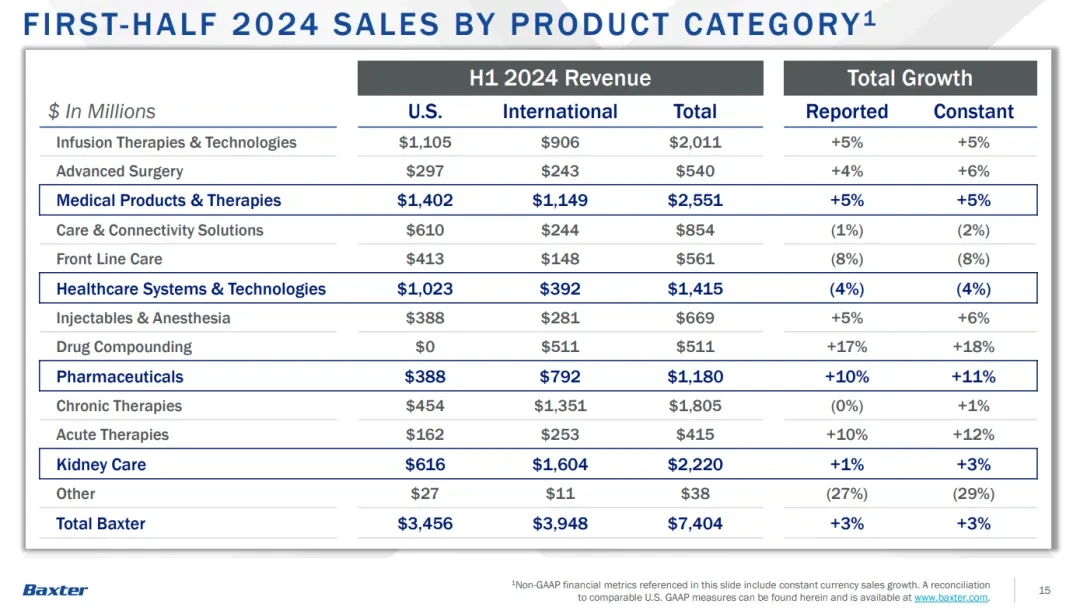
In August this year, Carlyle Group acquired Vantive, Baxter's renal care division, for $3.8 billion. Vantive is one of Baxter's largest business units, with sales last year reaching $4.453 billion, accounting for 30% of Baxter's total sales. In the first half of this year,VantiveThe sales revenue was $2.22 billion. Baxter soldVantiVE, this business is no longer a strongly growing one. A business with no prospects should be sold early to fetch a good price.Carlyle GroupOver the past decade or so, more than 40 billion US dollars have been spent in the medical field. This was achieved by acquiring a declining industry, then integrating resources and capital before selling it again to make a profit from the price difference.In 2014, it acquired Johnson & Johnson's Ortho Clinical Diagnostics for $4 billion, and in 2021, it spent $34 billion.Billion US dollarsOne InvestmentMedline. Last yearCarlyle Group respectively willQuidel andOne Medical with 60 and 40Billion-dollar price for sale.
This Year, JanuaryMonth, Boco for $3.7 billionThe acquisition of Axonics at the original price allowed Boston Scientific to further solidify its position as the leader in urology, while also enabling the company to enterSacral Nerve Stimulation Market (a market that Medtronic has always regarded as its own backyard). In order to prevent Boston Scientific from acquiringAxonics, filed an infringement lawsuit (although Medtronic eventually lost). Boston Scientific finalized the acquisition in November.Axonics Acquisition.The implantable sacral nerve stimulator is a highly effective method for treating overactive bladder (OAB) and fecal incontinence.AxonICS is currently the fastest-growing company in this field, and its rapid growth continues to erode Medtronic's original market share. With the acquisition by Boston Scientific...AxonICS, will inspireAxonICS Sales Potential. Good technology combined with stronger commercialization capabilities could possibly change the market landscape in the future.
This Year,Month, Johnson & JohnsonUS$1.7 billionYuanJohnson & Johnson's acquisition of V-Wave marks its first move in the structural field and also represents a significant step in the cardiovascular sector.V-Wave isImportant Player in the Atrial Shunt Technology Field, DespiteAtrial shunt technology currently still has manyControversy (mainly because the clinical studies of V-Wave and Corvia Medical did not meet the clinical endpoints), butAtrial shunt technology continues to attract industry giants such as Johnson & Johnson and Edwards.Now, Johnson & Johnson has spent a huge sum to acquire it, and it will become part of their future cardiovascular product portfolio.An important component. Johnson & Johnson believes that the Ventura Interatrial Shunt has the potential to serve as a first-line therapy for heart failure, filling the current treatment gap.
【06】Rotech Healthcare
$1.4 billion
In July this year, Owens & Minor acquired Rotech Healthcare for $1.4 billion. As a company providing respiratory health equipment and related services, Rotech Healthcare’s integration will bring Owens & Minor a full range of product lines, including ventilators, CPAP machines, diabetes equipment, etc., which is expected to significantly enhance Owens & Minor's competitiveness in the home care market in the coming years.
【07】Road Medical
$1.4 billion

In June this year, Boston Scientific acquired Silk for $1.16 billion.Road Medical. Silk Road Medical is the pioneer of "Transcarotid Artery Revascularization (TCAR)." Prior to this, patients with moderate to severe carotid artery disease could only undergo one of two surgical procedures: "Carotid Endarterectomy (CEA)" or "Transfemoral Carotid Artery Stenting (TFCAS)." However, these two treatment methods often lead to many complications (e.g., cerebral infarction).BocoThroughSilk Road MedicaStrengthen its periphery, enabling it to lead in carotid artery treatment over Medtronic and Abbott.
This April, KarlZEISS Acquires Dutch Ophthalmic Research Center D.O.R.C. for $1.07 Billion. This acquisition represents not only a significant strategic move by Carl Zeiss Meditec after achieving annual revenue of €2.089 billion but also an important expansion in the global ophthalmic medical device market. As a key player in the retinal surgery equipment market, D.O.R.C. is set to become a crucial contributor to Carl Zeiss' long-term strategy and success. Through this acquisition, ZEISS will strengthen its position in the vitreoretinal surgery sector, further solidifying its status as the fastest-growing manufacturer of ophthalmic medical devices globally.