

Vantis Vascular Submits IPO Prospectus for CrossFAST Guide Extension System, Pioneering Integrated Microcatheter Platform for Complex PCI

Vantis Vascular
Developer of Vascular Interventional Therapy Technology
Recently, Vantis Vascular (hereinafter referred to as "Vantis"), a medical technology company, announced the completion of a US$10 million (approximately RMB 73 million) Series B round of financing.
This funding will be used to support the full commercialization of its core product, CrossFAST, which is designed to address the issues of insufficient push force and the risk of vascular injury associated with traditional guiding extension catheters, thereby improving procedural efficiency and safety as it seeks FDA approval.
Vantis, located in San Jose, California, was founded by doctors. Its team members have teaching and clinical experience from renowned medical schools such as Cornell University Medical College, Massachusetts General Hospital, Stanford University Hospital, and Michigan State University College of Human Medicine.
Vantis Vascular, Inc. also secured $5 million in funding in May 2024 to drive innovation in the vascular intervention field. This funding will accelerate the company’s development efforts and support the commercial launch of the CrossFAST system. The company has also raised a total of $24 million from high-net-worth individuals and grants from the U.S. National Institutes of Health (NIH).
According to the World Health Organization, approximately 2 out of every 100 people worldwide suffer from coronary heart disease, and about 15 out of every 10,000 people die from it. Coronary heart disease accounts for 16% of global total deaths and has become a leading cause of death worldwide, posing a serious threat to human health.
Coronary Intervention Surgery, also known as Percutaneous Coronary Intervention (PCI), is one of the key treatments for coronary heart disease. PCI is a minimally invasive procedure with the advantages of small trauma, quick recovery, and low risk. However, based on clinical observations, a small number of patients may experience complications such as vascular injury, thrombosis formation, and in-stent restenosis after the surgery.
Notably, during the interventional treatment of some complex PCI procedures, doctors may encounter situations where microcatheters, microwires, and therapeutic devices (such as drug-coated balloons, covered stents, long stents, etc.) cannot reach the lesion site smoothly.
Extension catheters can play an important auxiliary role in improving the aforementioned situations. By utilizing extension catheters, enhanced support and improved coaxiality can be provided for microcatheters and microwires to cross through stenotic and calcified lesions, thereby enhancing the pushability of devices. Additionally, they offer a smooth passage for the delivery of specialized instruments, ensuring that therapeutic devices are smoothly delivered to the target vessel.
In clinical practice, extension catheters often face three issues during deep insertion.First, there is insufficient promotion.Traditional extension catheters often exhibit poor performance when deeply inserted into coronary arteries due to their relatively larger "distal ends." Prolonged deep insertion can significantly impede antegrade coronary blood flow, leading to myocardial ischemia.
Secondly, the blood vessel wall may be damaged during the pushing process.Traditional extension catheters consist of a catheter body, an oblique opening, and a push rod. During the pushing process, if bending, breakage, or separation occurs, it can exert pressure on the vascular wall, causing vascular injury.
Third, it is difficult to handle complex cases.Traditional extension catheters can easily block distal blood flow when deeply inserted into narrow lesions or small distal vessels. If the patient experiences severe no-reflow or slow-flow, it may lead to hemodynamic instability. Therefore, for handling lesions at the distal edge of stents, extension catheters with better passage and compliance should be selected for assistance.
Based on this, Vantis developed the CrossFAST product, which specifically addresses current clinical issues in terms of pushability, safety, and applicability.
CrossFAST is the world's first integrated microcatheter guiding extension catheter and has received FDA approval for marketing.

(CrossFas product, image source: Vantis official website)
The so-called "microcatheter" refers to the combination of traditional microcatheter technology and guiding extension technology into one, representing a new mechanism that couples inner and outer catheters. Among them, the inner tube is the microcatheter, and the outer tube is the guiding extension catheter, allowing the two to lock together and advance as a single unit, thereby improving the safety and delivery capability of the product.
The patented DuoPro interlocking technology is one of the highlights of CrossFAST, achieving the following innovations:
First, the smooth pushability of the catheter has been enhanced.Utilizing DuoPro technology enhances the control and flexibility of extended catheters, enabling them to smoothly navigate through calcified and complex vascular anatomies. The low-profile, tapered catheter design improves overall navigation efficiency, allowing for smooth and effortless guidance to distal target lesions.
In addition, its flared central lumen entrance design simplifies stent insertion and advancement, allowing even more rigid shockwave balloon catheters to be delivered smoothly.
Secondly, it reduces the risk of vascular injury.CrossFAST is equipped with a non-invasive microcatheter tip and a seamless transition design, which helps prevent vascular tearing and damage, ensuring safety during the surgical procedure.
Finally, it has broader applicability and can be used for complex cases.CrossFAST is particularly suitable for handling narrow, tortuous, or severely calcified vessels, offering greater convenience and effectiveness for interventional treatments. According to statistics from the Vantis website, there are over 1 million PCI treatments performed annually in the United States, with approximately 20% of cases unable to advance the guide extension catheter to the distal end.
CrossFAST is also suitable for complex conditions such as below-the-knee (BTK) peripheral surgeries. In the United States, one in five people over the age of 60 suffer from peripheral artery disease (PAD). There are more than 690,000 BTK cases annually in the U.S., with 50% of them involving moderately to severely calcified BTK vessels.
The emergence of CrossFAST provides patients with severe calcification, stenosis, and tortuosity in blood vessels with a safer and more effective new treatment method, offering a novel approach to address existing complex arterial treatment challenges.
Vascular Solutions is an American company focused on the production and research of vascular interventional devices. The company was acquired by American Teleflex for 1 billion US dollars in 2017. Its launched product, the GuideLiner catheter extension, is a counterpart to CrossFAST.
GuideLiner has now evolved to the third generation (GuideLiner V3). In terms of product performance, both generations offer excellent support and coaxiality, effectively avoiding vascular injury while creating a pathway to the lesion site.
The main difference between them lies in the core technology of the products. The GuideLiner V3 collar adopts a proprietary half-tube technology, which is designed to guide and align the collar when transitioning through the collar, thereby minimizing the interaction between the device and the collar, facilitating smooth entry of the device into the catheter body and completing delivery. CrossFAST, on the other hand, utilizes proprietary DuoPro interlocking technology, enhancing smooth pushability and helping achieve stable and effortless delivery.
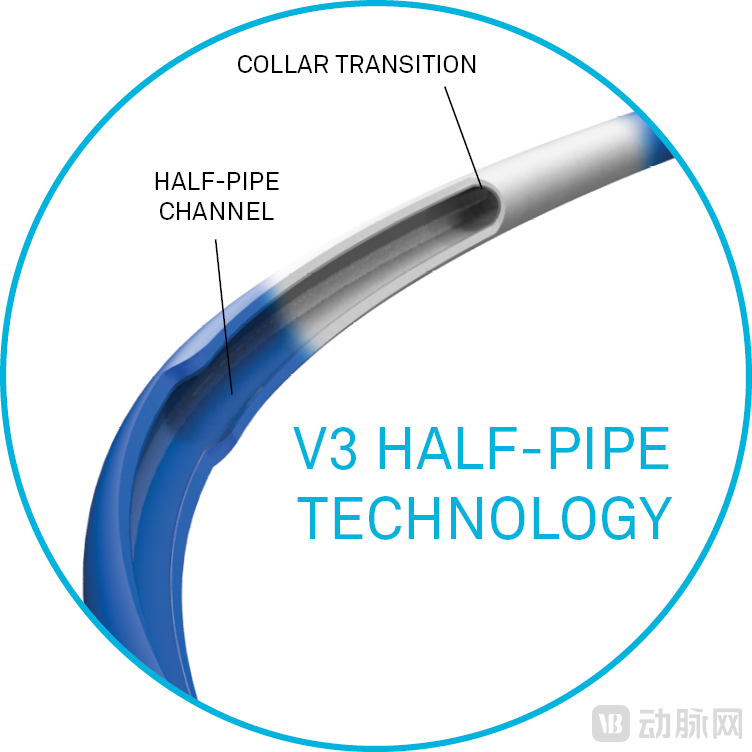
(GuideLiner V3 Half-Pipe Technology, Image Source: teleflex Official Website)
In China, the total number of PCI cases is steadily increasing. Influenced by factors such as an aging population, the affordability of device prices after centralized procurement, and technological advancements, the future demand for PCI in China is expected to grow further.
On the other hand, the penetration rate of PCI in China remains at a low level. According to statistics from the Research and Development Center of Southwest Securities, the number of PCI procedures per million people in 2019 was 2,951 in the United States, 2,276 in Japan, and 2,222 in Europe, while in China it was only 729. There is still at least three times the potential for growth in the volume of PCI procedures in China, indicating a broad market space for domestically produced alternatives.
Currently, Chinese companies such as Everpeace Medical, Lepu Medical, Yepmed, and Cregit have obtained approvals for multiple guide extension catheter products by enhancing their independent R&D capabilities. Market expansion through domestic substitution is quietly underway. It can be foreseen that in the future, more medical device companies will lead through innovation, developing products that meet clinical needs. The market will give rise to multiple leading Chinese companies, benefiting even more patients!