MNC Doubles Down: J&J Inks Global Deal for Kaken's Oral STAT6 Inhibitor KP-723

Johnson & Johnson
Medical Device R&D and Manufacturer

Kaken
Medical Device and Pharmaceutical Manufacturers
Frontier Information
On December 26, 2024, Johnson & Johnson (JNJ) announced that it had entered into an exclusive licensing agreement with Kaken Pharmaceutical for the global development, manufacturing, and commercialization of the STAT6 program targeting autoimmune and allergic diseases, including atopic dermatitis (AD).
Johnson & Johnson has obtained the exclusive license for Kaken's STAT6 program, including the lead candidate KP-723. Kaken will retain commercialization rights in Japan, and Johnson & Johnson will have the option to enter into a co-promotion agreement with Kaken. Additionally, Kaken is eligible to receive equity investment from Johnson & Johnson Innovation - JJDC (Johnson & Johnson's venture capital organization).
By modulating STAT6, KP-723 complements the company's portfolio of molecules targeting AD-related pathways.KP-723 is expected to begin Phase 1 trials in AD next year and may be applied to other Th2-mediated diseases, including asthma.。
"To address the significant unmet needs of people suffering from highly heterogeneous diseases such as atopic dermatitis and asthma, we must have multiple candidate therapies in our pipeline that target the key pathways driving disease progression," said David Lee, Global Head of Immunology Therapeutic Area at Johnson & Johnson Innovative Medicine.STAT6 represents a promising area of research as it offers the potential for an effective and safe oral option for those striving to control atopic dermatitis and other autoimmune diseases.。”
"Nearly three-quarters of atopic dermatitis patients do not achieve remission with currently available treatments," said Candice Long, Vice President of Global Immunology at Johnson & Johnson. "Our investment in KP-723 may allow us to offer patients suffering from this complex immune-mediated disease a novel treatment option with the convenience of a pill."
Atopic Dermatitis (AD), also known as eczema, is a chronic inflammatory skin condition that affects more than 9.6 million children and 16.5 million adults in the United States. The disease is characterized by an overactive immune system that damages the skin barrier, leaving it dry, itchy, and prone to rashes. Atopic dermatitis can recur throughout life, with patients experiencing severe flare-ups. This condition can lead to social stigma, impact the ability to interact with family and friends, disrupt sleep due to intense itching and/or skin pain, and cause anxiety, stress, and depression, increasing the risk of suicide and leading to a reduced quality of life.
STAT6: An Important Direction for MNCs in the Future
Although JNJ did not disclose the specific transaction amount, it is enough to reflect its level of importance. From JNJ's pipeline layout, it currently has only one drug in the AD field, JNJ-67484703 (PD1 agonist monoclonal antibody), in the clinical trial stage, and its efficacy is still unknown. The future potential of STAT6 makes KP-723 a crucial part of its future strategy.
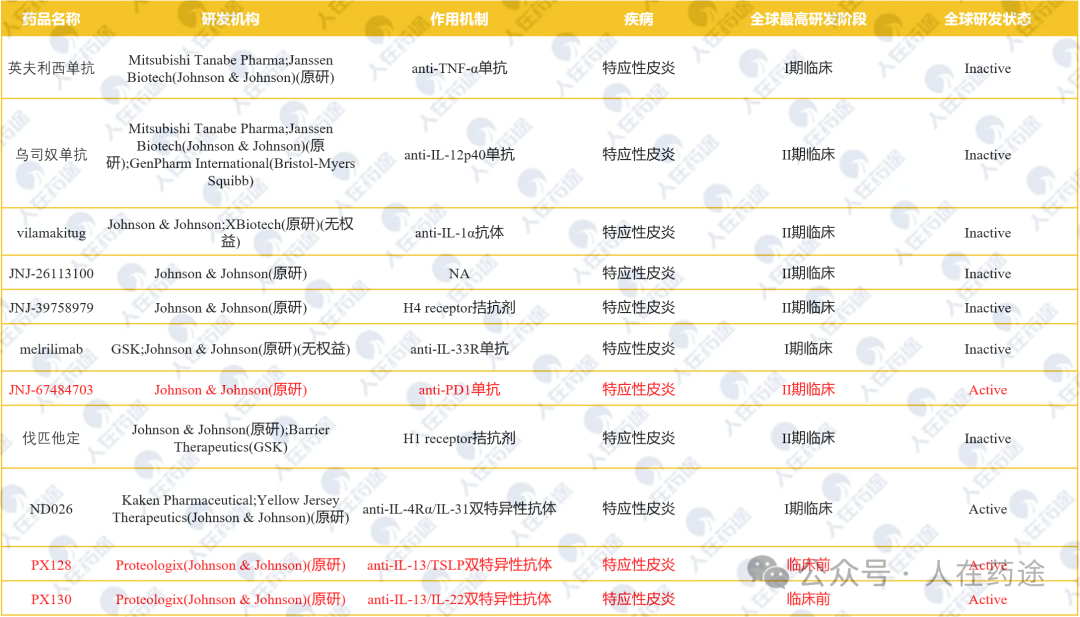
At the same time, this deal marks the third transaction by MNC in the STAT6 field. The other two include Sanofi's collaboration with Nurix to develop STAT6 PROTAC, and Sanofi's acquisition of Recludix’s phosphopeptide STAT6 inhibitor program. As previously mentioned [PROTAC Beacon of Hope: Kymera Oral STAT6 PROTAC KT-621 Preclinical Data Released】,In view of the current industry's evaluation of the STAT6-targeted drug "oral Dupixent" and the upcoming patent cliff for Sanofi's cash cow Dupixent, STAT6 will be an important research and development direction in the future AD field.
Other STAT6 Related Articles:
Targeting STAT6: Phosphopeptide Inhibitors, a Long Road Ahead
STAT6 PROTAC: Inferring the Approximate Structure of KT-621 from Patents (Forward-looking Chapter)
STAT6 PROTAC: Inferring the Approximate Structure of KT-621 from Patents
Recludix R&D Progress and STAT3/6 PROTAC Patent Analysis
Discovery of the PROTAC Degrader AK-1690 Targeting STAT6
So, what does Kaken's STAT6 inhibitor look like, and why is it favored by JNJ?
Mining the General Structure of KP-723 from Patents
Regarding other STAT6 inhibitor-related patents, a detailed summary has been provided in previous articles [STAT6 PROTAC: Inferring the Approximate Structure of KT-621 from Patents (Forward-looking Chapter)】。
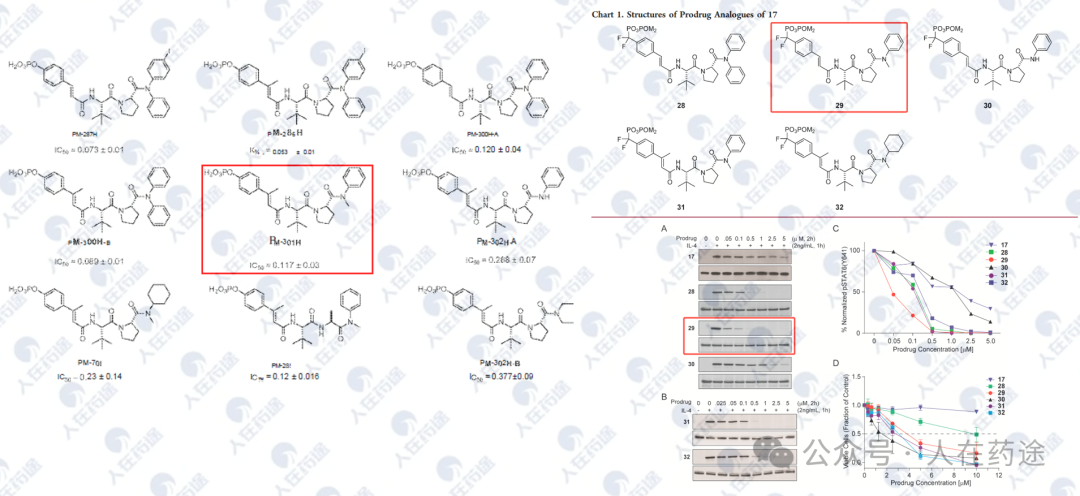
2024.4.4, Kaken Pharmaceuticals Co., Ltd. disclosed its first STAT6 inhibitor patentWO2024071439. The patent contains 224 embodiments, evaluating the STAT6 inhibition rate of these compounds as well as their inhibitory activity on STAT6/IL-4 binding, andCompared with the positive control PM-301H。
As previously described in the summary article 【STAT6 PROTAC: Inferring the Approximate Structure of KT-621 from Patents (Forward-looking Chapter)], The positive control compound PM-301H is a research achievement from the team of John S. McMurray at the University of Texas/Baylor College of Medicine (WO2014182928;J. Med. Chem. 2015, 58, 8970−8984)。PM-301H inhibits STAT6 with an activity of 0.117 μM, while the cell-permeable prodrug Cpd.29 exhibits nanomolar activity in inhibiting pSTAT6 and suppressing IL-4 levels.。This research also forms the basis for the development of phosphopeptide-based STAT6 inhibitors. Recludix has developed new STAT6 inhibitors based on this, and the warhead of Kymera's STAT6 PROTAC KT-621 may also be derived from this.
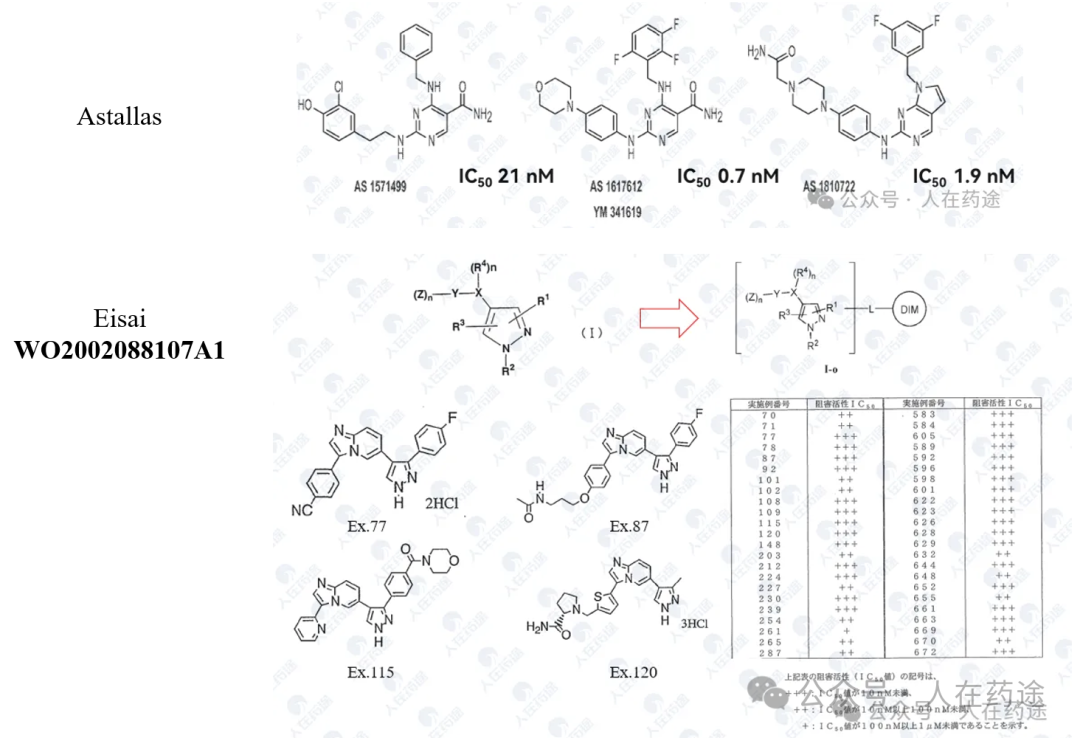
As for Kaken's STAT6 inhibitor, its compound design may have simultaneously referred to patents from Astallas and Eisai over 20 years ago.
From the perspective of the patent's Markush structure and examples, the patent generally maintains the indole-biphenyl (linked pyridine) structural backbone, with modifications primarily involving substituents. The overall SAR of all examples in the patent also clearly reflects the design strategy. The preferred compound structures and activity data in the patent are as follows:
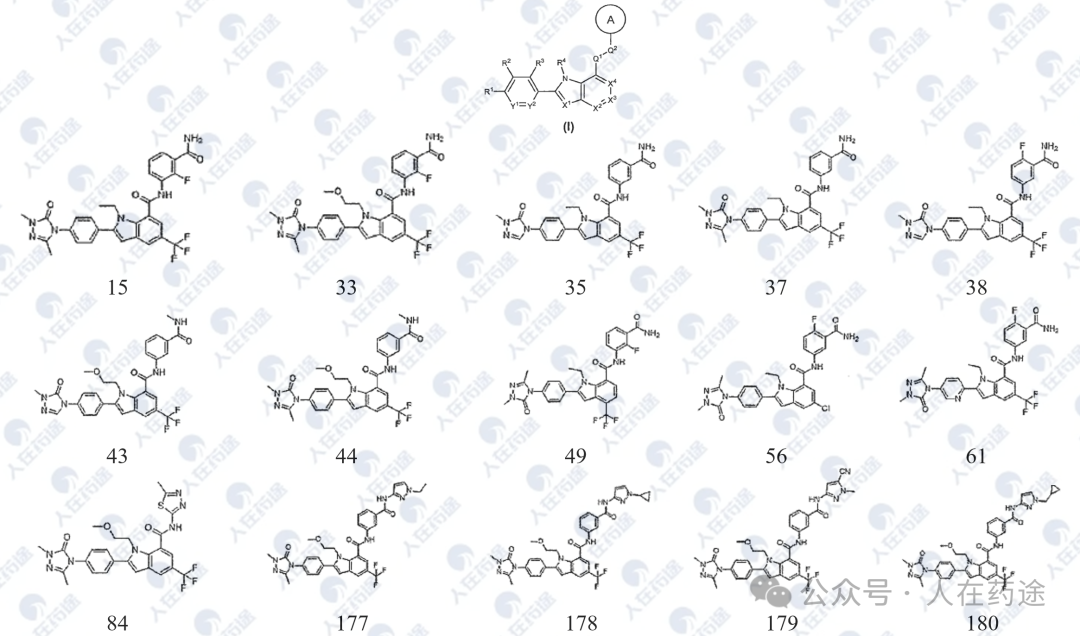
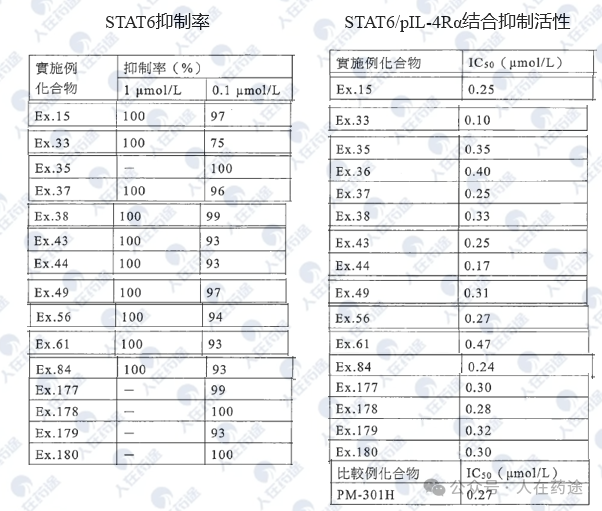
From the activity evaluation, it can be seen that the optimized compound exhibits excellent STAT6 inhibitory activity (presumably at the subnanomolar level), and its inhibitory activity on STAT6/pIL-4Rα is comparable to the positive control PM-301H. However, these evaluations are all at the protein level, lacking IL-4 inhibitory activity at the cellular level.
It is worth noting that both Astallas and Eisai's STAT6 inhibitors have achieved nanomolar levels of STAT6 inhibitory activity. Numerous studies have also reported the excellent in vivo and in vitro efficacy of Astallas' STAT6 inhibitor. However, neither class of compounds has shown clinical progress. It is speculated that there may be issues with drug-likeness or selectivity for STAT6.
At the same time, although Kaken claims that KP-723 is an oral STAT6 inhibitor, the company has not disclosed any drugability or in vivo efficacy data, and its selectivity is also unknown. This patent may be the potential core patent for KP-723, but it is also possible that new patents will be disclosed later.
Of course, assuming that this patent is its core patent, compounds such as Ex.15/33/44/56 are very likely to be its PCC. As mentioned above, there is too little disclosed data in the patent. As for the specific druggability or in vivo and in vitro efficacy of such compounds, interested readers can synthesize one to verify it, which should not be difficult.
Disclaimer: The publication/reposting of this article is solely for the purpose of information dissemination, and does not represent the views of this public account or confirm the authenticity of its content. Any judgment made based on this content will be at your own risk.If there is any infringement, please inform us and we will delete it immediately!
Long press to follow this official account