

Merck Bets $2 Billion on Oral Small-Molecule GLP-1 Agonist Amid Keytruda Patent Cliff
Hansoh Pharma
Pharmaceutical Research, Production, and Sales
With the global obesity and2The continuous increase in the incidence of metabolic diseases such as type diabetes, glucagon-like peptide-1(GLP-1) Receptor Agonist Drug Market Demand Continues to Grow. Among them, oralGLP-1Drugs have received widespread attention due to their convenience.ItsThe small molecule sector also shows fierce competition.
Recently, Merck & Co. and Hansoh Pharma jointly announced that they have signed a global exclusive licensing agreement for HS-10535, an oral small molecule GLP-1 receptor agonist currently in the preclinical research stage, to jointly explore this highly promising market.
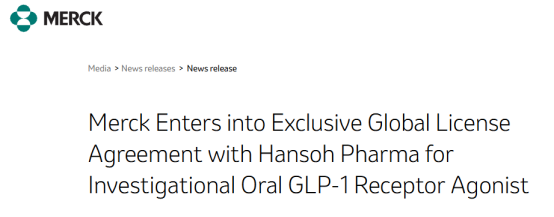
According to the agreement, Hansoh Pharma will grant Merck the global exclusive license for the development, production, and commercialization of HS-10535. This collaboration not only brings Hansoh Pharma an upfront payment of $112 million but also makes it eligible to receive milestone payments of up to $1.9 billion based on the development, regulatory approval, and commercialization progress of the candidate drug.
In addition, Hansoh Pharma will receive royalties based on product sales, further securing its long-term interests. Under specific conditions, Hansoh Pharma may even have the opportunity to co-promote or exclusively commercialize HS-10535 in China.
It is worth mentioning that the competition in the current GLP-1 drug market has become increasingly fierce. Multinational pharmaceutical giants such as Novo Nordisk and Eli Lilly have already taken the lead in capturing market share with their continuously upgraded new products. However, the total value of this collaboration between Hansoh Pharma and Merck exceeds $2 billion, which not only demonstrates the high confidence both parties have in the market prospects of HS-10535 but also adds fuel to the GLP-1 drug market.


HS-10535, an investigational oral small-molecule GLP-1 receptor agonist, functions by mimicking the action of the gut hormone GLP-1 to stimulate insulin secretion, thereby effectively controlling blood glucose. GLP-1 is a natural incretin hormone that plays a crucial role in regulating blood sugar and body weight. Compared with traditional injectable GLP-1 drugs, the oral administration of HS-10535 significantly improves patient compliance, which is of great significance for enhancing the quality of life of diabetes patients.
In preclinical studies, HS-10535 has demonstrated remarkable safety and efficacy. It not only significantly reduces postprandial blood glucose but also effectively promotes weight loss, making it particularly suitable for patients with type 2 diabetes accompanied by obesity. Additionally, HS-10535 exhibits fewer gastrointestinal adverse reactions, offering patients a more comfortable medication experience.
Currently, although HS-10535 is still in the preclinical development stage, its outstanding performance in animal experiments has already drawn widespread attention from the industry. This time, Merck's significant investment in collaboration with Hansoh Pharma to advance the subsequent development of this drug clearly demonstrates the importance they place on this potential medication.
In the industry's view, Merck's increased investment in the GLP-1 field is closely related to the performance pressure it currently faces. As Merck's core product, Keytruda (K drug) is approaching the "patent cliff"时间节点, and the pressure to maintain rapid growth is increasing. Therefore, Merck urgently needs to find new growth points to maintain its leading position in the pharmaceutical market.
In fact, Merck's layout in the GLP-1 field has a long history. As early as August 2020, Merck signed an exclusive licensing agreement with Hanmi, obtaining the exclusive rights for the development, manufacturing, and commercialization of efinopegdutide in the United States and globally. At that time, Merck was not only interested in the drug's indications for diabetes and weight loss but also saw its potential in non-alcoholic steatohepatitis (NASH). Instead of blindly following the trend to pursue treatments for type 2 diabetes and obesity, Merck adopted a different strategy, focusing on tackling the field of non-alcoholic fatty liver disease.
However, as multinational pharmaceutical giants like Novo Nordisk and Eli Lilly achieve great success in the GLP-1 drug market, Merck may realize the need for a more aggressive strategy to address the increasingly fierce market competition. The recent introduction of HS-10535 from Hansoh Pharma marks another significant move by Merck in the GLP-1 space. According to reports, Merck will leverage its research experience in incretin biology to comprehensively evaluate the potential of HS-10535, particularly its possibility of providing additional cardiometabolic benefits beyond weight loss.
Notably, there are currently no orally administered small-molecule GLP-1 receptor agonists approved for marketing globally, and Hansoh Pharma's HS-10535 is undoubtedly a strong contender. Although HS-10535 may still be several years away from commercialization, Merck clearly anticipates the convenience of its oral administration method and its potential benefits in weight loss and cardiometabolic health.
Currently, the development trend of GLP-1 drugs has already indicated that weight loss effects alone can no longer meet the demands of the market and patients. Novo Nordisk's semaglutide, with additional advantages such as cardiovascular benefits, has demonstrated strong market dominance. Merck is well aware of this, so when evaluating HS-10535, in addition to focusing on its weight loss effects, they are also paying close attention to its potential for providing extra cardiometabolic benefits. If HS-10535 can play a positive role in regulating blood sugar, reducing the risk of cardiovascular diseases, and improving liver metabolism, its competitiveness in the market will significantly increase.
For Hansoh Pharma, the collaboration with Merck not only brings substantial cash flow and R&D support but also further highlights its strength and forward-looking vision in the field of innovative drug development. Meanwhile, through this partnership, Merck has gained more "leverage" in the GLP-1 space and is seeking a new successor to the "throne" of Keytruda (K药). Facing the upcoming pressure of the patent cliff and market competition, Merck is actively planning to promote a diversified product pipeline and innovative drug R&D strategy.


In the current GLP-1 drug market, competition among pharmaceutical companies is becoming increasingly fierce. Multinational pharmaceutical giants such as Novo Nordisk and Eli Lilly have already captured the majority of the market share due to their first-mover advantage.
According to incomplete statistics, the sales of Novo Nordisk's semaglutide have soared year by year, surpassing $21.201 billion in 2023, making it the world’s first GLP-1 drug to enter the "tens of billions of dollars club." Its market position is approaching that of Merck's Keytruda, and it is expected to become the next "blockbuster drug king." Similarly, Eli Lilly's tirzepatide has shown impressive performance with strong market competitiveness. In the first three quarters of 2024, the cumulative sales of tirzepatide reached $11 billion.
In recent years, the market size of GLP-1 drugs in China has shown a rapid growth trend. According to incomplete statistics, in 2022, the market size of GLP-1 in China was approximately 5.79 billion yuan, and it is expected that by 2030, this market size will surge to 27.75 billion yuan. Faced with this highly potential market, numerous pharmaceutical companies in China have rushed in, hoping to gain a share. Although multinational pharmaceutical companies continue to launch new products and carry out iterative upgrades, bringing considerable competitive pressure to domestic pharmaceutical companies, many pharmaceutical enterprises still choose to focus on GLP-1 drug research and development, making the entire GLP-1 market present a prosperous scene of a hundred flowers blooming and a hundred schools contending.
According to incomplete statistics, more than 100 GLP-1 class new drugs in China have entered the clinical stage. Numerous pharmaceutical companies are making arrangements in different directions, different sites, different dosage forms, and different indications, leading to extremely fierce competition.
Among them, Huadong Medicine's Liraglutide and Renhui Biotechnology's Benaglutide have been approved for marketing. Mastytide, a GLP-1R/glucagon receptor (GCGR) dual agonist jointly advanced by Innovent Biologics and Eli Lilly, has achieved the primary endpoint and all key secondary endpoints in the Phase III clinical study (DREAMS-1) conducted among Chinese patients with type 2 diabetes, demonstrating comprehensive benefits in glycemic control, weight reduction, and cardio-renal metabolic indicators. Meanwhile, Hansoh Pharma's GLP-1/GIP dual agonist HS-20094 for overweight or obesity has also entered Phase II clinical trials.
In terms of the convenience of administration, oral is superior to subcutaneous injection, and subcutaneous injection is superior to intravenous injection. Nowadays, large-molecule antibody drugs are evolving from intravenous injection to subcutaneous injection, while GLP-1 peptide drugs are transitioning from subcutaneous injection to oral administration. This trend has gained significant attention.
Since 2023, the approval and commercialization progress of the oral version of semaglutide, Rybelsus, has been highly anticipated. However, among GLP-1 dual-target drugs, tirzepatide, as the earliest marketed peptide drug, currently has no plans for developing an oral version. Similarly, Eli Lilly has no intention of developing an oral version in its triple-target drug pipeline.
Currently, the only GLP-1 dual-target drug with an oral version is Viking's VK2735, whose oral formulation is still in Phase I clinical trials. In order to overcome the limitation that multi-target GLP-1 peptides cannot be made into oral formulations, major pharmaceutical companies have taken action: Novo Nordisk has developed a combination drug, Cagrisema, and is prioritizing the advancement of its oral version; Eli Lilly has chosen to develop the GLP-1R small molecule drug Orforglipron (LY3502970), which currently has several clinical studies in Phase III.
It is generally believed in the industry that there are currently four main directions for optimizing and improving GLP-1 drugs, including long-acting, small-molecule drugs, oral administration, and multi-target approaches. Oral and long-acting options correspond to convenience and compliance, multi-target approaches correspond to enhanced efficacy, and small molecules correspond to research and production costs. Different optimization directions, combined with the varying therapeutic focuses of different companies, can create numerous possibilities.
Therefore, from the perspective of R&D expansion, the era of GLP-1 as a major drug will see growth in multiple areas, rather than being dominated by just one or two companies. However, the risk lies here too: with many players entering the field, competition is becoming increasingly fierce. Notably, apart from the weight-loss giants Eli Lilly and Novo Nordisk, other pharmaceutical companies looking to enter the weight-loss market are prioritizing GLP-1 small-molecule drugs. The BD collaboration between Eternity Bio and AstraZeneca serves as a typical example.
In addition, Pfizer's experience in the GLP-1 oral small molecule agonist field is also noteworthy. In 2023, Pfizer successively terminated the clinical development of two GLP-1 oral small molecule agonists, Lotiglipron and Danuglipron. However, Pfizer did not give up but chose to improve the formulation of Danuglipron, changing it from twice daily to once daily.
In China, HRS-7535, a GLP-1R small molecule drug developed by Hansoh Pharma, is progressing rapidly. In September 2024, a Phase III clinical trial for type 2 diabetes was initiated, and its weight loss indication has entered Phase II in China.
As the GLP-1 drug market continues to expand, the next wave of competitive hotspots is gradually emerging. The main research and development directions in the GLP-1 field currently focus on long-acting formulations, multi-target drugs, and oral medications. Long-acting R&D aims to increase the drug's half-life, reduce dosing frequency, and improve patient compliance. Multi-target R&D is primarily concentrated on the three major targets of GLP-1, GIP, and GCG, with multi-target drugs based on the GLP-1 receptor already becoming a popular track in the fields of blood sugar reduction and weight loss.
At the same time, in the research and development of oral drugs, more oral GLP-1 drugs are under development besides the already approved semaglutide tablets. These drugs further improve patient compliance by enhancing the bioavailability of oral peptides or adopting oral small molecules. With their convenient administration method, oral GLP-1 drugs will become an important option for treating metabolic diseases. In addition, small molecule drugs, with advantages such as simple structure, ease of synthesis, and low cost, have broad application prospects in the treatment of metabolic diseases and have also become a hot area that major pharmaceutical companies are competing to explore.
With the continuous rise in the global incidence of metabolic diseases, the GLP-1 drug market will keep growing. The competition for oral GLP-1 drugs in the small molecule field will become even more intense. In the future, whoever achieves breakthroughs in long-acting formulations, multi-target drugs, and oral drug development will have the potential to take a leading position in the GLP-1 drug market.
Editor: Wanan


www.yyjjb.com.cn
Insight into Industry Trends
"Pharmaceutical Economy Herald"
Academic Official Account
Focus on the Frontiers of Oncology Academia

Terminal Official Account