Statement:Due to limited proficiency, errors are inevitable, and some information may not be the most up-to-date. Please feel free to leave comments to point them out.This article only provides an introduction to drugs related to healthcare, not a recommendation of treatment plans (if involved); this article does not constitute any investment advice.
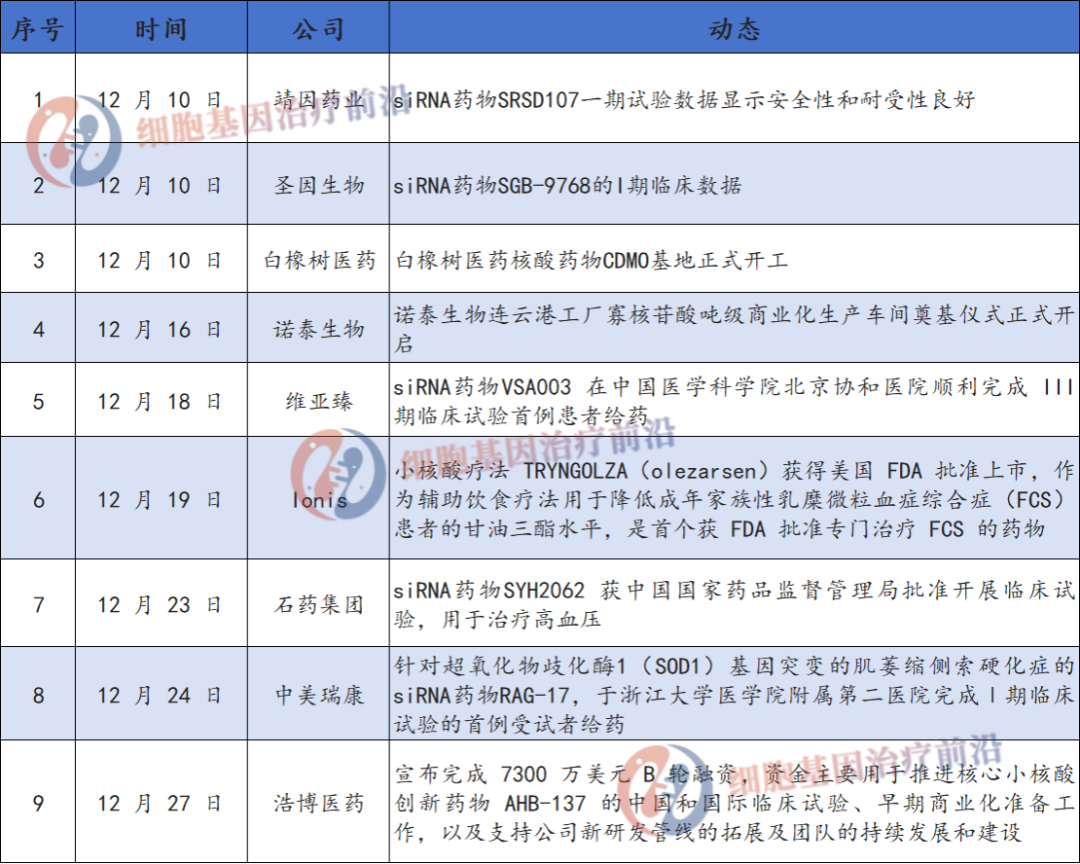
In the wave of innovation in the biopharmaceutical field, small nucleic acid drugs are gradually emerging as a promising star for tackling various difficult diseases.On December 19, Ionis's small nucleic acid therapy TRYNGOLZA (olezarsen) was approved by the U.S. FDA for marketing as an adjunctive dietary treatment to reduce triglyceride levels in adult patients with familial chylomicronemia syndrome (FCS).It is the first drug approved by the FDA specifically for the treatment of FCS, which can significantly reduce triglycerides and, when combined with an appropriately low-fat diet, markedly decrease acute pancreatitis events.Recently, many pharmaceutical companies have had significant developments in the research and development, clinical trials, and production construction of small nucleic acid drugs. Let's take a look.
Source: Cell Gene Therapy Manufacturing
On December 27, AusperBio announced the completion of a $73 million Series B financing round. The funds will primarily be used to advance the China and international clinical trials of its core small nucleic acid innovative drug, AHB-137, as well as preparations for early commercialization. Additionally, the funds will support the expansion of the company’s new R&D pipeline and the ongoing development and growth of the team.AusperBio is an innovative biopharmaceutical company with a global presence and in the clinical stage, committed to transforming hepatitis B curative therapies and leading advancements in oligonucleotide technology. Leveraging its proprietary Med-Oligo™ ASO platform and highly efficient targeted delivery technology, the company focuses on revolutionary ASO therapies for applications in viral infections, metabolic diseases, genetic disorders, and immune-related conditions.
On December 24, Ractigen Therapeutics announced that the first subject in the Phase I clinical trial of its innovative therapy RAG-17 for amyotrophic lateral sclerosis (ALS) caused by superoxide dismutase 1 (SOD1) gene mutations was dosed at the Second Affiliated Hospital of Zhejiang University School of Medicine, bringing new hope to solving the significant challenge of ALS.RAG-17 is an innovative double-stranded small interfering RNA (siRNA) drug independently developed by Ractigen Therapeutics for the treatment of amyotrophic lateral sclerosis (ALS) carrying SOD1 gene mutations. The drug, based on Ractigen’s proprietary SCAD™ (Smart Chemical-Assisted Delivery) platform, can efficiently inhibit the expression of the SOD1 gene, thereby reducing the production of toxic proteins and protecting neuronal function. In preclinical efficacy studies, RAG-17 significantly delayed disease onset, extended the survival of model animals, and markedly improved their motor function. Additionally, in an investigator-initiated trial (IIT), intrathecal administration of RAG-17 demonstrated good tolerability and safety at all dose levels, with comprehensive safety assessments further supporting its feasibility for clinical development. RAG-17 received orphan drug designation (ODD) from the U.S. FDA in 2023 and has successively obtained clinical trial approvals from the U.S. FDA and China’s CDE in 2024. Phase I clinical trials have now been initiated in China, bringing new hope for ALS patients.
On December 23, the ShiYi Group announced that SYH2062 Injection (a double-stranded small interfering RNA (siRNA) drug), a self-developed chemical Class 1 new drug by the group (hereinafter referred to as "the product"), has been approved by the National Medical Products Administration of the People's Republic of China to conduct clinical trials in China for the treatment of hypertension.This product is an siRNA drug delivered through conjugated N-acetylgalactosamine (GalNAc), capable of targeting and inhibiting angiotensinogen (AGT), and is applicable for the treatment of hypertension. By optimizing sequences and employing chemical modification strategies, the product achieves a more prolonged gene silencing effect, with the potential to become a stable blood pressure control drug administered once every six months. Preclinical studies show that the drug’s active duration is significantly longer than similar siRNA products, with anticipated advantages such as long-lasting effects, good safety, and high patient compliance, offering substantial clinical development value.
On December 18, ViyaGen announced that the first patient dosing in the Phase III clinical trial of its investigational Class 1 new drug VSA003 injection (hereinafter referred to as VSA003) was successfully completed at Peking Union Medical College Hospital, Chinese Academy of Medical Sciences.VSA003 is an innovative siRNA drug targeting ANGPTL3. This drug effectively reduces LDL-C levels in HoFH patients through dual lipid-lowering mechanisms, both LDLR-dependent and LDLR-independent. Given its novel mechanism and therapeutic potential, VSA003 was granted Breakthrough Therapy Designation by the CDE in January this year for the treatment of HoFH and is expected to become the world's first approved small nucleic acid drug targeting ANGPTL3.On January 29, 2024, VSA003 injection was included in the list of breakthrough therapy drugs by the Center for Drug Evaluation (CDE) of the National Medical Products Administration (NMPA). The drug is intended for the treatment of Homozygous Familial Hypercholesterolemia (HoFH).
On December 16, the groundbreaking ceremony for the ton-scale commercial production workshop of oligonucleotides at NovaTech Biologics' Lianyungang plant officially commenced.Peptide Biotech's oligonucleotide production workshop is built according to international first-class standards, incorporating production concepts such as automation, digitalization, and intelligence. The newly constructed workshop covers approximately 5,200 square meters and introduces the Cytiva synthesis and purification system. The project is scheduled for completion in October 2025, with an annual production capacity of 1,000 kilograms of oligonucleotides, 100 kilograms of PMO, and 200 kilograms of PEG-conjugated cyclic peptides.
White Oak Pharmaceuticals
On December 10, it was reported that a nucleic acid drug CDMO base in China (CDMO base of Dongguan Baimed Oak Pharmaceutical Co., Ltd.) officially commenced operations. As a wholly-owned subsidiary of HighTech Bio, Baimed Oak Pharmaceutical will expand HighTech Bio’s business in the CDMO sector, providing delivery solutions for the development of innovative nucleic acid drugs to meet the growing market demand.The base construction project is located in Building 1 of Songshan Lake Science Wisdom City, Dongguan City, Guangdong Province. The planned decorated floor area will reach 10,600 square meters, covering facilities such as LNP liposome preparation, sterile formulation production, R&D laboratories, quality control laboratories, warehousing, clean utility systems, and offices. It is scheduled to be fully operational by 2026.
On December 10, Jingyin Pharmaceuticals announced the latest data from the Phase I clinical trial of SRSD107 at the 66th American Society of Hematology (ASH) Annual Meeting.In the study, SRSD107 demonstrated good safety and tolerability, with significant changes in pharmacodynamic biomarkers observed from baseline.SRSD107 Injection is a double-stranded small interfering RNA (siRNA) drug independently developed by Jingyin Pharmaceuticals with proprietary intellectual property rights. By specifically targeting the liver-directed human coagulation factor XI (FXI) mRNA, it inhibits FXI protein expression and blocks the activation of the intrinsic coagulation pathway, thereby achieving an anticoagulant effect. Preclinical trial data shows that a single subcutaneous injection of SRSD107 can reduce peripheral blood FXI concentration by nearly 100%, with effects lasting up to half a year, without any observed bleeding.
On December 10, SinoBiologics announced for the first time the Phase I clinical data of the siRNA drug SGB-9768. The trial data showed that after a single subcutaneous injection, SGB-9768 demonstrated good safety and tolerability, while a dose-dependent, significant, and sustained reduction in C3 levels and complement pathway activity was observed. Compared with other siRNA products targeting the same site, SGB-9768 exhibited higher knockdown efficacy of the target protein C3 at a lower dose.This drug aims to treat various complement-mediated diseases by reducing complement factor C3, including IgA nephropathy, C3 glomerulopathy, immune complex-mediated membranoproliferative glomerulonephritis, dry age-related macular degeneration, paroxysmal nocturnal hemoglobinuria, and other renal and hematological disorders.
Summary
From the approval of new drugs for marketing to key breakthroughs in clinical trials, and then to the construction and preparation of production bases, these pharmaceutical companies' relentless efforts in the small nucleic acid drug field have laid a solid foundation for the industry's future development. With continuous technological advancements and ongoing in-depth research and development, small nucleic acid drugs will play an increasingly important role in the pharmaceutical field, opening a new chapter in human health. These pharmaceutical companies will continue to write their own brilliance in this innovative journey, leading small nucleic acid drugs to new heights.
Reference: Company Announcement