Top 10 Global MedTech Trends of 2024: Innovations in PFA, Surgical Robotics, Nitinol, CGM, and AI

Boston Scientific
Medical Device Manufacturer

Johnson & Johnson
Healthcare Product Manufacturers, Health Service Providers

Intuitive
Surgical Robot Developer

Medtronic
Chronic Disease Medical Device and Therapy Developer

Abbott
Diagnostic and pharmaceutical product manufacturers

Dexcom
Blood Glucose Monitoring System Developer


Source: Siyu Medtech
In 2024, the rapid development of medical technology brought significant changes to the industry, especially in the treatment of atrial fibrillation, surgical robots, nitinol applications, and diabetes treatment technologies. Numerous innovative achievements have continuously emerged, becoming the focus of the industry.
Cardiac ablation for the treatment of atrial fibrillation became a hot topic this year, with Medtronic and Boston Scientific successively gaining approvals for their cardiac pulsed field ablation (PFA) technologies. This has driven the widespread application of the technology and made the field a fiercely competitive area within the medical device industry.
Meanwhile, surgical robot technology showed strong growth momentum in 2024, especially in the application scenarios of minimally invasive surgery and precision medicine, with its development prospects highly regarded.
The application of nickel-titanium alloy continues to expand, playing an increasingly important role particularly in medical devices for cardiovascular and structural heart disease.
In addition, the medical device industry witnessed frequent M&A activities in 2024, with several significant cases indicating that medical technology companies will seek more strategic integration opportunities in the future to further optimize operational efficiency and strengthen market competitiveness.
Pulse Field Ablation (PFA) technology made significant progress in 2024, with multiple companies' related products receiving FDA approval, driving the development and application of this technology.
On December 14, 2023, Medtronic announced that its PulseSelect™ Pulsed Field Ablation (PFA) System received FDA approval for market release, becoming the first FDA-approved PFA product.
In November 2024, the Affera mapping and ablation system under Medtronic received FDA approval for market release in the United States, including the Sphere-9™ catheter and Affera™ Prism-1 mapping software.
At the beginning of 2024, Boston Scientific Corporation announced that its FARAPULSE™ Pulsed Field Ablation System (PFA) received approval from the U.S. FDA.
In October 2024, Boston Scientific Corporation announced that its FARAWAVE NAV cardiac pulsed field ablation (PFA) catheter with magnetic mapping functionality received approval from the U.S. FDA, and the new FARAVIEW software module also obtained FDA 510(k) clearance.
In November 2024, Johnson & Johnson Medical announced that its Varipulse Pulse Field Ablation (PFA) platform had successfully received FDA approval.
Recently, Citibank has conducted the latest forecast analysis on the 2025 PFA market landscape. As Medtronic, Boston Scientific, and Johnson & Johnson compete in one of the fastest-growing segments of the medical technology field, pulsed field ablation (PFA) may soon dominate electrophysiological procedures used to treat atrial fibrillation (AFib) and drive changes in market share by 2025.
On March 14, 2024, Intuitive announced that its next-generation multi-port surgical robotic system, da Vinci 5, received FDA 510(k) clearance in the United States.
Da Vinci 5 introduced force feedback technology, allowing certain optional instruments to measure the minute forces applied to human tissues during surgery and enabling surgeons to feel the force, which can be said to offer something no other surgical technology can provide.
In preclinical studies, surgeons with varying levels of experience utilized force feedback technology, resulting in a reduction of force applied to tissue by up to 43%, which may imply less trauma to the tissue.
The ability to measure this force adds an important new data stream to surgical data science, which, with the support of artificial intelligence in the future, can lead to insights in data analysis.
In the future, surgical robot technology will continue to advance towards higher precision, greater flexibility, broader application fields, and more personalized options, with innovations such as force feedback technology being key factors in this progress.
Nitinol, as a unique shape memory alloy, exhibits vast application potential in the medical field due to its excellent superelasticity, shape memory properties, and biocompatibility, with a huge market demand.
Nickel-titanium alloy exhibits high electrical conductivity, making it highly useful as an electrode, capable of withstanding significant deformation without plastic deformation. Shape memory allows it to deform after heat treatment and regain its original shape when reheated above the transition temperature. Superelasticity enables it to endure considerable strain and stress while retaining its original form.
Medtronic's PulseSelect pulsed field ablation system and Affera PFA catheter both rely on nitinol as a key material, utilizing its superelasticity and shape memory properties to design catheters that can be minimally invasively delivered to the heart and then expand to a preset shape.
According to Research and Markets, the global Nitinol medical device market was estimated at $20.2 billion in 2023 and is projected to reach $32.1 billion by 2030, with a compound annual growth rate (CAGR) of 6.9% from 2023 to 2030.
Companies such as Abbott, Dexcom, Insulet, Medtronic, and Tandem Diabetes Care have introduced innovative technologies like continuous glucose monitors (CGMs) and insulin pumps for people with type 1 diabetes.
Currently, these companies are turning their attention to patients with type 2 diabetes, a key theme at the American Diabetes Association conference.
On August 7, 2024, Abbott and Medtronic announced a significant partnership in the field of diabetes technology.
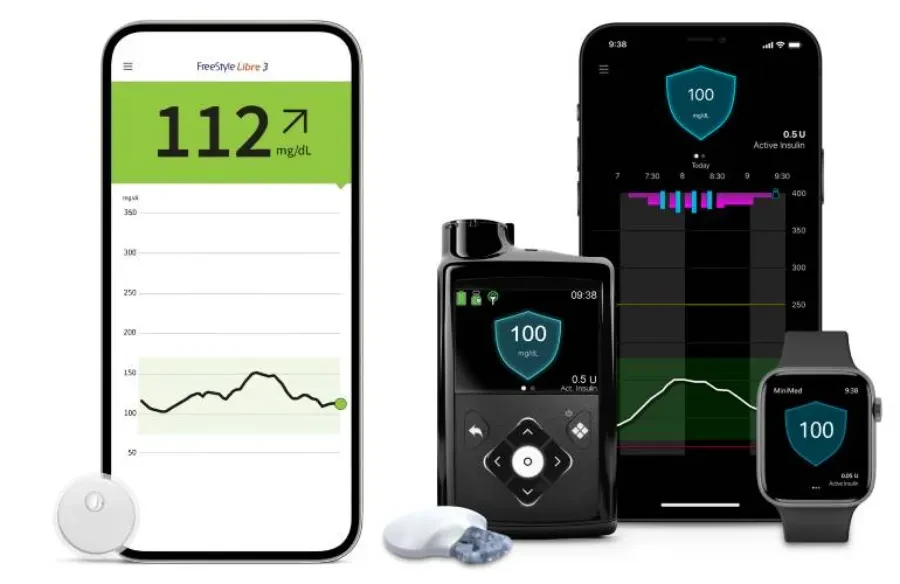
Left: Abbott FreeStyle Libre 3 CGM Right: Medtronic MiniMed 780G
The two companies will integrate Abbott's CGM (Continuous Glucose Monitoring) products with Medtronic's insulin delivery systems through this collaboration. According to the agreement, Abbott will be responsible for developing the sensors, while Medtronic will handle sales.
This collaboration aims to integrate Abbott's FreeStyle Libre CGM (FreeStyle Libre 3) product with Medtronic's automated insulin pump (MiniMed 780G) and smart insulin pen (InPen system) to jointly develop a comprehensive system. The combination of Abbott's CGM and Medtronic's automated insulin delivery algorithm will enable automatic adjustment of insulin, ensuring that blood glucose remains within the optimal range.
In May 2024, Medtronic announced a collaboration with Arecor (a biopharmaceutical company) to develop a new type of insulin, which can be used in conjunction with the new insulin pump that Medtronic is currently developing. The new insulin pump will be placed subcutaneously rather than on the skin surface.
This research collaboration aims to develop a new type of high-concentration, heat-stable insulin that can minimize the need for pump maintenance interventions. Currently in the early stages of development, clinical trials are still required.
Dexcom excels in real-time continuous glucose monitoring systems, with its latest product, the G7, offering more accurate glucose readings and improved alert settings.
Insulet is currently conducting a commercial pilot for its Omnipod GO tubeless pump, designed to replace daily long-acting insulin injections for people with type 2 diabetes. In April of last year, Insulet received FDA approval for the device.
The core of the diabetes management device market is shifting from electrochemical blood glucose test strips that require finger pricking to minimally invasive continuous glucose monitoring patches.
Digital healthcare also plays an important role in diabetes management. With the development of connected medical devices such as continuous glucose monitoring patches, insulin pumps, connected blood glucose meters, and smart insulin pens, a large amount of data can be analyzed and shared online.
Innovative trends in diabetes treatment technology, particularly in continuous glucose monitoring and insulin delivery systems, are expected to continue, moving towards more precise, personalized, and automated solutions to improve patients' blood glucose control and quality of life.
Neurological disorders are a major health issue faced globally and the second leading cause of death worldwide. Neurological disorders and neuropsychiatric disorders result in 9 million and 8 million deaths annually, respectively, together accounting for over 30% of total deaths.
The fields of neuromodulation and neurostimulation are rapidly evolving, with companies heavily investing in R&D to create innovative devices that enhance patient comfort, safety, and treatment outcomes. Brain-computer interfaces are also one of the most active research areas in the field of neural engineering today.
According to data from the international market research firm IMARC, the global brain-computer interface market size reached US$1.5 billion in 2021. The brain-computer interface sector is expected to achieve a compound annual growth rate (CAGR) of 14.2% between 2022 and 2027, with the market size reaching US$3.3 billion by 2027.
On September 19, 2024, Onward Medical, a medical technology company focused on developing innovative spinal cord stimulation therapies, announced the third successful implantation of its ARC-BCI brain-computer interface product, which aims to help individuals with spinal cord injuries and motor disabilities regain movement, functionality, and independence.
On December 20, 2024, the U.S. FDA approved Axoft for its first human brain implant trial.
Axoft is a new type of nanoscale soft electronic material for brain implants, with mechanical and physicochemical properties similar to brain tissue itself, achieving significant breakthroughs in softness, scalability, and reactivity.
This study is the first to introduce flexible materials into the brain-computer interface field. To achieve the softness of electronic devices, the research team continuously thinned the materials of the electronic devices until their thickness reached approximately 800 nanometers. The team used the most advanced photolithography technology to integrate millions of sensors onto the electronic devices.

Source: Axoft Official Website
Axoft uses an elastomer based on perfluoropolyether (PFPE) as the elastic, photopatternable dielectric material. This PFPE-based photolithographic dielectric material is 10,000 times softer than traditional hard plastic encapsulation while maintaining the same level of longitudinal dielectric performance, enabling 3D photolithography multilayer nanofabrication with micron resolution and compatibility with nanometer-thick metal deposition.
It is expected that neuroregulation technology and BCI technology will continue to develop towards being more precise, portable, reliable, and user-friendly, and will play a significant role in multiple fields, including the medical industry, in the future.
In the current climate of uncertainty regarding the economy, healthcare systems, and supply chains, some medical technology companies are undergoing strategic realignments and reorganizations, which include layoffs.
In April 2024, Medtronic cut 44 jobs in Carlsbad, California. In May, Medtronic laid off 35 employees in Israel, accounting for approximately 3% of the company's total workforce in Israel.
In the annual report submitted to the U.S. Securities and Exchange Commission, Medtronic estimated its global workforce to be over 95,000, compared to 101,867 in February 2022.
In addition to Medtronic, MassDevice has reported this year on layoffs at several other companies, including Johnson & Johnson, Edwards Lifesciences, and Philips. Moreover, the MedTech Dive website published a forecast article predicting that the trend of layoffs will continue into 2025.
In 2024, medtech companies are paying more attention to women's health initiatives, with Abbott and Medtronic making significant efforts in this area.
For example, Abbott is committed to enhancing the diversity of clinical trials through its "Diversity in Clinical Trials Initiative."
As early as May 2022, the National Academy of Sciences in the United States recommended increasing the representation of women and minority groups in clinical trials and research.
The medical device industry is closely monitoring policy moves by the Trump administration and preparing for potential regulatory changes, tariff threats, and the impact of FDA reforms.
Trump's Nominee for Healthcare Leadership Commits to Major FDA Reforms
In 2024, the development of AI in the medical technology field shows a trend of rapid growth and widespread application, with multiple companies actively making strategic moves, including Medtronic, Aier Eye Hospital, Siemens Healthineers, and GE Healthcare.
Taking Medtronic as an example, Medtronic's GI Genius™ computer-aided polyp detection system includes an AI software application that helps detect precancerous polyps and has the computing power to run multiple AI software applications.
The system is highly compatible and can be used simply by connecting to the existing endoscopes, video processors, and monitors in medical facilities. It integrates seamlessly with mainstream endoscope processors available on the market without altering the colonoscopy workflow.
In addition, Medtronic has also applied artificial intelligence to its Reveal Line implantable cardiac monitoring devices to help detect arrhythmias, reduce false alarms, and improve information accuracy.
Medtronic Launches AccuRhythm AI Update: Deep Learning Algorithms Applied to CareLink Network to Eliminate False Positives for Atrial Fibrillation and Pause Events
Medtronic expects that, with the addition of these algorithms, the cumulative false alert rate for atrial fibrillation and pauses will be reduced by 85%. Additionally, the company anticipates that the false alert rates for atrial fibrillation and pauses will reach 98.2% and 99.9%, respectively.
In the future, AI technology will be integrated with more medical technologies, such as deep learning and generative AI, driving the intelligent upgrade of the healthcare industry. Application scenarios will continue to expand, from medical imaging diagnosis, drug development to personalized medicine, all of which will see more AI applications.
According to analysts at Bank of America, significant acquisition deals occurred in the medical device industry in 2024, such as Johnson & Johnson's acquisition of Shockwave Medical, BD's acquisition of Edwards' critical care business, and Boston Scientific's acquisition of Axonics.
Analysts expect that with a more favorable regulatory environment, lower financing costs, and more standardized end markets, the growth rate of medtech M&A is expected to rebound in 2025.
This article is reprinted, all views belong to the original author.Tai (Siyu Medtech), Medical DevicesThe Medical Business Review remains neutral on all viewpoints in the article and only shares them for communication purposes.
*Advertisement

▼More Good Book Recommendations▼
In order not to miss any content, everyone remembers toMedical Device Business ReviewSet as starred? Oh,
Looking forward to meeting you at the earliest opportunity each time.