Pfizer's BRAF Inhibitor BRAFTOVI® Receives FDA Accelerated Approval for First-Line Treatment of BRAF V600E-Mutant Metastatic Colorectal Cancer

Pfizer
Pharmaceutical R&D Developer


Jiuzhou News
●BRAFTOVI in combination with cetuximab and mFOLFOX6 is an approved targeted treatment regimen for first-line treatment of patients with BRAF V600E-mutant metastatic colorectal cancer.
● The accelerated approval was based on an overall response rate (ORR) of 61%, compared to an ORR of 40% in the control group of the phase 3 trial codenamed BREAKWATER.
Jiuzhou News
Pfizer announced that the U.S. FDA has approved BRAFTOVI® (encorafenib) in combination with cetuximab (marketed as ERBITUX®) and mFOLFOX6 (fluorouracil, leucovorin, and oxaliplatin) for the treatment of patients with metastatic colorectal cancer (mCRC) harboring the BRAF V600E mutation, as detected by an FDA-approved test. The approval of this indication is based on statistically and clinically significant improvements in response rate and durability of response among treatment-naïve patients receiving BRAFTOVI in combination with cetuximab and mFOLFOX6 in the Phase 3 BREAKWATER trial. Continued approval for this indication is contingent upon verification of clinical benefit. This accelerated approval is one of the approvals under the FDA’s "FrontRunner Program," which aims to support the development and approval of novel anticancer drugs for advanced or metastatic diseases.
The ongoing BREAKWATER trial is evaluating the role of BRAFTOVI in combination with cetuximab, with or without chemotherapy (mFOLFOX6), in patients with previously untreated BRAF V600E-mutant mCRC. This is a Phase 3 trial of a BRAF-targeted treatment regimen for first-line BRAF V600E-mutant mCRC. The ORR for BRAFTOVI in combination with cetuximab and mFOLFOX6 was 61% (95% CI: 52, 70), compared to 40% (95% CI: 31, 49) for chemotherapy with or without bevacizumab, p=0.0008; the median duration of response (mDOR) for the BRAFTOVI regimen was 13.9 months (95% CI: 8.5, not estimable), versus 11.1 months (95% CI: 6.7, 12.7) in the chemotherapy group.
Chris Boshoff, MD, PhD, Chief Oncology Officer and Executive Vice President of Pfizer, Inc., stated: "For more than a decade, Pfizer has been a pioneer in delivering targeted therapies for molecularly driven cancers. With today's accelerated approval of the BRAFTOVI regimen, patients with mCRC harboring the BRAF V600E mutation now have a first-line treatment option. This milestone continues our tradition of developing innovative medicines for BRAF tumors, one of the most difficult-to-treat cancers. We look forward to continuing to expand our portfolio, including exploring next-generation brain-penetrant BRAF inhibitors."
In the BREAKWATER trial, the safety of BRAFTOVI in combination with cetuximab and mFOLFOX6 was consistent with the known safety profiles of the individual drugs. The most common adverse reactions (≥25%) were peripheral neuropathy, nausea, fatigue, rash, diarrhea, decreased appetite, vomiting, bleeding, abdominal pain, and fever. The discontinuation rate in the BRAFTOVI group was 12%.
About Colorectal Cancer (CRC)
CRC is the third most common type of cancer globally, with approximately 1.8 million new cases diagnosed in 2022. Overall, the lifetime risk of developing CRC is about 1 in 23 for men and 1 in 25 for women. In the United States alone, it is estimated that 152,810 people will be diagnosed with CRC in 2024, and around 53,000 people die from the disease each year. For 20% of CRC patients, the disease has already metastasized or spread.
It is estimated that 8% to 10% of mCRC patients will develop BRAF mutations, and these patients have a poorer prognosis. The BRAF V600E mutation is the most common type of BRAF mutation, and mCRC patients with the BRAF V600E mutation have more than twice the risk of death compared to patients without known mutations.
About BREAKWATER
BREAKWATER is a Phase 3 randomized, active-controlled, open-label, multicenter trial investigating BRAFTOVI with cetuximab alone or in combination with chemotherapy in previously untreated patients with BRAF V600E-mutant mCRC. Patients were randomly assigned to receive either BRAFTOVI 300 mg orally once daily in combination with cetuximab (discontinued after randomization of 158 patients), BRAFTOVI 300 mg orally once daily with cetuximab and mFOLFOX6 (n=236), or mFOLFOX6/FOLFOXIRI/CAPOX with or without bevacizumab (control group, n=243).
The dual primary endpoints were ORR and progression-free survival (PFS), assessed by blinded independent central review (BICR). Key secondary endpoints included BICR-assessed DoR, TOR, overall survival, and safety.
Summary
Apart from BRAF multi-target inhibitors, the U.S. FDA has approved three selective BRAF inhibitors to date: Roche's vemurafenib, which was approved in 2011, Novartis' dabrafenib, approved in 2013, and Pfizer's encorafenib, approved in 2018.
Vemurafenib, which was approved in 2011, reached its sales peak of 354 million Swiss francs in 2013. After that, it was impacted by the launch of dabrafenib, and the sales of vemurafenib have been declining. In Roche's 2017 annual report, it was no longer disclosed. Nowadays, only the sales of dabrafenib and encorafenib are in the growth stage.
However, there is a significant gap in sales between dabrafenib and encorafenib. The sales of dabrafenib in the first nine months of 2024 were $1.531 billion (disclosed in combination with Mekinist), while the sales of encorafenib in the same period were $474 million (disclosed in combination with Mektovi). The main reason for this difference lies in the fact that dabrafenib has been approved for more indications, earlier treatment lines, and a broader age range of the patient population.
For example, in melanoma, dabrafenib has been approved for adjuvant treatment of melanoma; in more tumor types, dabrafenib has been approved for ATC (anaplastic thyroid cancer), LGG (low-grade glioma), and pan-solid tumors; in terms of age groups, dabrafenib is approved for patients aged 1 year and above for pan-solid tumors and LGG.
In the same indications, dabrafenib and encorafenib show basically similar PFS and OS benefits in melanoma, while encorafenib demonstrates a relatively better DOR in previously treated NSCLC.
This time, encorafenib's approval for the first-line treatment of colorectal cancer (CRC) is bound to narrow the sales gap with dabrafenib. Otherwise, for a drug that entered the market five years later than its competitors, if it cannot leverage its differentiated advantages to achieve higher sales, then the market value of this drug would not be particularly significant.
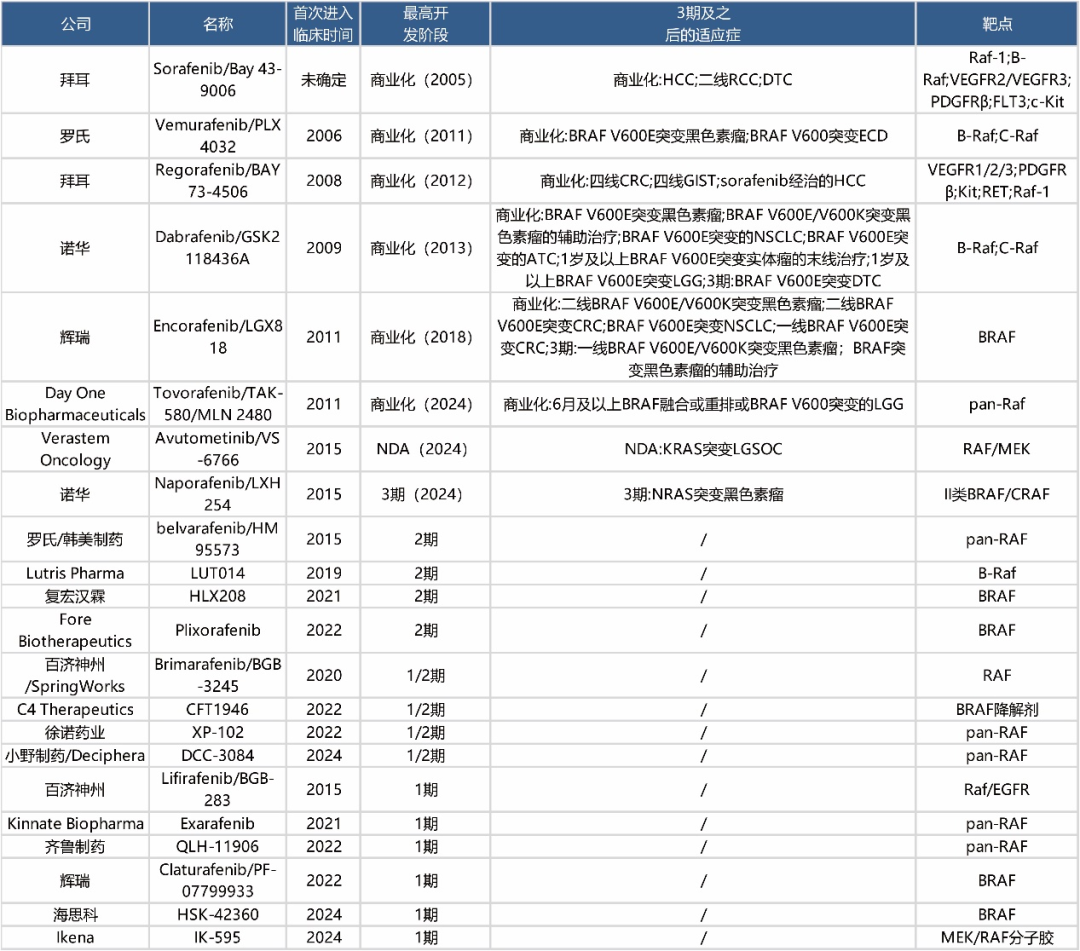
▲RAF inhibitors under clinical investigation
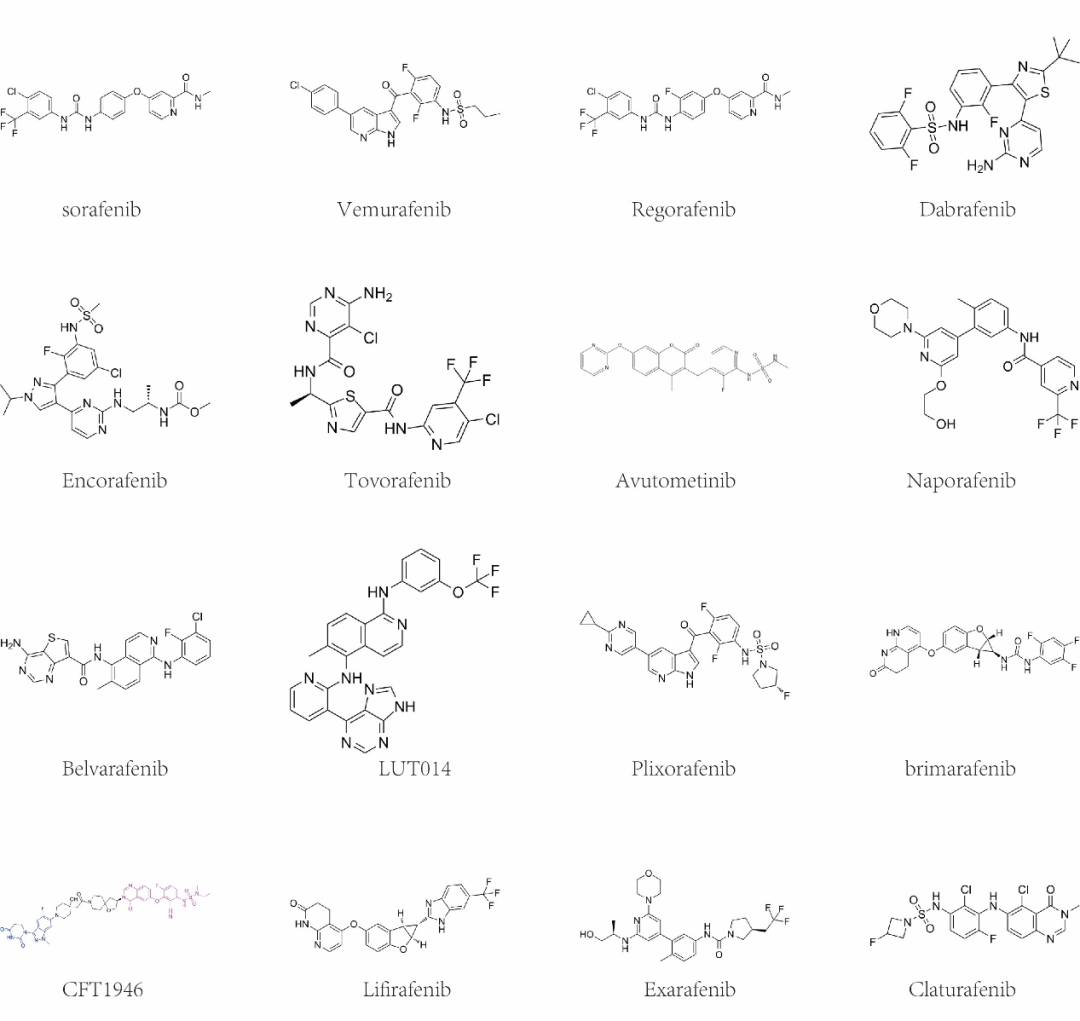
▲Disclosed Structural Formulas of Clinical RAF Inhibitors Under Research
References
1.https://investors.pfizer.com/Investors/News/news-details/2024/U.S.-FDA-Approves-Pfizers-BRAFTOVI-Combination-Regimen-as-First-Line-Treatment-of-BRAF-V600E-Mutant-Metastatic-Colorectal-Cancer/default.aspx
2. Roche Financial Report
3. FDA Labels for Dabrafenib and Encorafenib
Disclaimer
All original content rights in this official account are owned by Jiuzhou Pharmaceutical. Without authorization, it cannot be used or licensed to others for use. If you need to obtain authorization, please contact Jiuzhou Pharmaceutical in advance. Those who have obtained authorization should use it within the authorized scope, and must indicate the source. It cannot be sublicensed to others in whole or in part.
This official account remains neutral regarding the legality, accuracy, reliability, or completeness of the content reproduced, shared, stated, or opinions expressed. The original author owns the copyright of such content, which is for reference and study purposes only. If there are any rights-related questions about the reproduced or shared content, please contact Jiuzhou Pharmaceutical.