Eleven Targeted Protein Degradation (TPD) Companies Secured Funding in 2024: Pipeline and Financing Overview

HealZen Therapeutics
Innovative Small-Molecule Drug Developer

Johnson & Johnson
Medical Device R&D and Manufacturer

On January 10, HealZen Therapeutics and the Shanghai Institute of Materia Medica, Chinese Academy of Sciences, jointly announced a global licensing agreement with Johnson & Johnson to develop HZ-Q1070, a potentially best-in-class BTK degrader, for the treatment of various diseases. HZ-Q1070 capsules feature a novel structure, excellent degradation activity/selectivity, and good drug-like properties.BTK Protein Degrader, which is expected to solve the drug resistance problem of BTK inhibitors and become a new therapeutic drug for BCM.
In 2001, Dr. Craig first proposed the concept of Proteolysis Targeting Chimeric (PROTAC) molecules in a paper, aiming to use small molecules to link the protein of interest (POI) with E3 ligase. The linked POI would then be tagged with ubiquitin and subsequently degraded by the ubiquitin-proteasome system (UPS). As protein degradation technology advances in clinical applications, multiple molecular glue and PROTAC pipelines are increasingly demonstrating potential across various indications.
Compared with small molecule inhibitors, the advantages of targeted protein degradation (TPD) drugs include: 1) lower dosage of degraders; 2) degraders can remove all functions of the target protein, especially scaffold functions; 3) degraders have better selectivity; 4) degraders do not need to have high affinity for the target protein.
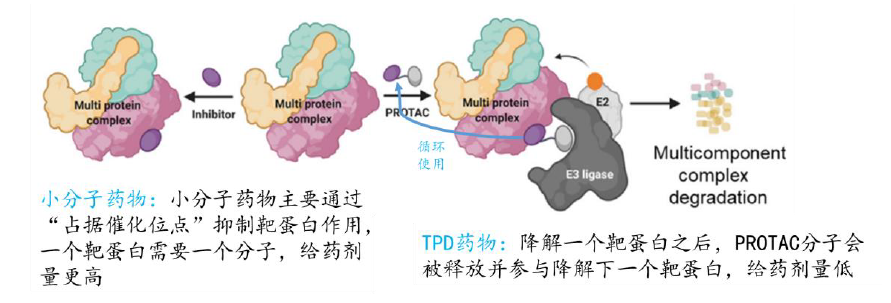
Among them, the most notable PROTAC is mainly divided into three parts: the POI ligand binds to the target protein, which is connected to the E3 ligase ligand through a linker. This induces the connection between the E3 ligase and the target protein, ubiquitinates the target protein, and subsequently degrades it. Due to the presence of a linker and two ligand molecules in the PROTAC molecule, its molecular weight is relatively large, often making it difficult to comply with Lipinski's Rule of Five. There is a high design barrier to improving bioavailability for oral administration. Molecular glue promotes the binding of E3 ligase and the target protein by altering their interface, leading to protein degradation. The molecular weight of molecular glue is smaller, with representative drugs such as thalidomide and lenalidomide. Additionally, lysosome-targeting chimeras (LYTAC), which have recently drawn significant investor attention, are also bifunctional molecules with two binding domains. One end carries an oligosaccharide peptide group that binds to the CI-M6PR transmembrane receptor on the cell surface, while the other end carries an antibody or small molecule that binds to the target protein, connected by a chemical linker.
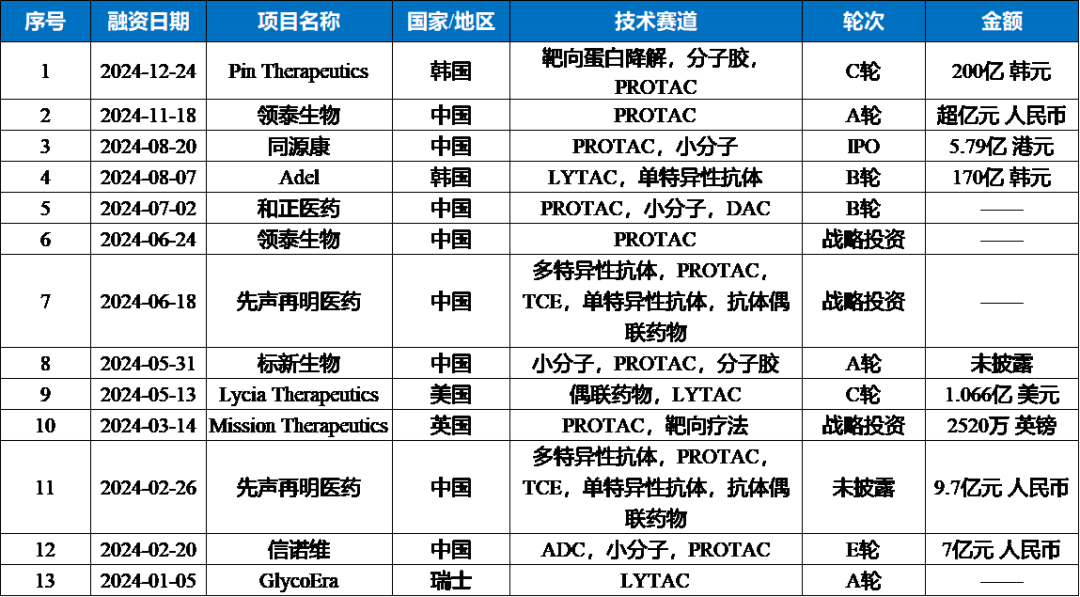
At the same time, multiple companies focusing on the development of targeted protein degradation drugs have also received financing; according to incomplete statistics, there were approximately 13 financing events for related companies in 2024, among which domestic companies such as LeadBio and Simcere Ming completed two rounds of financing each this year.
1. Official Websites of Various Companies
2. Asymchem News, PharmaCube
Disclaimer
1. All information provided by the "Drug Hunter Club" is for reference only and should not be used as a basis for any commercial transactions or medical services. If any deviation occurs from the independent use of the "Drug Hunter Club" content, our company shall bear no responsibility, including but not limited to legal liability or compensation.
2. "Drug Hunter Club" is committed to providing reasonable, accurate, and complete information, but does not guarantee the reasonableness, accuracy, or completeness of the information, and assumes no responsibility for any loss or damage caused by unreasonable, inaccurate, or omitted information.
3. Some articles in the "Drug Hunter Club" are reprinted from the Internet for the purpose of conveying more information, without implying endorsement or verification of their viewpoints or content authenticity. If you have any questions about the content, please contact our company in a timely manner.
4. For issues not covered in this statement, please refer to relevant national laws and regulations. In case of any conflict between this statement and national laws and regulations, the latter shall prevail.