Medtronic's Harmony Transcatheter Pulmonary Valve Receives CE Mark as World’s First Self-Expanding TPV

Medtronic
Chronic Disease Medical Device and Therapy Developer


Pioneer in Medical Device Media Reports
Share Professional Medical Device Knowledge
Recently, Medtronic (NYSE: MDT)Announces CE Mark Approval for Its Harmony Transcatheter Pulmonary Valve (TPV) System.

According to Children's HeartLink, a non-profit organization based in Minneapolis, approximately 1.3 million children worldwide are born with congenital heart disease each year. The Harmony system provides a minimally invasive alternative to open-heart surgery for patients with congenital heart disease who have primary or surgically repaired right ventricular outflow tracts (RVOT).
The Harmony system received its first FDA approval in March 2021. The Medtronic Harmony Transcatheter Pulmonary Valve (TPV) System is the world's first self-expanding pulmonary valve and was designated as a "Breakthrough Device" by the FDA.Its biggest feature is "minimally invasive," providing patients with congenital heart disease a method during surgery that causes minimal trauma and can replace traditional open-heart surgery.

Although TPVR was the first to be introduced, its development has lagged relatively behind TAVR due to factors such as patient population size, indications, durability, and promotional value. In the field of TPVR, there are "two mainstream valves": balloon-expandable transcatheter pulmonary valves and self-expanding transcatheter pulmonary valves. Currently, the main TPVR products available globally are balloon-expandable valves, such as Medtronic's Melody and Edwards' Sapien. The total number of global implants has reached tens of thousands (with the majority using the Melody valve).
Due to the smaller size of the balloon-expandable valve, it is not suitable for the anatomical characteristics of RVOT aneurysmal dilation caused by long-term PR, which also limits the usage of TPVR.
With the FDA approval of Medtronic's self-expanding Harmony valve, it is expected to address the issue of smaller-sized balloon-expandable valves.

However, the product has not had a smooth journey since its approval and market launch.
FDA Designates Class I Recall for Medtronic System in April 2022 After Reports of Adhesive Failure at Delivery Catheter Tip Fixing Capsule During TPV Placement.
Medtronic Reintroduced Harmony in the U.S. in February 2023, Quickly Reporting Two-Year Positive Outcomes for the System; Harmony Transcatheter Pulmonary Valve (TPV) Makes a Comeback, with Engineers Having Resolved the Recall Issues, According to Medtronic. To Date, 2,200 Patients Have Received the Harmony Valve, and EU New Regulatory Approval Is Expected to Broaden Its Application.
Medtronic Senior Vice President and President of Structural Heart and Aortic Business, Nina Goodheart, stated in the latest press release: "The expansion of the Harmony TPV System provides an important new solution, ensuring more patients can access cutting-edge transcatheter technology and potentially reducing the need for multiple surgeries." "This significant milestone underscores our unwavering commitment to providing safe and effective minimally invasive treatment options for patients and physicians worldwide."
According to Medtronic, 80% of patients with congenital heart disease require either natural or surgical repair of the RVOT at birth, and many of these individuals will need pulmonary valve replacement later in life. Valve replacement often means undergoing open-heart surgery again.
"Peter Ewert, MD, Professor and Head of the Department of Congenital Heart Defects and Pediatric Cardiology at the German Heart Center in Munich, Germany, stated: 'The CE Mark approval of the Harmony TPV system provides physicians with a minimally invasive solution option to treat this vulnerable patient population and optimize their treatment outcomes.'"
"Clinicians across Europe need solutions to fill this gap, and this milestone will be a potential turning point for patients who wish to avoid multiple surgeries and minimize medical disruptions in their daily lives."
In the global transcatheter interventional valve field, Medtronic, Edwards Lifesciences, and Boston Scientific are currently the "three driving forces."Among them, Edwards is the pioneer in the industry, having launched the first porcine bioprosthetic heart valve as early as 1975, while Medtronic entered the market through acquisitions.
In 2009, Medtronic acquired CoreValve for $850 million, marking the beginning of its TAVR (Transcatheter Aortic Valve Replacement) business. At the time of the acquisition, CoreValve had already gained certain market applications and recognition since its system received CE approval in Europe in 2007.
Later, Medtronic acquired Ventor, an Israeli company, for $325 million, adding minimally invasive transapical technology and next-generation percutaneous transfemoral technology to its transcatheter valve portfolio, providing clinical benefits for subgroups of patients with severe or high-risk aortic stenosis.
After the acquisition, Medtronic demonstrated the non-inferiority or superiority clinical outcomes of its Evolut series products compared to surgical aortic valve replacement (SAVR) through the CoreValve, Notion, Surtavi, and Evolut Low Risk series of clinical trials.
Medtronic spent 10 years conducting continuous research and trials until it expanded the TAVR indication to include low-risk surgical patients in 2019, aligning with industry leaders.
Until 2021, with the FDA approval of Medtronic's self-expanding valve Harmony, there was hope to address the issue of smaller-sized balloon-expandable valves. Therefore, whether in the balloon-expandable valve field or the self-expanding valve field, Medtronic has outperformed Edwards, leading globally in the transcatheter interventional valve sector.
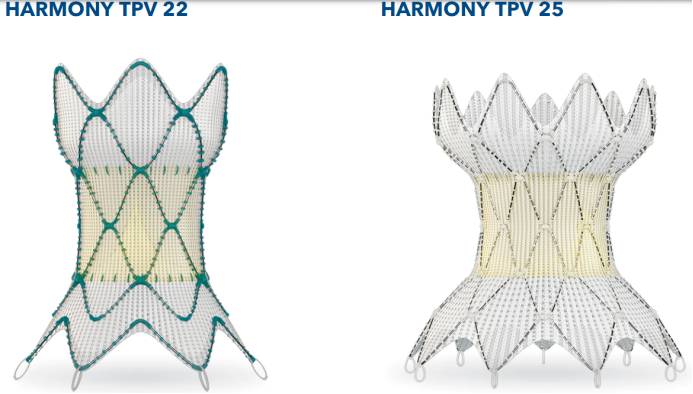
Compared with the overseas TAVR market, the interventional treatment of valvular diseases in China started relatively late. However, supported by a vast market, its development speed has been rapidly advancing. Apart from Medtronic's Harmony, VenusP-Valve by Qiming Medical is also a specially designed transcatheter pulmonary valve replacement system. It is the transcatheter pulmonary valve replacement system with the broadest patient coverage in the world, having been granted 7 domestic patents and 1 international patent.
According to statistics, the global TPVR market size was $44.7 million in 2023. The compound annual growth rate from 2023 to 2033 will exceed 9%. It is also predicted that the compound annual growth rate from 2023 to 2028 will reach 21.9%.
Currently, the TPVR market is mainly dominated by a few giants such as Medtronic and Edwards Lifesciences. Due to high technical barriers, great R&D difficulties, and a limited patient population, new entrants face significant hurdles. Apart from the existing giants, some small innovative companies are also actively developing TPVR-related technologies and products, which may lead to changes in the future competitive landscape of the market.
More exciting content
Welcome to follow WeChat Video Channel


Following Johnson & Johnson, Boston Scientific Enters This Field
Imaging Giant Announces Major Move
Aohua Endoscopy Announces: Share Repurchase Plan
The Largest Birth in the United States: Philips Sells This Imaging Business
Chinese Optoelectronics Leader Withdraws IPO Plan
Orthopedic Giant Announces: Nearly $36 Billion Acquisition
$2.5 Billion: Hologic Completes "First and Only" Acquisition
Major Progress in China’s First Precision Cancer Cell “Buster” (BNCT)
2024 Accelerator Big Data: United Imaging China-produced First
How Will GE Healthcare Spend $1 Billion?

BusinessBusiness cooperation email: qxzj@landianyiliao.com