Johnson & Johnson Fires the First $10B+ Shot of 2025 with Intra-Cellular Therapies Acquisition

Johnson & Johnson
Medical Device R&D and Manufacturer

Amino Observation - Original Production by the Innovative Drug Team
Author | Wu Yue
On the first day of the JPM conference, Johnson & Johnson stole the spotlight.
Johnson & Johnson Announces $14.6 Billion Acquisition of Intra-Cellular, Focused on CNS, to Obtain Its Key Antipsychotic Drug Caplyta.
If successful, this will surpass Karuna and Cerevel to become the largest M&A deal in the CNS field since 2023, reigniting momentum in a field that has faced numerous setbacks.
For Johnson & Johnson, acquiring a blockbuster with a peak of $5 billion not only strengthens its CNS portfolio but also provides more composure in the face of the upcoming patent cliff. For Intra-Cellular, it will also secure a stable position.
Since 2024, there has only been one acquisition exceeding $10 billion in the entire industry, with Novo Nordisk acquiring CDMO company Catalent. Focusing on the biopharmaceutical sector, Johnson & Johnson's acquisition of Intra-Cellular stands as the only deal surpassing $10 billion.
Of course, Johnson & Johnson CEO Joaquin Duato said: "Large deals are more of an exception, and most of the value we create comes from small deals and collaborations where we can leverage the advantages of our scale."
Whether or not there will be other major M&A deals surfacing during the JPM conference, 2025 has just begun, and big pharmaceutical companies with substantial capital cannot afford to miss opportunities for growth.
This will also lead to a new round of reshuffling.
/ 01 /
$5 Billion Blockbuster
What’s the Background of Intra-Cellular, Which Johnson & Johnson Acquired for $14.6 Billion?
As an innovative pharmaceutical company focused on CNS drug development, Intra-Cellular's core asset currently is Caplyta, an oral antipsychotic taken once daily.
This is a 5-hydroxytryptamine 2A (5-HT2A) receptor antagonist and dopamine receptor D2 modulator, originally developed by Bristol-Myers Squibb. In 2015, Intra-Cellular obtained the license for global development.
From a mechanistic perspective, lumateperone can partially agonize dopamine D1 and D2 receptors, antagonize 5-HT2A receptors, inhibit DA and 5-HT transporters, and promote the activation of the NR2B subunit of NMDA receptors. Therefore, Caplyta has demonstrated therapeutic potential in various CNS disorders.
In December 2019, Caplyta was approved by the FDA for the treatment of adults with schizophrenia, and in December 2021, it was also approved as an adjunctive treatment for depressive episodes associated with bipolar I or II disorder (bipolar depression).
With the support of these two major indications, Caplyta has already demonstrated significant commercial potential. In 2023, its sales reached $462 million, representing an 86% year-over-year increase; in 2024, growth continued, with sales in the first three quarters reaching $482 million, and full-year sales projected to reach up to $685 million.
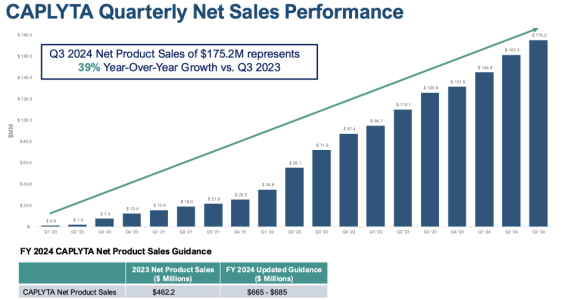
As expected, Caplyta will continue its rapid growth. At the end of last year, Intra-Cellular submitted a new drug application to the FDA for Caplyta's third indication, as an adjunctive treatment for major depressive disorder (MDD).
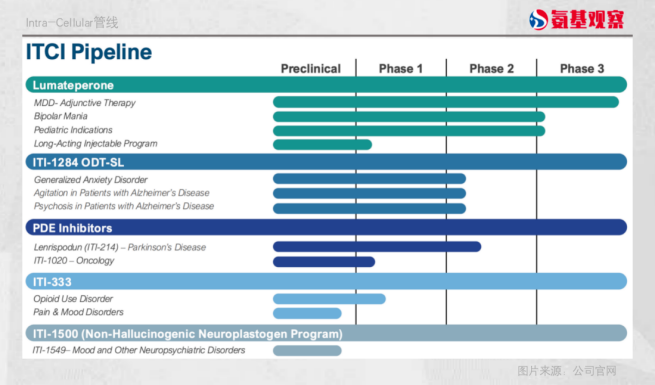
In two global, double-blind, placebo-controlled Phase 3 studies, Caplyta, as an adjunctive treatment to antidepressants, demonstrated statistically significant and clinically meaningful improvements in reducing depressive symptoms. In addition, Intra-Cellular is also exploring its pediatric indications and long-acting formulations.
To put it into perspective, the potential number of patients with MDD far exceeds those with schizophrenia and bipolar disorder. According to data disclosed by Johnson & Johnson, more than 1 billion people worldwide—one in every eight individuals—are affected by neuropsychiatric or neurodegenerative diseases. In the United States, approximately 2.4 million adults have schizophrenia, 6.1 million adults suffer from bipolar disorder, and 21 million adults are affected by MDD.
According to Johnson & Johnson, if approved, Caplyta could become the first drug in 15 years to be approved for treating MDD and depressive symptoms in bipolar I and II disorders.
Because of this, in Johnson & Johnson's eyes, the peak sales of Caplyta will reach 5 billion US dollars.
/ 02 /
A Win-Win Situation
Since Caplyta was approved in 2019, Intra-Cellular's stock price has continued to rise, with an increase of over 30% in the past year, and its market value has approached $10 billion.
After the news of Johnson & Johnson's premium acquisition spread, its stock price surged by 34%, bringing its market value to $13.4 billion.
In the eyes of some market participants, Caplyta is making continuous progress, and other pipeline products are accelerating. There is no need for Intra-Cellular to sell itself.
The reality is, according to Amino's previous review of top overseas biotech companies, it takes at least five years and 1 billion US dollars to reach the revenue breakeven point. How to increase sales and reduce the expense ratio while maintaining R&D competitiveness always challenges all biotech companies entering the commercialization stage.
For Intra-Cellular, Caplyta has been on the market for five years with sales exceeding $500 million, but it is still in the growth phase. High sales expenses persist, R&D investment cannot be stopped, and generic drugs are also a looming threat. The new chemical entity exclusivity for Caplyta expired last December. Although patents listed in the Orange Book may extend its protection against generics until 2040, several generic drug companies have already submitted abbreviated new drug applications.
Just last week, Intra-Cellular settled its patent dispute with Sandoz, which agreed not to launch a generic version of Caplyta until 2040. Following the announcement, its shares surged over 14%.
According to foreign media reports, Intra-Cellular has previously filed lawsuits against seven generic drug applicants, and apart from Sandoz, several other cases are still awaiting judgment.
In this case, throwing oneself into the arms of Johnson & Johnson is also a good choice.
As the CEO of Intra-Cellular stated in an internal letter, this is a rare opportunity, and the company will also reach another milestone. In his view, Johnson & Johnson will raise the sales expectations for Caplyta. The support will help the company seek approval for MDD, expand the sales team; at the same time, leveraging Johnson & Johnson's experience in launching therapies globally in the field of neuroscience will accelerate Caplyta’s market uptake and advance the development of other pipelines.
For Johnson & Johnson, the hefty acquisition of Intra-Cellular brings the most immediate benefit of securing a blockbuster drug worth $5 billion.
In addition to this drug, Johnson & Johnson will also acquire several R&D pipelines, including ITI-1284, lenrispodun, ITI-1020, ITI-333, and ITI-1549, further strengthening its pipeline layout in the neuroscience field.
Currently, the pillars of Johnson & Johnson's neuroscience business are the antipsychotic drug Invega and the antidepressant nasal spray Spravato. In May 2024, Johnson & Johnson announced that its investigational new drug for MDD, seltorexant, succeeded in the Phase III MDD3001 study, showing significant and meaningful improvements in patients' depressive symptoms and sleep.
Johnson & Johnson's neuroscience business is not without its challenges. In October, Johnson & Johnson terminated three clinical research programs in the neuroscience field: a Phase II clinical trial of seltorexant for Alzheimer's disease, a Phase I clinical trial of JNJ-0376 for Parkinson's disease, and a Phase II clinical trial of a P2X7 antagonist for bipolar disorder.
Obviously, despite Johnson & Johnson's many years of presence in the field, it still cannot change the R&D difficulties in CNS.
As several blockbuster drugs are approaching patent expiration—STELARA (patent expiring in 2023), SIMPONI (patent expiring in 2024), and DARZALEX (patent expiring in 2029)—all of which rank among the top ten best-selling drugs of Johnson & Johnson, the company has been compelled to accelerate its strategic adjustments.
Over the past year, after completely divesting its consumer business, Johnson & Johnson has undertaken a series of actions, including corporate brand renewal and major acquisitions. A "new Johnson & Johnson" is now fully focused on the two fields of innovative pharmaceuticals and medical technology.
Specifically in the field of innovative drugs, Johnson & Johnson is fully focused on the three major areas of oncology, immunology, and neuroscience. Previously, the company disclosed a new five-year plan, which aims to launch more than 20 new drugs and over 50 products by 2030.
Among them, 10 or more drugs have a peak sales potential of at least $5 billion each, including Teclistamab Injection and JNJ-2113; 15 products with sales potential ranging from $1 billion to $5 billion include Spravato, seltorexant, aticaprant, and JNJ-4804.
With the acquisition of Intra-Cellular, Johnson & Johnson is set to gain another blockbuster product worth $5 billion, providing new momentum to address the patent cliff crisis.
/ 03 /
Mergers and Restructuring
The CNS market boasts a massive scale, attracting an increasing number of major pharmaceutical companies to invest more. Prior to Johnson & Johnson, Biogen chose to acquire Sage, a pioneer in the CNS field.
Due to consecutive clinical trial failures, Sage's stock price plummeted nearly 75% in 2024. As of the close on January 10, 2024, Sage's stock was trading at $5.5 per share, with a market value of only $340 million.
Biogen offered a non-binding bid of $7.22 to acquire Sage, with a total valuation of $442 million. The two parties had previously reached a collaboration to jointly develop and commercialize two CNS products: Zurzuvae for the treatment of PPD/MDD, and SAGE-324 for the treatment of essential tremor.
According to the agreement, Biogen needs to pay an upfront fee of $875 million, subsequent milestone payments of up to $1.6 billion, and a 40% premium equity investment (at $104.14 per share). It can be said that the upfront payment for this transaction alone is twice the amount of this acquisition.
Last October, Lundbeck acquired Longboard Pharmaceuticals for $2.6 billion, obtaining a highly selective 5-HT2C superagonist for the treatment of drug-resistant epilepsy (DEE).
AbbVie Bets Again on Alzheimer's, Acquires Aliada for $1.4 Billion; the latter’s core asset is ALIA-1758, an anti-amyloid antibody currently in Phase I clinical trials.
Of course, it's not just the CNS field; the entire biopharmaceutical sector will see a rise in mergers and acquisitions.
Despite a significant decrease in the number of large deals in 2024 and a decline in M&A value compared to 2023, the interest of big pharmaceutical companies in small-scale acquisitions remains high, as seen at this year’s JPM conference. They also show a strong desire for assets in early or mid-stage development.
After acquiring Sage at a low price, Biogen clearly stated that it will continue to expand its capabilities through mergers and acquisitions in 2025.
Roche Showcases Its Strong "M&A Firepower" at the Conference, with Approximately $10 Billion Available Annually. Meanwhile, its CEO emphasized that the company does not intend to spend blindly but prefers target assets that can either complement its existing product portfolio or bring disruptive breakthroughs in key disease areas.
Gilead CEO States Existing Products Can Generate Billions in Annual Revenue, Enabling "Appropriate M&A and Partnerships" to Bolster the Pipeline. During the JPM2025 Conference, Gilead Also Secured a Deal, Acquiring Leo Pharma's STAT6 Inhibitor for a Total of $1.7 Billion.
Lilly announced on the first day of the conference that it had secured Scorpion Therapeutics' PI3Kα inhibitor project with a $1 billion upfront payment and committed to adding $1.5 billion upon achieving subsequent regulatory and sales milestones; GSK announced the acquisition of IDRx for $1.15 billion, gaining a rare disease drug.
These deals during the JPM conference have brought more hope for biopharmaceutical M&A in 2025.
In fact, both Goldman Sachs and Atlas, a U.S.-based pharmaceutical venture capital firm, believe that the M&A market holds promise for the future, as these large pharmaceutical companies are well-equipped with resources.
According to Goldman Sachs estimates, these companies have a potential financing capacity of approximately $500 billion at a debt leverage of 2.5 times EBITDA. If the leverage level increases to 4 times EBITDA, their financing capacity could approach nearly $900 billion. Currently, the total market value of XBI is approximately $400 billion.
In other words, even without increasing leverage, large pharmaceutical companies have the ability to buy up all biotech firms.
Under the dual pressures of the patent cliff and the rise of new technologies, acquiring companies or introducing assets has long become the main path for giants to maintain long-term growth and competitiveness.
From the information conveyed on the first day of the JPM conference, it may only be a matter of time before more M&A deals exceeding $1 billion or even larger emerge in the biopharmaceutical field.
And this will also lead to a new round of industry reshuffle.
PS: Welcome to scan the QR code below to add Amino's WeChat ID for communication.