Daiichi Sankyo Submits NDA in China for Oral Anticancer Drug Pexidartinib Capsules for TGCT

Daiichi-Sankyo
Pharmaceutical R&D Developer
▎WuXi AppTec Content Team Report
On January 15, the latest announcement was made on the official website of the Center for Drug Evaluation (CDE) of the China National Medical Products Administration.Category 5.1 New Drug Submitted by Daiichi SankyoPimitinib Hydrochloride Capsules(PLX3397)The listing application has been accepted. The product was officially included in the priority review by the CDE in October 2024.Indications for UseAdult patients with symptomatic tenosynovial giant cell tumor (TGCT) accompanied by severe lesions or functional limitations that cannot be improved through surgery.。
Public information shows,Pexidartinib (pexidartinib)It is a CSF1R small molecule inhibitor, which was previously approved for marketing by the US FDA in August 2019, for the treatment of symptomatic tenosynovial giant cell tumor.(TGCT)Adult patients. According to the FDA's press release at the time, this was the first treatment for TGCT that it had approved.

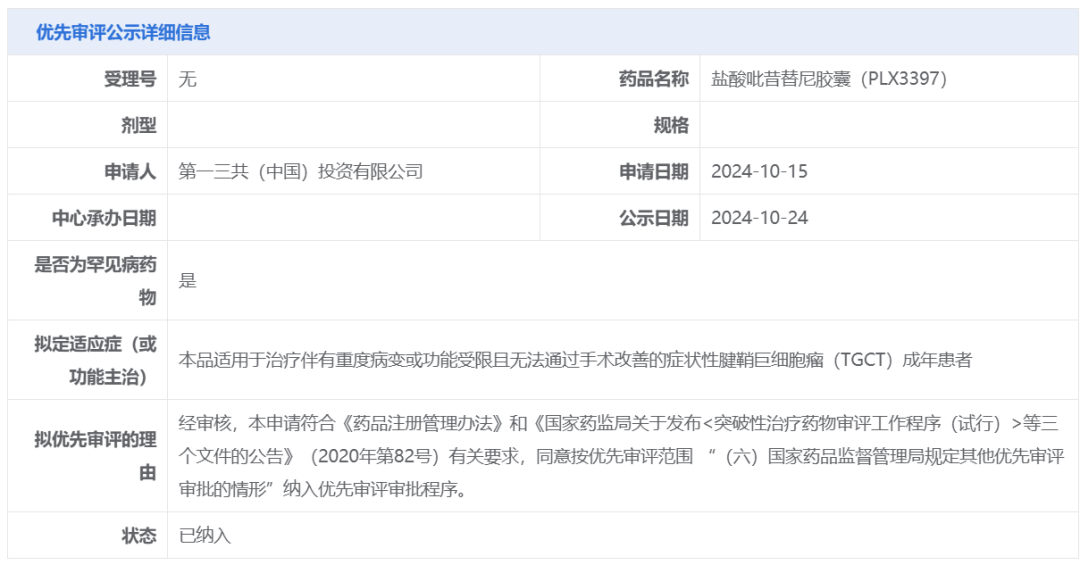 Screenshot source:CDE Official Website
Tenosynovial Giant Cell Tumor (TGCT), also known as Pigmented Villonodular Synovitis, is a rare non-malignant tumor with local invasiveness.It can affect synovial-covered joints, bursae, and tendon sheaths, leading to swelling, pain, stiffness in the joints or limbs, as well as a reduced range of motion.Currently, surgery is the standard treatment for tenosynovial giant cell tumors (TGCT). However, for patients with recurrent, refractory, or diffuse TGCT,Surgery is not only difficult for removing the tumor but also may lead to severe joint damage and loss of function.For some patients, they may consider amputation to relieve pain.。
PimitinibAn innovative oral CSF1R small molecule inhibitor,It also inhibits the activity of c-kit and FLT3-ITD.。The CSF1R-mediated signaling pathway is a key driver of abnormal cell proliferation in the synovium.

In August 2019, the FDA approved pexidartinib for the treatment of adult patients with symptomatic TGCT. This approval was based on the results of a multicenter international Phase 3 clinical trial named ENLIVEN. A total of 120 patients received either pexidartinib (n=61) or placebo (n=59). The trial results showed,39% of patients treated with pexidartinib achieved remission after 25 weeks of treatment, compared to 0% in the placebo group.。The partial response rate was 23% and the complete response rate was 15%.Among the 23 patients who achieved remission, 22 maintained their remission status at a follow-up of at least 6 months. Among the 13 patients with a follow-up period of at least 12 months, all patients had a remission duration exceeding 12 months.
According to the official website of the Chinese Drug Clinical Trial Registration and Information Disclosure Platform, Daiichi Sankyo has already launched an international multicenter (including China) Phase 3 clinical study in China. This study aims to evaluate pexidartinib forAdult patients with symptomatic TGCT who have severe lesions or serious functional limitations that cannot be improved by surgery.Efficacy and safety.
This innovative productCSF1R Small Molecule Inhibitor Submitted for Marketing Approval in China, Signaling Potential Availability for Patients SoonBring new treatment options.
[1] Center for Drug Evaluation, National Medical Products Administration of ChinaNet. RetrievedJan 15, 2025, from https://www.cde.org.cn/main/xxgk/listpage/da6efd086c099b7fc949121166f0130c
[2]FDA approves first therapy for rare joint tumor. Retrieved August 2, 2019, from https://www.fda.gov/news-events/press-announcements/fda-approves-first-therapy-rare-joint-tumor
ThisText from the content team of WuXi AppTec. Individuals are welcome to share it on their social media, but unauthorized reproduction by media or organizations in any form on other platforms is strictly prohibited.Reprint Authorization andFor other collaboration needs, please contact wuxi_media@wuxiapptec.com.
Disclaimer: The content team of WuXi AppTec focuses on introducing the research progress in global biopharmaceuticals and health. This article is for information exchange purposes only, and the views expressed in the article do not represent the position of WuXi AppTec, nor does it indicate that WuXi AppTec supports or opposes these views. This article is not a recommendation for treatment plans. For guidance on treatment options, please visit a正规 hospital.