Medtronic Bets Big on Neuroguard to Challenge Boston Scientific in the Next Hot Spot of Neurointervention

Medtronic
Medical Device Manufacturer

Contego Medical
Developer of Thrombosis Protection Devices


Source: Medical Device Business Review
Author: Jin Fan
Reproduction without authorization is prohibited, and reproduction is allowed 24 hours later.
Boston Scientific, Medtronic and other giants take action one after another, "Involution" in neurointervention sees new "explosive points"!
Innovative Carotid Artery Stent
Recently, according to the official account MedTF,Medtronic Announces Exclusive Distribution Agreement with Contego Medical for the U.S. Market, Not only that, Medtronic has also invested in Contego Medical and obtainedThe Right of First Refusal to Acquire Contego Medical in the Future.
In fact, this is not the first collaboration between the two parties. As early as 2020, Medtronic had already become an investor in Contego Medical and held a minority stake.
So, what are the outstanding features of Contego Medical that have won the favor of Medtronic, the global medical device giant?
It is reported that Contego Medical is a medical device company focusing on the research and development of novel medical devices for cardiovascular and peripheral vascular surgeries.The exclusive Integrated Embolic Protection (IEP) technology platform combines embolic protection and treatment in one, not only streamlining surgical steps but also improving patient outcomes.
Based on this technology platform, Contego Medical launched the revolutionary three-in-one carotid stent Neuroguard andWas approved for marketing by the U.S. FDA in October last year.
Directly Addressing the Pain Points of Clinical CAS Treatment
Innovative Three-in-One Carotid Artery Stent Launched
In response to this pressing clinical challenge, Neuroguard has ingeniously integrated a 40μm pore embolic protection filter into its 6Fr balloon catheter, achieving an all-in-one solution that combines a carotid artery stent, embolic protection filter, and balloon catheter.This innovative design not only further simplifies the surgical steps during carotid revascularization but also effectively captures emboli during the procedure, thereby significantly reducing the patient's risk of stroke.
Particularly worth mentioning is that the embolic protection filter of Neuroguard, compared to traditional filters,The volume has been reduced by 3 to 4 times., which can significantly enhance the protective ability against stroke and cognitive impairment.At the same timeAlso supports operators in adjusting the size according to the actual needs of patients., ensuring precise alignment with the patient's anatomical structure.
In addition, Neuroguard offers two stent options: a closed-cell stent and an open-cell stent. Among them, the closed-cell stent provides both short-term and long-term stability and durability.No thrombosis or target lesion revascularization occurred during the use, and the restenosis rate within one year was extremely low.
Powerful Alliance
Cutting-edge Technology Products Impact Blue Ocean Market
Clearly, the launch of the Neuroguard carotid stent has opened up a completely new pathway for the clinical treatment of carotid artery stenosis.As for this cooperation between Medtronic and Contego Medical, both parties have placed high expectations and confidence in it.
David Moeller, Senior Vice President and President of Peripheral Vascular Health at Medtronic:
Contego's innovation, supported by outstanding data, is transforming the treatment of carotid artery disease and complementing Medtronic's peripheral and stroke protection portfolio. This strategic agreement with Contego MedicalExpands our commitment to this rapidly growing carotid market and embodies Medtronic's unwavering dedication to advancing innovation and enhancing patient care.
Ravish Sachar, Founder and CEO of Contego Medical:
This strategic agreement marks an important milestone for Contego Medical and Medtronic. By combining our innovative product portfolio with Medtronic's extensive market presence and clinical leadership, we are poised to revolutionize revascularization treatments in the fields of carotid and peripheral vascular diseases.This partnership enhances our ability to provide patients with the most advanced solutions and reinforces our commitment to expanding treatment options across the United States.
This shows that the excellent technical strength of the Neuroguard carotid artery stent, combined with Medtronic's powerful channel resources and market influence, will accelerate Neuroguard's market expansion, bring good news to more patients with carotid artery stenosis, and inject new vitality into the development of the medical device industry.
$8.4 Billion Acquisition Entry
However, from the perspective of market competition, although Neuroguard has unique technical advantages, it does not dominate the field of carotid artery stenosis treatment.
In response to the many pain points in clinical carotid artery stenosis surgery, the medical community has been continuously exploring and innovating. In 2015, a new surgical method for treating carotid artery stenosis ——TransCarotid Artery Revascularization (TCAR) emerges as a solution.
This technology effectively avoids the shortcomings of endarterectomy and stent implantation. Through a unique proximal common carotid artery blood flow occlusion technique, it can achieve temporary blood flow reversal during surgery, which not only prevents detached plaque fragments from flowing to the brain but also filters out plaque fragments outside the body, thereby reducing the risk of stroke in patients.
Last September,Silk Road Medical, the U.S.-based publicly traded company that pioneered this innovative procedure, was acquired by Boston Scientific for a premium at a price of $1.16 billion (equivalent to 8.4 billion yuan).With the dust settling on this acquisition, Silk Road Medical has developedThe World's Only Commercially Available Device for TCAR Minimally Invasive Surgery — ENROUTE® Transcarotid Neuroprotection System, will also be incorporated into Boston Scientific's portfolio.
At the same time, in March last year, Silk Road Medical launched the new Tapered ENROUTE Transcarotid Stent System in the United States, which balances lesion coverage with anatomical compliance to achieve long-term plaque stabilization.
It can be foreseen that in the current field of carotid artery revascularization, Neuroguard, which is highly valued by Medtronic, and the TransCarotid Artery Revascularization (TCAR) technology of Silk Road Medical, on which Boston Scientific has placed a heavy bet, will engage in an intense market showdown in the United States.
So, in this competition, who can gain the upper hand and become the ultimate winner?
In terms of current market coverage and performance,Boston Scientific's acquisition of Silk Road Medical appears to have gained a more prominent advantage in the field of carotid artery revascularization.
Data shows that, as of 2023, Silk Road Medical has successfully completed over 25,000 TCAR procedures in the United States.The global cumulative total has broken through the 100,000 mark., is rapidly becoming a new alternative to traditional carotid endarterectomy (CEA) and carotid artery stenting (CAS).
Particularly eye-catching is,Silk Road Medical Achieved Full-Year 2023 Sales of $177.1 Million (Approximately RMB 1.285 Billion), Representing a 28% Increase Compared to 2022, demonstrating strong market growth potential and momentum.
Moreover, it is worth mentioning that in March last year, Silk Road also signed an exclusive distribution cooperation with China's Genius Medical.Gian Healthcare to Introduce Contego Medical's Innovative TCAR Technology and Core Products to the Chinese Market, further expanding its global influence and reputation, thisUndoubtedly, it has brought certain challenges and pressure to Medtronic in promoting the commercialization process of Neuroguard.
However, as a latecomer, Neuroguard has shown advantages in clinical data., achieving even more outstanding results.
According to the data published by Contego Medical, Neuroguard demonstrated a high level of safety in both the PERFORMANCE I and PERFORMANCE II IDE clinical studies: no major strokes, no neurological deaths, and no stent thrombosis at 30 days and within 1 year.Compared with Silk Road's TCAR technology, it has a lower risk of embolism-induced stroke.
Undoubtedly, the outcome of this competition will be influenced by multiple factors such as technological advancements, market promotion, patient acceptance, and continuous validation of clinical data. Whether the pioneers will maintain their lead, the latecomers will catch up, or all parties will advance side by side remains to be revealed over time.
But there is no denying that this competition among the giants will undoubtedly drive the continuous optimization and innovation of core products, while also igniting the R&D enthusiasm across the entire market. These efforts will ultimately benefit more patients with carotid artery stenosis, offering them better treatment options.
The Next "Explosion Point" in Neurointervention
The carotid artery, as a key arterial pathway supplying blood to the brain, has a stenosis degree closely related to the risk of stroke.According to statistics,AboutThirty percent of ischemic strokes are caused by carotid plaque stenosis.
In addition, foreign studies have revealed that among people aged 50 to 60, 5 out of every 1,000 suffer from severe carotid artery stenosis; while in those over 80 years old, this proportion surges to 1 in 10.From this, it can be seen that,Carotid artery stenosis is a relatively common and harmful disease among the middle-aged and elderly population.
However, in stark contrast,Currently, there are approximately 10 carotid artery stent products in widespread use globally, but most of them are first-generation products that have been in service for nearly 20 years., such as Abbott's Acculink, Medtronic's Protege, Coedis's Precise, and Boston Scientific's Wallstent, etc.,AndThere are no domestically produced carotid artery stent products approved for marketing in China.
After long-term clinical practice and verification,The limitations of the first-generation carotid artery stent products are becoming increasingly apparent.,The oversized mesh of the stent has become a major concern, which can easily lead to plaque detachment post-surgery and subsequently increase the risk of stroke.
Although the second-generation product was subsequently launched, improving the design by reducing the stent mesh size, new issues arose: the deliverability of the dual-layer stent was suboptimal, requiring the use of larger-diameter delivery catheters.This not only increases the difficulty of the surgery but may also cause additional stimulation and damage to the blood vessels.
Obviously, in the field of neurointervention, compared to coils, intermediate catheters, intracranial balloons, and thrombectomy stents, which are overly homogenized and highly competitive in the acute ischemia and access markets,The field of arterial stenosis, with its enormous demand, relatively uncrowded space, and vast room for innovation, is undoubtedly the next "explosive point" in neurointervention.
Against this backdrop, Contego Medical, a Chinese innovative medical device company, has joined forces with Professor Liqun Jiao's team from Xuanwu Hospital, Capital Medical University, to independently develop and launchContego Medical's Tian Tian Mi carotid artery stent not only fills the gap in China-produced products in this field but also perfectly addresses issues such as postoperative plaque detachment and poor deliverability found in first and second-generation stent products.
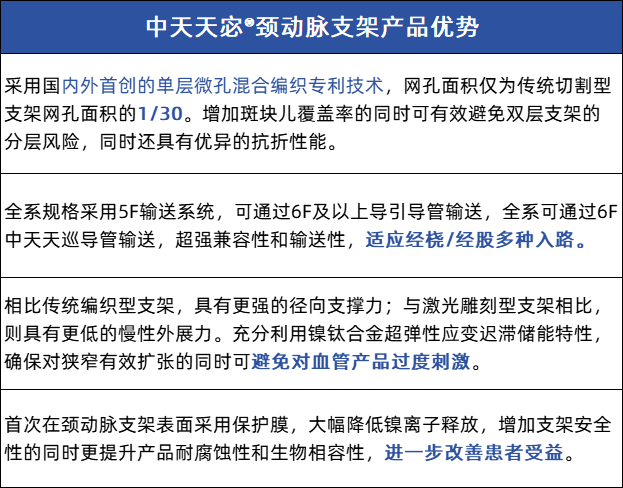
Currently, all case enrollments for the pre-market clinical trial of Contego Medical's carotid artery stent have been completed.Successfully entered the special review "green channel" for innovative medical devices in May last year., and in the same September, the company successfully completed a new round of financing. These supports will greatly promote the pace of Contego Medical's Tian Tian Mi carotid artery stent going to market.Expected to obtain the first Chinese production certificate.
Besides carotid artery stents, surrounding carotid artery stenosis,Contego Medical also offers distal protection devices, carotid artery balloons, and long sheaths, innovatively upgrading the two major carotid artery stent angioplasty approaches via radial or femoral access, providing a one-stop innovative solution for carotid artery stenosis interventional treatment (CAS)., and its products are expected to be approved in the short term.
In the challenging and promising field of neurointervention, its development trajectory is often constrained by the phenomenon of "becoming competitive before fully expanding." However, this very situation underscores the critical importance of innovative products and emerging sectors for companies to break through barriers and achieve outstanding growth.The field of carotid artery stenosis, which giants such as Medtronic and Boston Scientific are increasingly entering, clearly indicates a new direction for the development of neurointervention in China.
In the future, we look forward to having more innovative neurointerventional medical device companies like Contego Medical, which, with their strong R&D capabilities and forward-looking market insights, break through the intense competition in this "internally competitive" track and jointly open a new chapter of neurointervention in China.
The content of this article is for reference only and does not constitute investment advice. Readers are expected to effectively distinguish.If any platform reprints this article, it must take responsibility for the content of the article itself. Medical Device Business Review is not responsible for any impact caused by secondary dissemination after reprinting.

In order not to miss any content, everyone remembers toMedical Device Business ReviewSet as starred? Oh,
Looking forward to meeting you at the earliest opportunity each time.