Boehringer Ingelheim Announces Phase 3 CONNEX Program for Iclepertin in Schizophrenia-Related Cognitive Impairment Fails to Meet Primary and Key Secondary Endpoints

Johnson & Johnson
Medical Device R&D and Manufacturer

On January 16, 2025, a piece of news drew attention in the biopharmaceutical field: Boehringer Ingelheim's schizophrenia candidate drug failed to improve cognitive impairment or function in patients across three late-stage trials.
The Phase III program, referred to as CONNEX, consists of three double-blind, placebo-controlled studies designed to evaluate the efficacy of the oral medication iclepertin—an experimental GlyT1 inhibitor. The program recruited 1,840 adult patients with schizophrenia who were receiving stable antipsychotic treatment. According to Boehringer Ingelheim, this is the largest trial of its kind conducted among patients with cognitive impairment associated with schizophrenia. However, announcements released on January 16 revealed that the program did not meet its primary or key secondary endpoints. No statistically significant differences were observed in relevant measures over six months between the group receiving the experimental treatment and the placebo group. Based on these results, Boehringer Ingelheim decided to immediately halt a related long-term extension study.
It is worth mentioning that the U.S. Food and Drug Administration (FDA) granted iclepertin a Breakthrough Therapy Designation due to the current lack of targeted drugs for cognitive impairment in schizophrenia. However, the failure of this trial is undoubtedly a heavy blow. In response, Shashank Deshpande, head of Boehringer Ingelheim's human pharmaceuticals division, stated: Although these results are disappointing, we remain committed to finding effective solutions for patients with severe mental illnesses. Our innovative R&D pipeline includes over 20 investigational therapies at various stages of development, targeting different disease areas, including schizophrenia and major depressive disorder, which are expected to yield more results in the near future. Boehringer Ingelheim also plans to present the full data from this late-stage program at an upcoming medical conference.
Just days before news of Boehringer Ingelheim's project failure broke, Johnson & Johnson acquired Intra-Cellular Therapies for $14.6 billion, gaining access to Caplyta, the biotech company’s schizophrenia and bipolar disorder treatment drug. This marks one of the largest acquisitions in the biopharmaceutical sector since Novo Nordisk's $16.5 billion purchase of Catalent in February 2024.
In recent years, pharmaceutical companies in China have actively laid out plans in the central nervous system (CNS) field, creating a situation of multiple breakthroughs.
Enhua Pharmaceutical is the only listed company in China that focuses on the research, development, and production of central nervous system drugs. It mainly engages in the production of central nervous system products, including anesthetic, psychiatric, and neurological pharmaceutical raw materials as well as their formulations. The company has 21 innovative drugs for the nervous system in its pipeline, ranking first in terms of drug quantity. It has established a certain product portfolio in generic drugs for mature single products. Meanwhile, taking advantage of the rise of innovative drugs in China, Enhua Pharmaceutical has deployed several Class I new drugs in the fields of Alzheimer's disease, Parkinson's disease, and schizophrenia, though most are still in the early clinical stages.
Luye Pharma Focuses on Schizophrenia, Alzheimer's Disease, Parkinson's Disease, Depression, and Other Disease Areas
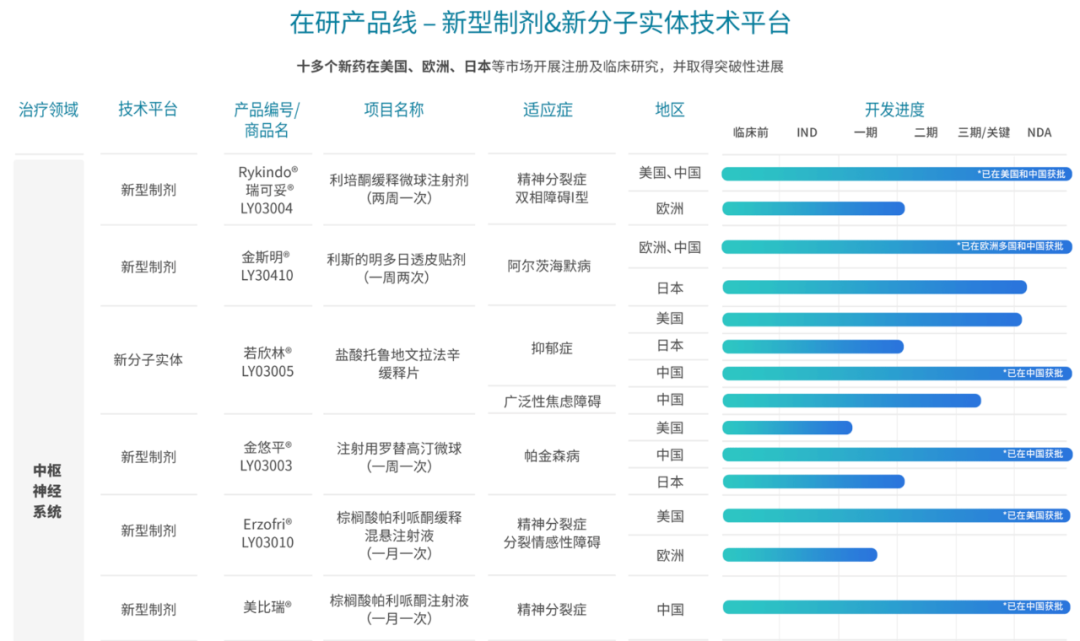
Screenshot from the official website of Luye Pharma
Ruijian Pharmaceuticals has developed two pipelines, NouvNeu001 and NouvNeu003. NouvNeu001 targets patients with mid-to-late stage Parkinson's disease, while NouvNeu003 is aimed at early-onset Parkinson's disease patients under the age of 50, collectively covering the entire life cycle and treatment period of Parkinson's disease. In August 2023, NouvNeu001 received approval from the National Medical Products Administration (NMPA) to conduct a combined Phase 1-2 clinical study. In March 2024, the U.S. Food and Drug Administration (FDA) granted NouvNeu001 special exemption, and in June 2024, it officially approved its overseas IND application. In 2024, clinical trials were successfully initiated at Beijing Hospital and Zhongnan Hospital of Wuhan University. The overall safety of the low-dose group was good, with no cell drug-related AE or SAE reactions observed. Furthermore, participants showed an average improvement of nearly 20 points in the UPDRS III motor function score just three months after transplantation, along with positive effects such as reduced dyskinesia and extended "on" periods. PET imaging analysis also confirmed that with increased transplantation time, there was a significant enhancement in dopamine transporter activity in the transplant region. Data on sleep PSQI and quality of life PDQ39 indicated improvements in non-motor symptoms among participants. In November 2024, NouvNeu001 completed dosing for the last participant in the high-dose group of the Phase I clinical study. Both the low-dose and high-dose groups demonstrated good overall safety, with improvements in motor function observed over time. Phase 2 clinical enrollment is expected to commence in the first quarter of 2025.