

Early-Stage Trispecific Antibody Pipeline Sells for $1.055 Billion as Big Pharma Bets on the Next Wave of Oncology Innovation

Simcere
Innovative Drug Developer

Simcere Zaiming
Developer of Innovative Anti-Tumor Drugs

AbbVie
Innovative Drug Developer
Bispecific antibodies are at the forefront, while trispecific antibodies are just beginning to emerge.
On January 13, 2025, ZAIMING, an innovative oncology drug company under Simcere, announced that it had reached a licensing option agreement with global pharmaceutical company AbbVie for its TCE tri-specific antibody pipeline SIM0500, which targets GPRC5DxBCMAxCD3 and is currently in Phase 1 clinical trials in both China and the United States. AbbVie will pay ZAIMING an upfront fee, along with up to $1.055 billion in optional rights payments and milestone payments, as well as sales royalties outside of Greater China.
Despite the critical roles played by monoclonal antibodies and bispecific antibodies in clinical treatment, their efficacy in treating malignant tumors remains limited. With the advancement of antibody drugs, trispecific antibodies targeting three specific antigen-binding sites simultaneously have demonstrated extraordinary application prospects in the field of cancer treatment.
Compared with bispecific antibodies, trispecific antibodies can also bind to another target on the surface of tumor cells or immune cells, or bridge immune cells and block dual signaling pathways, which is more conducive to redirecting drugs or immune cells to tumor sites, enhancing binding specificity, improving targeting, reducing off-target toxicity, and thereby enhancing anti-tumor capabilities.
Therefore, although there are currently no tri-specific antibody drugs approved globally, quite a few Chinese Biotechs have already positioned themselves in this field. Meanwhile, MNCs began to make their moves starting from 2024, and we may see an increasing number of tri-specific antibody pipelines in the 2025 BD deals.
The number of triple antibody deals in 2024 has exceeded the total of the past three years, with a total amount close to 8 billion US dollars.
Compared with the dual targets of bispecific antibodies, the antibody combinations of trispecific antibodies are more diverse, providing more space for the development of antibody drugs. Therefore, MNCs have started to enter the trispecific/multispecific antibody track through mergers and acquisitions, licensing deals, and equity investments.
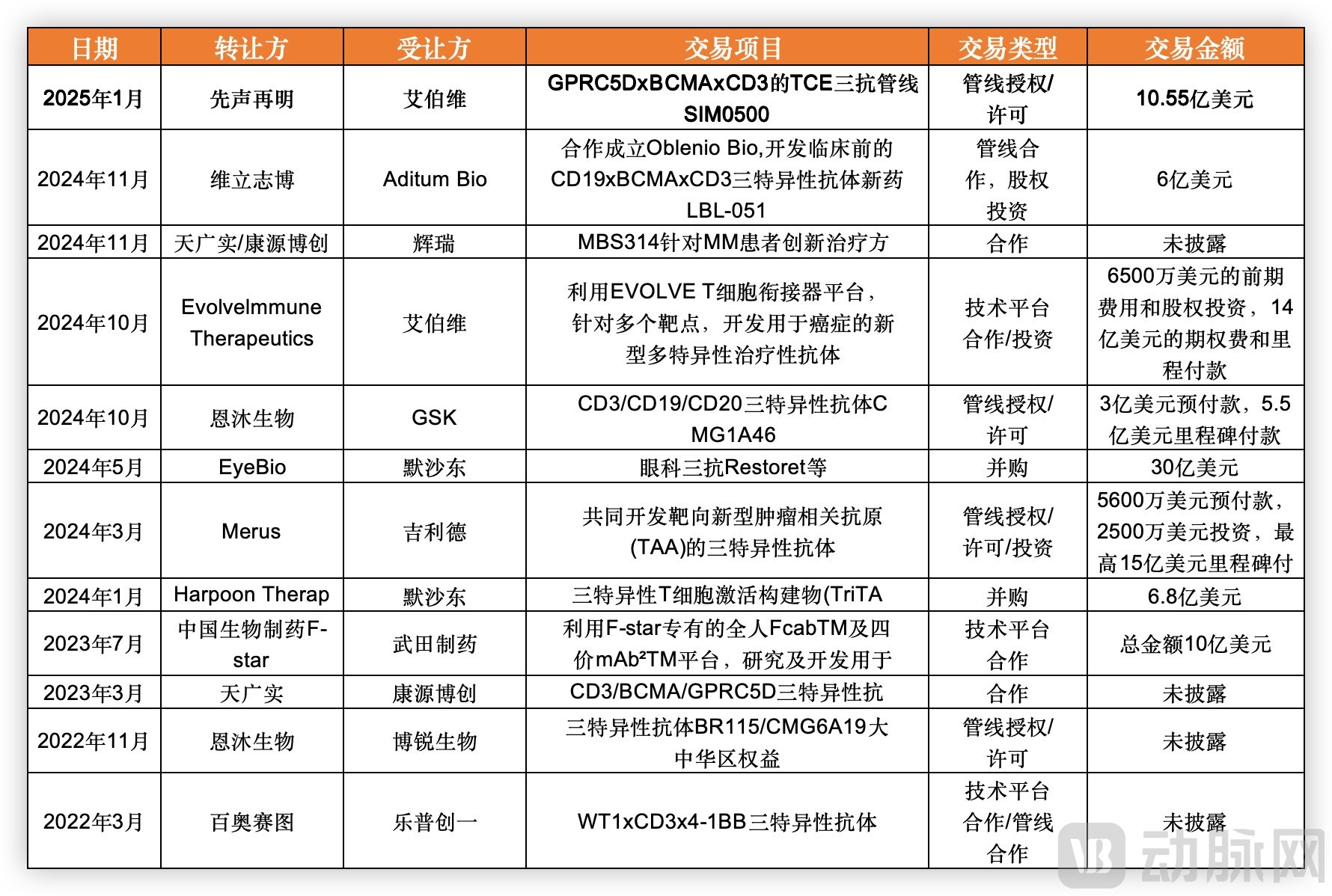
Tri-specific antibody transactions in recent years, collected and organized from public information
It can be seen that MNCs, including Pfizer, AbbVie, GSK, Gilead, and Merck, have all made moves in 2024. Notably, Merck spent nearly $4 billion in a year acquiring two companies focused on the development of trispecific antibody drugs, demonstrating its strong interest in this field.
Among them, EyeBio, which was sold to Merck for $3 billion, is worth mentioning. Founded in 2021, EyeBio has raised $130 million in funding so far, with Merck participating as early as the Series A round. In February 2024, EyeBio announced positive Phase 1b/2a clinical data for its core pipeline EYE103. Subsequently, in May, Merck moved to acquire the company, and by August, information about a Phase 2/3 clinical trial for EYE103 appeared on Clinicaltrials.gov—truly demonstrating the power of speed.
Merck's acquisition of Harpoon in January 2024 further highlights Merck's optimism towards tri-specific antibodies. In addition to gaining a promising DLL3/CD3 antibody pipeline (MK6070) in clinical trials, the deal also brought Merck multiple tri-specific antibody platforms from Harpoon, including the forward-looking ProTriTAC and TriTAC-XR platforms, which enable specific activation within the tumor microenvironment.
Notably, according to VCBeat database information, MK6070, Roche's RO7616789, and Zelgen Biopharma's ZG006 are the only three tri-specific antibody pipelines targeting DLL3 that have entered clinical stages globally. By August, Daiichi Sankyo and Merck had signed a global co-development and commercialization agreement for MK6070 (Merck retains exclusive rights to the drug in Japan), with Daiichi Sankyo paying an upfront fee of $170 million.
Interestingly, Harpoon also appeared in AbbVie's story. As early as 2019, AbbVie obtained the global exclusive license for one of Harpoon's tri-specific antibody pipelines with a $30 million upfront payment and $50 million in milestone payments. However, due to insufficient attention from AbbVie later on, the rights were returned.
AbbVie's hefty acquisition of ZAIMING's tri-specific antibody pipeline this time is likely influenced by its competitors. For instance, Johnson & Johnson has multiple products in the multiple myeloma (MM) field, including CD38 monoclonal antibodies, BCMA-CAR-T, BCMAxCD3 bispecific antibodies, and even GPRC5DxCD3 bispecific antibodies, while AbbVie itself only has one BCMAxCD3 bispecific antibody, which seems rather weak in comparison.
ZAIMING's GPRC5D/BCMA/CD3 trispecific antibody demonstrated potent T-cell cytotoxic effects against MM cells in early studies, with significant tumor killing efficacy, good tolerability, low effective dosage, and no tumor recurrence after discontinuation, among other advantages. For AbbVie, having missed the opportunity with the GPRC5D/CD3 bispecific antibody, directly entering the BCMA/GPRC5D/CD3 trispecific space could be a viable option.
From these M&A events, it is not difficult to see that tri-specific antibody pipelines entering the clinical stage have high transaction value. Moreover, tri-specific antibody pipelines involving popular targets also possess significant BD potential. Currently, the global tri-specific antibody pipeline has started advancing into the two major markets of oncology and autoimmune diseases.
The diversity of the three resistances brings more possibilities, making pharmaceutical companies flock to it.
Although no tri-specific antibody drugs have been approved yet, several biopharmaceutical companies have already ventured into the development of tri-specific antibodies and designed combination drugs with iterative advantages in targeting. According to incomplete statistics, there are currently over a hundred tri-specific antibody drug pipelines globally, with about half having entered clinical stages, though most are still in the early phases of clinical trials.
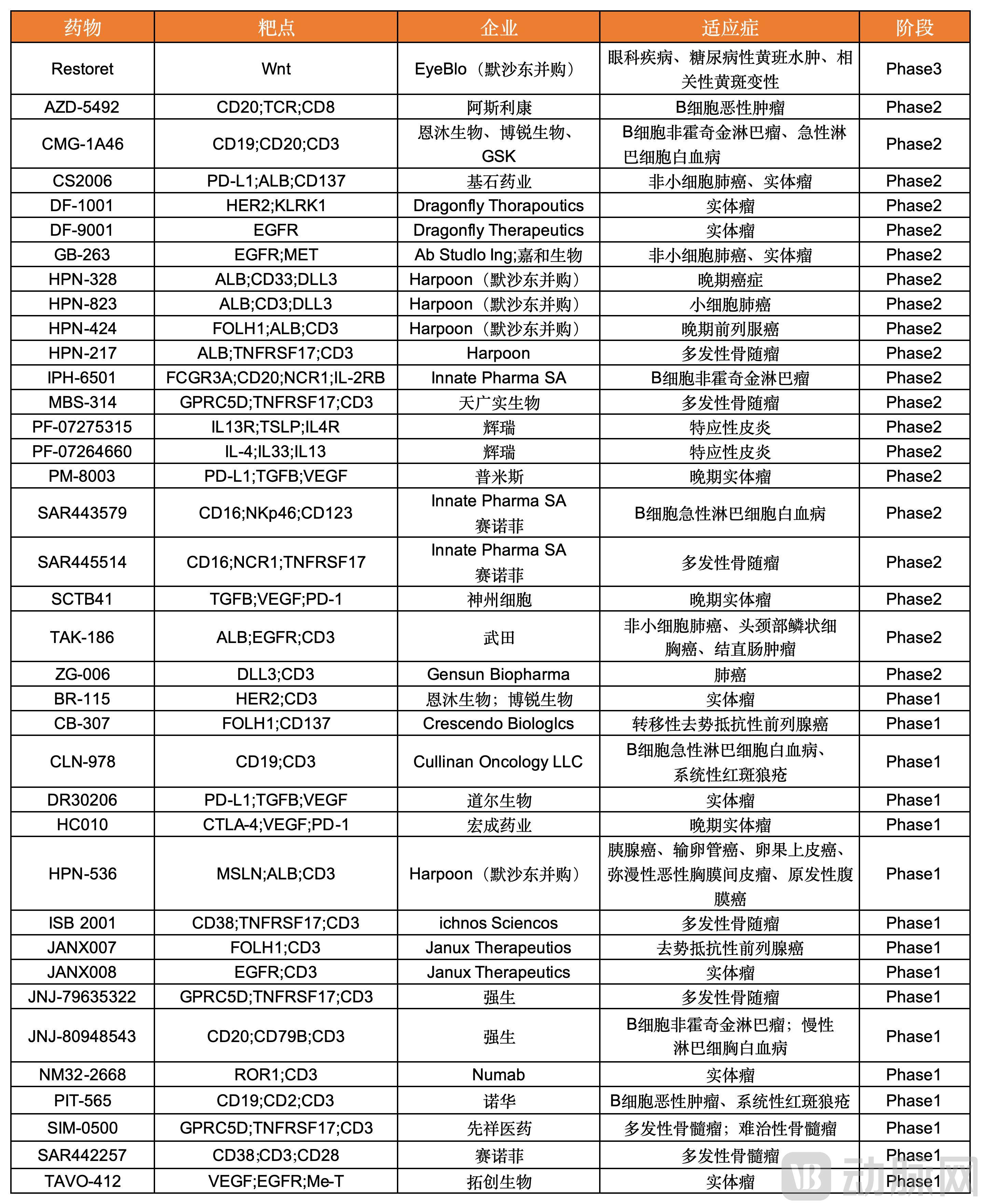
Part of the three-antibody pipeline under research, according to publicly available information
Among MNCs, Sanofi has made multiple strategic moves. For instance, SAR442257, which targets Anti-CD3/CD38/CD28, mediates a strong tumor cell-killing effect. Compared to anti-CD38 monoclonal antibodies, SAR442257 demonstrates 3~4 orders of magnitude higher killing efficacy in vitro against MM cells with both high and low CD38 expression. SAR443579 (NKp46/CD16/CD123) could become a new option for patients with hematologic malignancies. Pfizer’s PF-07275315, an Anti-IL-13/IL-4/TSLP tri-functional fusion protein, is currently in Phase 2 clinical trials for atopic dermatitis.
From a temporal perspective, the global tri-specific antibody/multi-specific antibody pipeline began to grow significantly starting in 2021, and the same growth trend occurred in China beginning that year. By 2024, multiple Chinese biotech companies had entered the tri-specific antibody field. In that year alone, more than 10 new drug pipelines for Class 1 tri-specific antibodies received IND approval in China for the first time. Companies with relatively rapid progress include Tian Guangshi, Baili Tianheng, Shenzhou Cell, Innovent Biologics, JHBP (CY) Holdings Limited, Zelgen Biopharmaceuticals, Triumvira Bio, BrightGene Bio-Medical Technology, and Promab Biotechnologies.
From the perspective of indications distribution, tri-specific antibodies follow a similar approach to mono- and bispecific antibody drugs. The most popular field remains oncology, with overall pipeline占比 exceeding 50%. Given the large market demand for anti-cancer drugs and extensive医保 coverage, companies are motivated to drive innovation.
Chinese pharmaceutical companies are quietly accelerating the R&D of trispecific antibody drugs.
CStone Pharmaceuticals announced at the end of 2024 that it had submitted a clinical trial application in Australia for its pipeline product CS2009 (a PD-1/VEGF/CTLA-4 tri-specific antibody) used to treat various solid tumors. Following this news, the company's stock price rose by 7% at one point.
The market's enthusiasm can be attributed to both the groundwork laid by Akeso's bispecific antibodies in 2024 and the anticipation of a subsequent explosion in trispecific antibodies.
From the mechanism of action, the PD-1/VEGF/CTLA-4 trispecific antibody, compared to Simcere's PD-1/VEGF bispecific antibody, promotes the activation and migration of more naïve T cells into tumor tissues through anti-CTLA-4. Preclinical data released by CStone Pharmaceuticals at the 39th Annual Meeting of the Society for Immunotherapy of Cancer showed that CS2009 demonstrated superior anti-tumor activity over potential competitors (including PD-1/CTLA-4 bispecific antibodies, PD-1/VEGFA bispecific antibodies, and combination therapies of anti-PD-1 and anti-CTLA-4).
In addition, AstraZeneca's PD-1/CTLA-4 bispecific antibody currently has four indications (non-small cell lung cancer, pleural mesothelioma, cervical cancer, and squamous cell carcinoma of the head and neck) in Phase 3 clinical trials, with a high probability of success inferred from preliminary data. Moreover, these targets are well-established, and their combination can cover multiple tumor indications, including non-small cell lung cancer, ovarian cancer, renal cell carcinoma, cervical cancer, hepatocellular carcinoma, and gastric cancer. At the same time, populations with low or negative PD-L1 expression who respond poorly to PD-(L)1 therapy can also benefit further.
If Akeso's PD-1/VEGF bispecific antibody has the potential to challenge Keytruda, could the PD-1/CTLA-4/VEGF trispecific antibody, which both CStone Pharmaceuticals and Hengrui Pharma are developing, also have further room for advancement?
Tri-specific antibodies are mainly classified into the following categories according to different mechanisms of action: T-cell engagers, immune checkpoint inhibitors, NK-cell engagers, targeting three tumor-associated antigens, TCE with extended half-life, and trifunctional fusion proteins. The current pipeline of tri-specific antibodies produced in China is relatively comprehensive.
Enmu Bio's CMG1A46 drug is a tri-specific antibody targeting CD3/CD19/CD20, with indications for acute lymphoblastic leukemia, hematological tumors, follicular lymphoma, and diffuse large B-cell lymphoma. CMG1A46 simultaneously targets CD3 on the surface of T cells and two antigenic epitopes on B cells, CD20 and CD19, by recruiting CD3.+T cells enhance T cell function, mediate B cell depletion, and kill B cells expressing CD19/CD20.
CS2006, developed by CStone Pharmaceuticals, is a tri-specific antibody targeting 4-1BB/PD-L1/HSA. It is an immune checkpoint inhibitor that simultaneously targets the tumor immunosuppressive PD-1/PD-L1 pathway and the tumor immune-stimulatory 4-1BB pathway. It exerts a synergistic effect through PD-L1 blockade and 4-1BB activation, locally activating tumor-directed specific immune responses.
Genor Biopharma's GB263 (Anti-EGFR/cMET/cMET) has taken the path of targeting three TAAs. By targeting EGFR and two different cMET epitopes, it blocks the signaling pathways of cMET and EGFR, downregulating the protein levels of cMET and EGFR. Tavotek’s TAVO-412 has also chosen a similar approach.
PM-8003, a trifunctional fusion protein developed by Primus Bio, targets PD-L1/TGF-β/VEGF. By blocking the TGF-β pathway, it can reduce the number of Treg cells and enhance the activity of effector T cells, thereby restoring sensitivity to anti-PD-L1 treatment.
Interestingly, China-produced tri-specific antibodies have just started to accelerate, and tetra-specific antibodies are already underway.
On December 20, 2024, Baili Pharmaceutical's GNC-038 tetravalent antibody injection received implied approval for clinical trial application from the NMPA. On September 20, Baili Pharmaceutical's GNC-077 multivalent antibody injection also received approval from the Center for Drug Evaluation (CDE) of the National Medical Products Administration (NMPA) for clinical trials.
Based on the GNC platform, Baili Tianhe has developed several candidate drugs. Among them, except for the undisclosed GNC-077, three tetraspecific antibodies are already in clinical development, including GNC-038 (CD3 × 4-1BB × PD-L1 × CD19), GNC-035 (CD3 × 4-1BB × PD-L1 × ROR1), and GNC-039 (CD3 × 4-1BB × PD-L1 × EGFRvIII).
It can be seen that domestically produced multi-specific antibodies have a relatively comprehensive layout in the field of oncology. Considering the recent frequent acquisitions of bispecific antibody assets by multinational corporations (MNCs) and their efforts to advance bispecific antibody pipelines for autoimmune clinical trials, trispecific antibodies also hold significant potential in the autoimmune market.
The heatwave of TCE eventually began to hit autoimmune diseases.
TCE Bispecifics Stole the Spotlight in 2024, Such as CD19/CD3, CD20/CD3, etc. The 2024 deals indicated that trispecific TCE will be a significant development direction in the future. In October 2024, GSK announced an $850 million acquisition of China’s Enmu Biotech's trispecific antibody CMG1A46. According to the agreement, GSK will pay Enmu Biotech an upfront payment of $300 million.
Notably, the news reveals that GSK plans to develop and commercialize CMG1A46, focusing on B-cell-driven autoimmune diseases such as systemic lupus erythematosus (SLE) and lupus nephritis (LN), with the potential to expand into related autoimmune conditions.
According to previously disclosed information, CMG1A46 can not only kill B cells that are double-positive for CD19 and CD20 but also eliminate cells that are single-positive for either CD19 or CD20. Meanwhile, its half-maximal effective concentration (EC50) in vitro is only 0.3 pM, showing better safety and stronger activity compared to traditional 1+1 type CD20 TCEs. In vivo, CMG1A46 can rapidly deplete B cells within 24 hours and allows for higher dosing compared to traditional CD20 TCE bispecific antibodies. At a dose of 1 mpk, the depletion of B cells persisted for 28 days.
AbbVie's Acquisition of SIM0500, a Trispecific Antibody from Simcere, Targets Beyond Hematologic Tumors: BCMA and GPRC5D are Also Expressed on B Cells in Certain Autoimmune Diseases. Existing BCMA-targeted Drugs Have Already Demonstrated Efficacy in Autoimmune Conditions Such as Sjögren's Syndrome, NMOSD, Systemic Sclerosis, and Rheumatoid Arthritis. The Future Development Potential of SIM0500 in the Autoimmune Field is Significant.
Interestingly, NewCo's influence is also beginning to extend to domestically produced multi-antibody therapies in China.
In January 2025, WuXi Biologics and Candid Therapeutics reached a research service cooperation agreement. Candid will hold the global rights to a trispecific antibody, discovered based on WuXi Biologics' proprietary universal multispecific antibody technology platform, WuXiBody, which is currently in the preclinical development stage. Just over 20 days ago, Candid also announced three TCE-related R&D collaboration deals with Chinese biotech companies in one go.
In November 2024, VibeBio reached an exclusive option and licensing agreement with venture capital firm Aditum Bio for a trispecific antibody drug. Based on VibeBio's CD19/BCMA/CD3 trispecific T-cell engager (TCE) LBL-051, the two parties will establish a new drug research and development company named Oblenio.
The trispecific antibody pipeline is expected to become a bright spot in 2025.