

Johnson & Johnson's BCMA CAR-T Therapy Carvykti Surges with 92.7% Growth, Reaching $963 Million in 2024 Sales

Johnson & Johnson
Healthcare Product Manufacturers, Health Service Providers
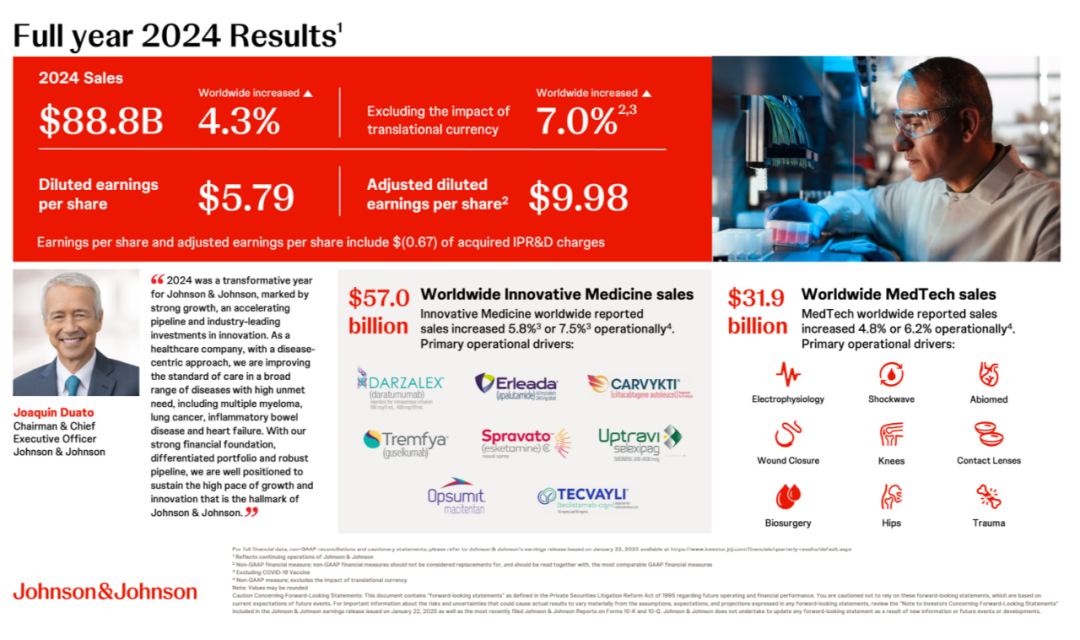
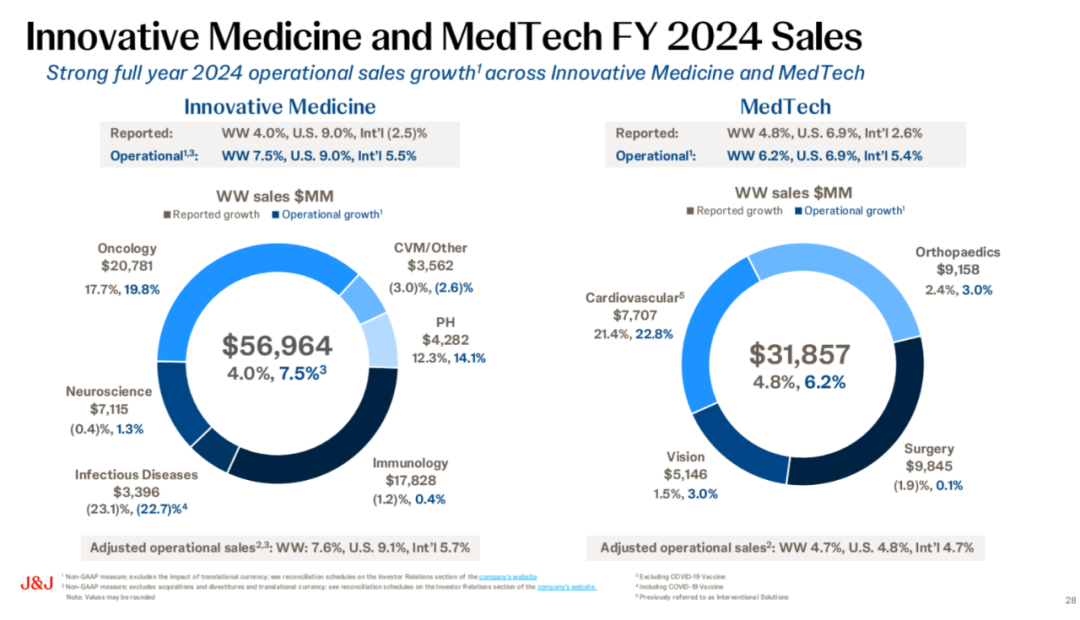
On January 22, Johnson & Johnson announced its 2024 financial results, with total annual revenue reaching $88.821 billion, a year-on-year increase of 4.3%. The two core business segments of Johnson & Johnson - Innovative Pharmaceuticals and Medical Technologies - achieved revenues of $56.964 billion (+4.0%) and $31.857 billion (+4.8%), respectively.
Johnson & Johnson's innovative pharmaceutical business mainly focuses on several key areas: oncology, autoimmune diseases, neuroscience, infectious diseases, pulmonary arterial hypertension (PAH), cardiovascular and metabolic diseases. Among them, oncology and autoimmune drugs contribute the most to the performance. The former achieved an annual revenue of $20.781 billion in 2024, representing a year-on-year increase of 17.7%; the latter generated $17.828 billion in revenue, marking a year-on-year decrease of 1.2%. Additionally, PAH products achieved revenue of $4.282 billion, growing by 12.3% year-on-year, also becoming a strong driving force for the overall business growth.
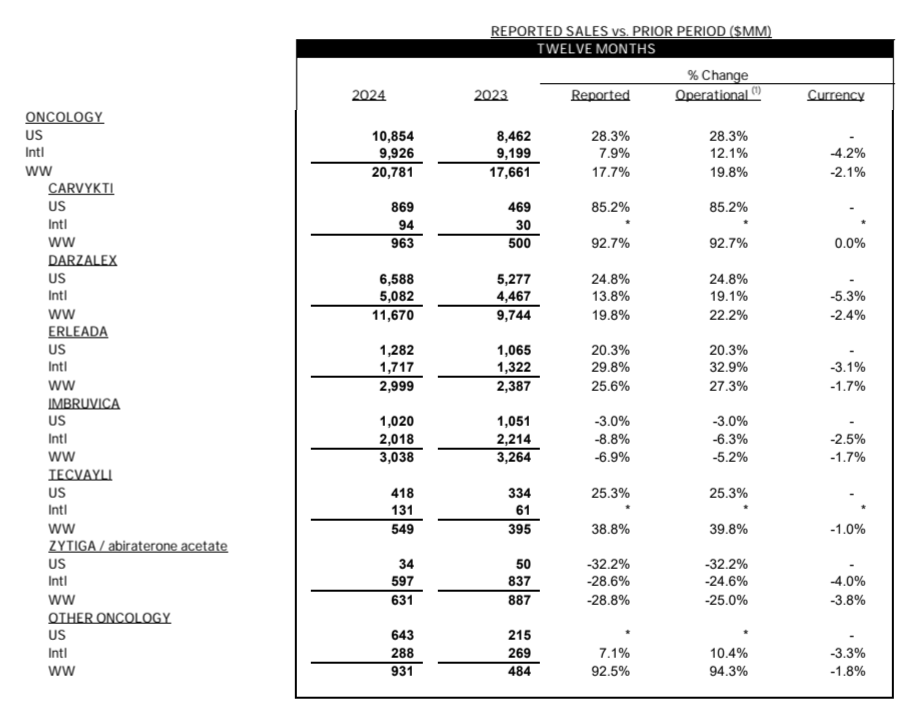
The growth of Johnson & Johnson's oncology business in 2024 was mainly attributed to the strong drivers such as Darzalex (daratumumab), Erleada (apalutamide), Carvykti (cilta-cel), and Tecvayli (teclistamab). Among them, Darzalex, a multiple myeloma treatment drug targeting CD38, continued to grow in market share across all regions globally, with annual revenue reaching $11.67 billion, representing a year-over-year increase of 19.8%. This marks the first time that the drug's sales have surpassed the $10 billion milestone since its launch in 2015.
Multiple myeloma is a key disease area for Johnson & Johnson. In addition to the CD38 monoclonal antibody Darzalex, the BCMA CAR-T cell therapy Carvykti (co-developed with Legend Biotech), the CD3/BCMA bispecific antibody Tecvayli, and the CD3/GPRC5D bispecific antibody Talvey (talquetamab, subcutaneous injection formulation) have all shown impressive results.
Carvykti Leads the Pack with a 92.7% Growth Rate, Becoming the Fastest-Growing Product in Johnson & Johnson's 2024 Innovative Pharmaceutical Business, with Full-Year Sales Reaching $963 Million, Nearly Doubling Last Year's FiguresIn April 2024, based on the results of the CARTUDE-4 study, the FDA approved the drug for second-line treatment of multiple myeloma, marking the second approved indication for Carvykti. With the expansion of indications and increased production capacity, this drug still has significant growth potential in the future.
Moreover, the sales of Johnson & Johnson's bispecific TCE Tecvayli reached 549 million U.S. dollars, increasing by 38.8% year-on-year. Another bispecific TCE, Talvey, has been on the market for a year. Although the specific sales figures have not been disclosed, it will continue to expand Johnson & Johnson's competitive advantage in the multiple myeloma field. Due to fierce competitive pressure, Imbruvica (Ibrutinib), another key product of Johnson & Johnson in the hematological tumor sector, saw its sales in 2024 decrease by 6.9% year-on-year to 3.038 billion U.S. dollars.
Due to the expiration of its patent, Zytiga (abiraterone), a major product for prostate cancer, also experienced a significant decline in sales, reaching $631 million (-28.8%). However, Erleada (apalutamide), an androgen receptor inhibitor, has taken over from Zytiga to become Johnson & Johnson's core product in this field. Since its launch in 2018, Erleada has rapidly captured market share with an annual growth rate of double digits or higher, achieving a full-year revenue of $2.999 billion (+25.6%) in 2024. To maintain its leading position in this area, Johnson & Johnson also launched Akeega, a combination of abiraterone and niraparib, in 2023.
In 2024, Johnson & Johnson achieved a significant breakthrough in the non-small cell lung cancer (NSCLC) field. The FDA approved its重磅 product combination of EGFR/c-Met bispecific antibody Rybrevant (amivantamab) and EGFR T790M inhibitor Lazcluze (lazertinib), establishing a first-line chemotherapy-free treatment option for NSCLC patients with EGFR exon 19 deletion (ex19del) or L858R mutation. The combination of Rybrevant with chemotherapy was also approved by the FDA for first-line treatment of NSCLC with EGFR exon 20 insertion mutations and second-line treatment of NSCLC with EGFR ex19del or L858R mutations. This will further expand Johnson & Johnson's oncology business. Johnson & Johnson predicts that the sales peak of the Rybrevant/Lazcluze product combination will exceed $5 billion.
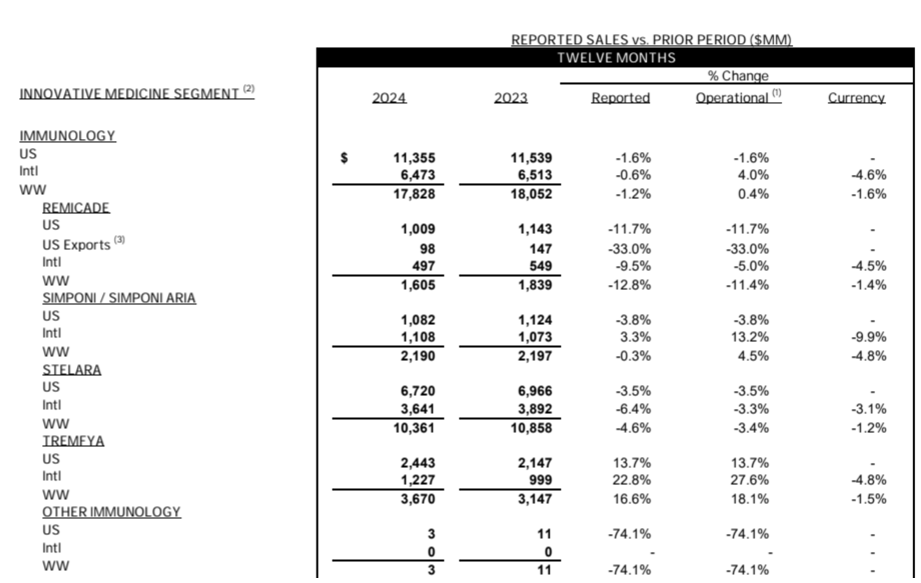
In the field of autoimmune diseases, Johnson & Johnson's sales performance has declined, mainly due to the impact of biosimilars on its major product Stelara (ustekinumab). Its revenue decreased by 4.6% year-on-year to $10.361 billion. Its European market has been continuously eroded, and it is expected that the U.S. market will also face significant challenges from biosimilars in 2025. Remicade (infliximab) has also experienced continuous sales declines due to patent expiration, with its full-year revenue in 2024 being $1.605 billion, a year-on-year decrease of 12.8%. Simponi (golimumab) sales also slightly declined (-0.3%) to $2.19 billion.
Tremfya (Guselkumab) continued to maintain double-digit growth, with sales reaching $3.670 billion (+16.6%) in 2024.
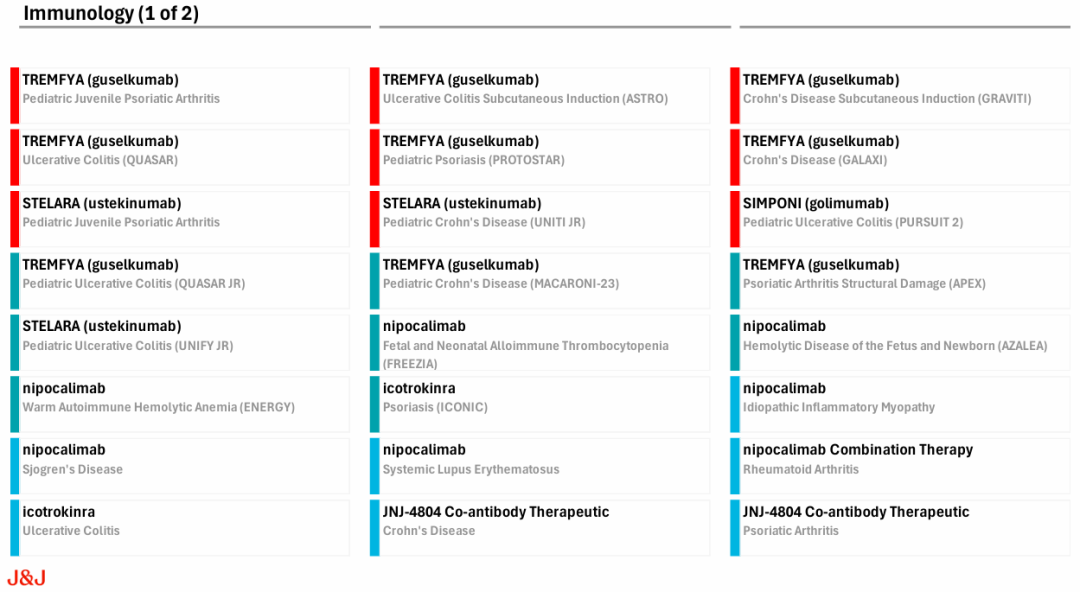
To address the crisis in the autoimmune field, Johnson & Johnson is exploring the further potential of its marketed product Tremfya by conducting multiple Phase III clinical trials for the treatment of Crohn's disease, ulcerative colitis, psoriatic arthritis, and other conditions to expand its range of indications.
On the other hand, Johnson & Johnson is accelerating the development of candidate drugs such as the FcRn monoclonal antibody nipocalimab, the oral IL-23R antagonist JNJ-2113, and the combination antibody therapy JNJ-4804. In November 2024, two Phase III studies of JNJ-2113 for the treatment of plaque psoriasis were successful, making it the first oral IL-23R-targeted drug to complete Phase III research. It can be foreseen that Johnson & Johnson will actively promote the market launch of these new products to offset the impact of declining performance of products like Stelara, Remicade, and Simponi.
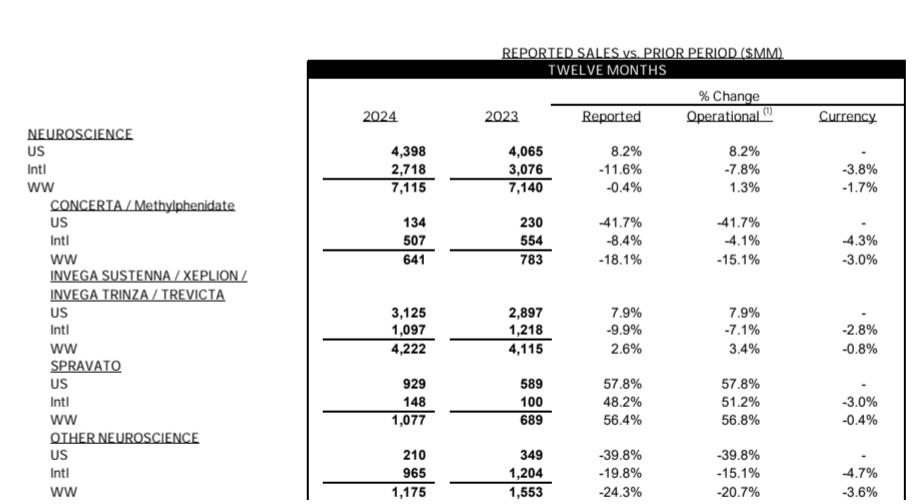
Notably, Johnson & Johnson recently spent $14.6 billion to acquire Intra-Cellular, further strengthening its neuroscience portfolio. Johnson & Johnson forecasts that the sales peak of the oral antipsychotic product Caplyta (lumateperone), obtained through this acquisition, could exceed $5 billion.
In 2024, Johnson & Johnson's revenue growth in the pulmonary arterial hypertension field was mainly driven by Opsumit (macitentan) and Uptravi (selexipag), with sales of these two drugs reaching $2.184 billion (+10.7%) and $1.817 billion (+14.9%), respectively.
Over the past year, Johnson & Johnson has been relatively active in biopharmaceutical M&A transactions. In March, it completed the acquisition of ADC company Ambrx for $2 billion, strengthening its oncology pipeline. In June, it finalized the acquisition of bispecific antibody company Proteologix for $850 million, gaining multiple antibody projects targeting atopic dermatitis and asthma. In July, it completed the acquisition of Yellow Jersey for $1.25 billion, obtaining global rights to NM26, a first-in-class bispecific antibody targeting IL-4Rα and IL-31, for the treatment of atopic dermatitis.
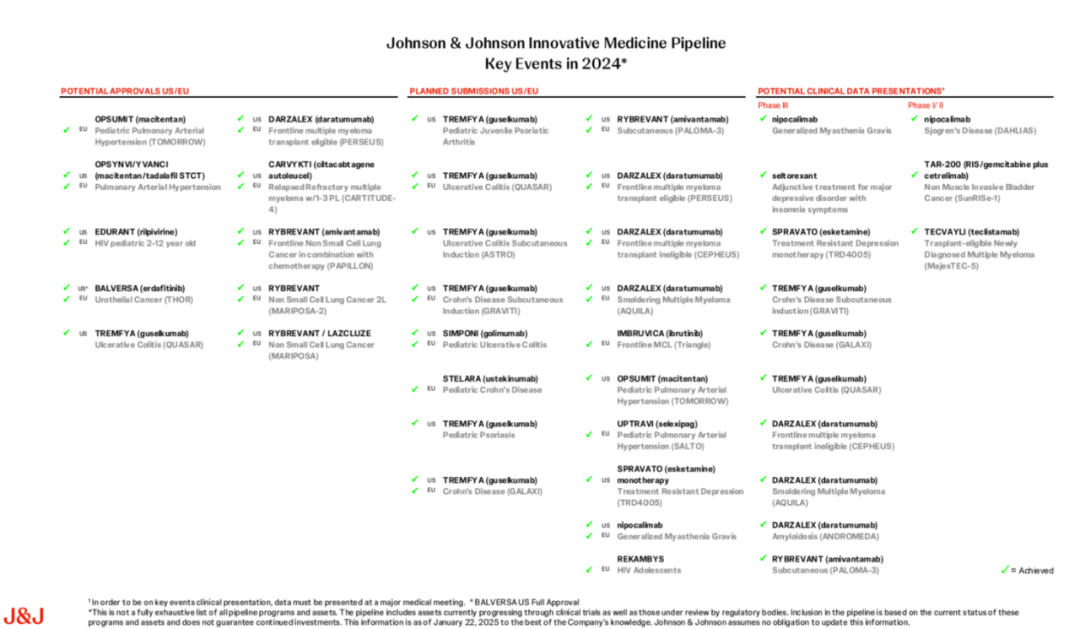
In 2024, Johnson & Johnson's innovative pharmaceutical product pipeline also achieved several key milestone events in terms of regulatory submissions and important clinical study data reads (see figure below).
Looking ahead to 2025, Johnson & Johnson expects a growth rate of 2.5%-3.5%, with total revenue projected to reach $90.9-$91.7 billion.
E.N.D

Article Recommendation(Click the article title below to open the original text):