On January 22, Legend Biotech and Johnson & Johnson updated the sales performance of their star CAR-T product, Carvykti.
In 2024, the total sales of the product reached $963 million, increasing by 92.7% compared to $500 million in 2023, nearly doubling. The product was also approved in China in August 2024. However, the vast majority of sales will undoubtedly be contributed by overseas markets.
By contrast, the five CAR-T products previously launched in China have achieved "lackluster results." Their prices range from 999,000 RMB/dose to 1.29 million RMB/dose, and none have been included in the national medical insurance. For instance, in the first half of 2024, the revenue of JW Therapeutics, the manufacturer of Relmacabtagene Autoleucel Injection, was only 86.82 million RMB.
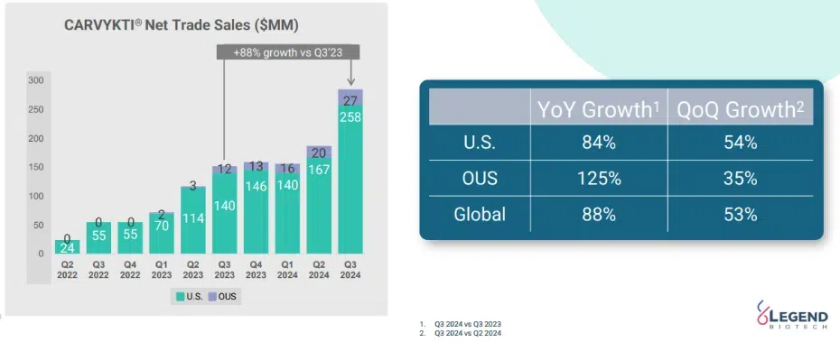
By quarter, Carvykti's sales were $157 million, $186 million, $286 million, and $334 million, respectively, showing a significant increase in the second half of the year.
This is because, in April 2024, Carvykti was approved in the U.S. for second-line treatment of relapsed/refractory multiple myeloma (r/r MM) and is the first and only BCMA-targeted therapy approved for second-line treatment of MM patients, including CAR-T, bispecific antibodies, and ADCs (antibody-drug conjugates). Compared to the previous fifth-line treatment, this significantly expands Carvykti's market potential.
Therefore, it can be confidently predicted that by 2025, Carvykti will become a "blockbuster" drug with annual sales exceeding $1 billion. It will also become the first domestically produced biologic immunotherapy in China to achieve this milestone, following BeiGene's small-molecule targeted drug zanubrutinib for blood cancer.
In fact, Legend Biotech and Johnson & Johnson expect the annual sales peak of Carvykti to exceed $5 billion. Therefore, the two parties are continuing to advance Carvykti for earlier first-line treatment while also expanding production capacity. The latter is a common bottleneck currently faced by allogeneic CAR-T therapies.
Currently, Carvykti has two Phase 3 clinical trials for first-line treatment of MM: CARTTITUDE-5 and CARTTITUDE-6.
The former targets patients who do not plan to undergo transplantation and is the first large-scale clinical trial of CAR-T therapy directly compared with first-line treatments, enrolling a total of 650 participants, with enrollment now completed. The latter is still in the recruitment phase, targeting patients eligible for transplantation, comparing Carvykti with bone marrow transplantation to explore its efficacy in newly diagnosed MM patients.
In contrast, BMS's CAR-T product Abecma, which targets the same point, was approved for marketing earlier.Has already been defeated. It is currently approved for third-line treatment, has encountered obstacles in first-line therapy research, and its annual sales have long been surpassed by Carvykti.
However, in the highly competitive MM field, a new rival for Carvykti has emerged. In November 2024, the CAR-T product Anito-Cel targeting the same antigen drew attention. This therapy was jointly developed by Gilead and Arcellx.
The results of the pivotal Phase 2 clinical iMMagine-1 study showed that in patients who had previously received a median of four lines of therapy, Anito-Cel demonstrated an overall response rate (ORR) of 95% (55/58), with a complete response/stringent complete response rate (CR/sCR) of 65%. No delayed neurotoxicity was reported in terms of safety.
Among them, neurotoxicity and cytokine release syndrome (CRS) are common adverse reactions of CAR-T therapy.
According to the industry media Fierce Biotech, analysts believe this means that Anito-Cel's efficacy is comparable to Carvykti, with a safety advantage, and it may also be more suitable for use in outpatient treatment.
In fact, outpatient administration is also a current competitive advantage of Carvykti. Due to Carvykti's unique delayed onset mechanism of CRS, patients have a longer time interval before episodes, allowing them to return home after treatment and then visit flexibly. Insurance companies also prefer this cost-saving approach.
Legend Biotech stated that currently, outpatient administration accounts for 48% of the total volume of Carvykti therapy in the U.S. The company expects that by the end of 2025, the majority of Carvykti patients will be treated in an outpatient setting rather than inpatient.
Currently, Anito-Cel has also entered Phase 3 clinical trials. Gilead stated that this therapy is expected to be commercially launched in 2026, initially for fifth-line r/r MM treatment.
In terms of production capacity, Legend Biotech and Johnson & Johnson have four production bases in the United States and Europe. It is expected that by the end of 2025, they will achieve the goal of an annual production capacity of 10,000 doses.
Previously, Legend Biotech/Johnson & Johnson also collaborated with Novartis, an established player in the CAR-T field.Signed the Capacity Expansion AgreementIn the first half and second half of 2025, the Novartis plant in the United States and the Tech Lane plant in Belgium will commence commercial production, respectively.
In terms of pipeline layout, besides Carvykti, which is developed in collaboration with Johnson & Johnson, Legend Biotech has two CAR-T therapies for solid tumors currently in Phase 1 clinical trials in the United States, namelyNovartis CollaborationLB2102 (targeting DLL3) for the treatment of small cell lung cancer; self-developed LB1908 (targeting CLDN18.2) for the treatment of gastric cancer and pancreatic cancer.
In addition, in July 2024, Legend Biotech was reportedReceived a $10 Billion Acquisition Offer。Industry insiders predict that Johnson & Johnson will participate in this competition. If the deal goes smoothly, the price may exceed 10 billion US dollars, setting a record for the largest acquisition of a domestic innovative drug company in China. However, so far, there has been no further news about the deal.
In October of the same year, Legend Biotech's parent company, Genscript Biotech, made changes to its "depositary agreement," and Legend Biotech was no longer consolidated into its financial statements. At that time, Genscript Biotech told Interface News that this change would help Legend Biotech improve its corporate governance and truly achieve equal rights for equal shares.
In terms of financial data, by the end of the third quarter of 2024, Legend Biotech had $1.2 billion in cash and cash equivalents, deposits, and short-term investments. The company believes these funds will provide financial reserves until 2026 and expects to achieve operating profits in 2026. In the first three quarters of 2024, Legend Biotech reported a loss of $203 million.
Interface News reporter |Chen Yang
Interface News Editor |Xie Xin
On January 22, Legend Biotech and Johnson & Johnson updated the sales performance of their star CAR-T product, Carvykti.
In 2024, the total sales of the product amounted to $963 million, marking a 92.7% increase compared to $500 million in 2023, nearly doubling. The product was also approved in China in August 2024. However, the vast majority of sales will undoubtedly be contributed by overseas markets.
By contrast, the five CAR-T products previously launched in China have achieved "disappointing results." Their prices range from 999,000 RMB to 1.29 million RMB per dose, and none have been included in the national medical insurance. For instance, in the first half of 2024, the manufacturer of Relmacabtagene Autoleucel Injection, WuXi Jounce, reported a revenue of only 86.82 million RMB.
By quarter, Carvykti's sales were $157 million, $186 million, $286 million, and $334 million, respectively, showing a significant increase in the second half of the year.
This is because, in April 2024, Carvykti was approved in the U.S. for second-line treatment of relapsed/refractory multiple myeloma (r/r MM) and is the first and only BCMA-targeted therapy approved for second-line treatment of MM patients, including CAR-T, bispecific antibodies, and ADCs (antibody-drug conjugates). Compared to the previous fifth-line treatment, this significantly expands Carvykti's market potential.
Therefore, it can be confidently predicted that by 2025, Carvykti will become a "blockbuster" drug with annual sales exceeding $1 billion. It will also become the first domestically produced bioimmunotherapy to achieve this milestone, following Brukinsa (zanubrutinib), a small-molecule targeted drug for blood cancer developed by BeiGene.
In fact, Legend Biotech and Johnson & Johnson expect the annual sales peak of Carvykti to exceed $5 billion. Consequently, both parties are continuing to advance Carvykti for earlier first-line treatment while also expanding production capacity. The latter represents a common bottleneck currently faced by allogeneic CAR-T therapies.
Currently, Carvykti has two Phase 3 clinical trials for first-line treatment of MM: CARTTITUDE-5 and CARTTITUDE-6.
The former targets patients who do not plan to undergo transplantation and is the first large clinical trial of CAR-T therapy to go head-to-head with first-line treatments, enrolling a total of 650 participants, with enrollment now completed. The latter is still in the recruitment phase, targeting patients eligible for transplantation, comparing Carvykti against bone marrow transplantation to explore its efficacy in newly diagnosed MM patients.
In contrast, BMS's CAR-T product Abecma, which targets the same point, was approved for marketing earlier.Has already been defeated. It is currently approved for third-line treatment, has encountered obstacles in first-line therapy research, and its annual sales were long ago surpassed by Carvykti.
However, in the highly competitive MM field, a new rival for Carvykti has emerged. In November 2024, the CAR-T product Anito-Cel, which targets the same antigen, garnered attention. This therapy was jointly developed by Gilead and Arcellx.
The results of the pivotal Phase 2 clinical iMMagine-1 study showed that in patients who had previously received a median of four lines of therapy, Anito-Cel demonstrated an overall response rate (ORR) of 95% (55/58), with a complete response/stringent complete response rate (CR/sCR) of 65%, and no delayed neurotoxicity was reported in terms of safety.
Among them, neurotoxicity and cytokine release syndrome (CRS) are common adverse reactions of CAR-T therapy.
According to the industry media Fierce Biotech, analysts believe that this means Anito-Cel's efficacy is comparable to Carvykti, with a safety advantage and potentially better suitability for outpatient treatment.
In fact, outpatient administration is also a current competitive advantage of Carvykti. Due to Carvykti's unique delayed onset mechanism of CRS, patients have a longer time interval before the onset of symptoms, allowing them to return home after treatment and then visit flexibly. Insurance companies also prefer this cost-saving approach.
Legend Biotech stated that currently, outpatient administration accounts for 48% of the total volume of Carvykti therapy in the U.S. The company expects that by the end of 2025, the majority of Carvykti patients will be treated in an outpatient setting rather than inpatient.
And currently, Anito-Cel has also entered Phase 3 clinical trials. Gilead stated that this therapy is expected to be commercially launched in 2026, initially for fifth-line r/r MM treatment.
In terms of production capacity, Legend Biotech and Johnson & Johnson have four production bases in the United States and Europe. It is expected that by the end of 2025, they will achieve the goal of an annual production capacity of 10,000 doses.
Previously, Legend Biotech/Johnson & Johnson also collaborated with Novartis, an old player in the CAR-T field.Signed the Capacity Expansion AgreementIn the first half and second half of 2025, the Novartis plant in the United States and the Tech Lane plant in Belgium will commence commercial production respectively.
In terms of pipeline layout, besides Carvykti, which is developed in collaboration with Johnson & Johnson, Legend Biotech has two CAR-T therapies for solid tumors currently in Phase 1 clinical trials in the United States, namelyNovartis CollaborationLB2102 (target DLL3), for the treatment of small cell lung cancer; self-developed LB1908 (target CLDN18.2), for the treatment of gastric cancer and pancreatic cancer.
In addition, in July 2024, Legend Biotech was reportedReceived a $10 Billion Acquisition Offer。Industry insiders predict that Johnson & Johnson will participate in this competition. If the deal goes smoothly, the price may exceed 10 billion US dollars, setting a record for the largest acquisition of a domestic innovative drug company in China. However, so far, there has been no further news about the transaction.
In October of the same year, Legend Biotech's parent company, GenScript Biotech, made changes to its "depositary agreement," and stopped consolidating the financial statements of Legend Biotech. At that time, GenScript Biotech told The Paper that this change would help Legend Biotech improve its corporate governance and truly achieve equal rights for equal shares.
In terms of financial data, by the end of the third quarter of 2024, Legend Biotech had $1.2 billion in cash and cash equivalents, deposits, and short-term investments. The company believes these funds will provide financial reserves until 2026 and expects to achieve operating profits in 2026. In the first three quarters of 2024, Legend Biotech reported a loss of $203 million.
Image Source: Interface Image Library
Interface News reporter |Chen Yang
Interface News Editor |Xie Xin
On January 22, Legend Biotech and Johnson & Johnson updated the sales performance of their star CAR-T product, Carvykti.
In 2024, the total sales of the product amounted to $963 million, marking a 92.7% increase from $500 million in 2023, nearly doubling. The product also received approval in China in August 2024. However, the vast majority of sales will undoubtedly be contributed by overseas markets.
In contrast, the five CAR-T products previously launched in China have achieved "lackluster results." Their prices range from 999,000 RMB/dose to 1,290,000 RMB/dose, and none have been included in the national medical insurance. For instance, in the first half of 2024, the manufacturer of Relma-cel injection, WuXi Jiaona, reported a revenue of only 86.82 million RMB.
By quarter, Carvykti's sales were $157 million, $186 million, $286 million, and $334 million, respectively, showing a significant increase in the second half of the year.
This is because, in April 2024, Carvykti was approved in the U.S. for second-line treatment of relapsed/refractory multiple myeloma (r/r MM) and is the first and only BCMA-targeted therapy approved for second-line treatment of MM patients, including CAR-T, bispecific antibodies, and ADCs (antibody-drug conjugates). Compared to the previous fifth-line treatment, this significantly expands Carvykti's market potential.
Therefore, it can be confidently predicted that by 2025, Carvykti will become a "blockbuster" drug with annual sales exceeding $1 billion. It will also become the first domestically produced biologic immunotherapy in China to achieve this milestone, following Brukinsa (zanubrutinib), a small-molecule targeted therapy for blood cancer developed by BeiGene.
In fact, Legend Biotech and Johnson & Johnson expect the annual sales peak of Carvykti to exceed $5 billion. Consequently, both parties are continuing to advance Carvykti for earlier first-line treatment while also expanding production capacity. The latter is a common bottleneck currently faced by allogeneic CAR-T therapies.
Currently, Carvykti has two Phase 3 clinical trials for first-line treatment of MM: CARTTITUDE-5 and CARTTITUDE-6.
The former targets patients who do not plan to undergo transplantation and is the first large-scale clinical trial of CAR-T therapy directly compared with first-line treatments, enrolling a total of 650 participants, with enrollment now completed. The latter is still in the recruitment phase, targeting patients eligible for transplantation, comparing Carvykti with bone marrow transplantation to explore its efficacy in newly diagnosed MM patients.
In contrast, BMS's CAR-T product Abecma, which targets the same point, was approved for marketing earlier.Have already been defeated. It is currently approved for third-line treatment, has encountered obstacles in first-line therapy research, and its annual sales have long been surpassed by Carvykti.
However, in the highly competitive MM field, a new rival for Carvykti has already emerged. In November 2024, Anito-Cel, a CAR-T product targeting the same antigen, garnered attention. This therapy was jointly developed by Gilead and Arcellx.
The results of the pivotal Phase 2 clinical iMMagine-1 study showed that in patients who had previously received a median of four lines of therapy, Anito-Cel achieved an overall response rate (ORR) of 95% (55/58), with a complete response/stringent complete response rate (CR/sCR) of 65%, and no delayed neurotoxicity was reported in terms of safety.
Among them, neurotoxicity and cytokine release syndrome (CRS) are common adverse reactions of CAR-T therapy.
According to the industry media Fierce Biotech, analysts believe this means that Anito-Cel's efficacy is comparable to Carvykti, with a safety advantage and potentially better suitability for outpatient treatment.
In fact, outpatient administration is also a current competitive advantage of Carvykti. Due to Carvykti's unique delayed onset mechanism of CRS, patients have a longer time interval before episodes, allowing them to return home after treatment and then visit the clinic flexibly. Insurance companies also prefer this cost-saving approach.
Legend Biotech stated that currently, outpatient administration accounts for 48% of the total volume of Carvykti therapy in the U.S. The company expects that by the end of 2025, the majority of Carvykti patients will be treated in an outpatient setting rather than inpatient.
Currently, Anito-Cel has also entered Phase 3 clinical trials. Gilead stated that this therapy is expected to be commercially available by 2026, initially for fifth-line r/r MM treatment.
In terms of production capacity, Legend Biotech and Johnson & Johnson have four production bases in the United States and Europe. It is expected that by the end of 2025, they will achieve the goal of an annual production capacity of 10,000 doses.
Previously, Legend Biotech/Johnson & Johnson also collaborated with Novartis, an established player in the CAR-T field.Signed the Capacity Expansion AgreementIn the first half and second half of 2025, the Novartis plant in the United States and the Tech Lane plant in Belgium will commence commercial production, respectively.
In terms of pipeline layout, in addition to Carvykti, which is developed in collaboration with Johnson & Johnson, Legend Biotech has two CAR-T therapies for solid tumors currently in Phase 1 clinical trials in the United States.Novartis CollaborationLB2102 (targeting DLL3) for the treatment of small cell lung cancer; self-developed LB1908 (targeting CLDN18.2) for the treatment of gastric cancer and pancreatic cancer.
In addition, in July 2024, Legend Biotech was reportedReceived a $10 Billion Buyout Offer. It is expected in the industry that Johnson & Johnson will participate in this competition. If the deal goes smoothly, the price may exceed 10 billion US dollars, setting a record for the largest acquisition of a domestic innovative drug company in China. However, so far, there has been no further news about the deal.
In October of the same year, Legend Biotech's parent company, Genscript Biotech, underwent a "change in depositary agreement" and ceased consolidating Legend Biotech's financials. At the time, Genscript Biotech told Interface News that this change would help Legend Biotech improve its corporate governance and truly achieve equal rights for equal shares.
In terms of financial data, by the end of the third quarter of 2024, Legend Biotech had $1.2 billion in cash and cash equivalents, deposits, and short-term investments. The company believes these funds will provide financial reserves until 2026 and expects to achieve operating profits in 2026. In the first three quarters of 2024, Legend Biotech reported a loss of $203 million.
Interface News reporter |Chen Yang
Interface News Editor |Xie Xin
On January 22, Legend Biotech and Johnson & Johnson updated the sales performance of their star CAR-T product, Carvykti.
In 2024, the total sales of the product amounted to $963 million, marking a 92.7% increase from $500 million in 2023, nearly doubling. The product was also approved in China in August 2024. However, the vast majority of sales will undoubtedly be contributed by overseas markets.
By contrast, the five CAR-T products previously launched in China have achieved "disappointing results." Their prices range from 999,000 yuan per dose to 1.29 million yuan per dose, and none have been included in the national medical insurance. For example, in the first half of 2024, the revenue of JW Therapeutics, the manufacturer of Relmacabtagene Autoleucel Injection, was only 86.82 million yuan.
By quarter, Carvykti's sales were $157 million, $186 million, $286 million, and $334 million, respectively, showing a significant increase in the second half of the year.
This is because, in April 2024, Carvykti was approved in the U.S. for second-line treatment of relapsed/refractory multiple myeloma (r/r MM) and is the first and only BCMA-targeted therapy approved for second-line treatment of MM patients, including CAR-T, bispecific antibodies, and ADCs (antibody-drug conjugates). Compared to the previous fifth-line treatment, this significantly expands Carvykti's market potential.
Therefore, it can be confidently predicted that by 2025, Carvykti will become a "blockbuster" drug with annual sales exceeding $1 billion. It will also become the first domestically produced bio-immunotherapy in China to achieve this milestone, following BeiGene's small-molecule targeted drug zanubrutinib for blood cancer.
In fact, Legend Biotech and Johnson & Johnson expect the annual sales peak of Carvykti to exceed $5 billion. Therefore, both parties are continuing to advance Carvykti for earlier first-line treatment while also expanding production capacity. The latter is a common bottleneck currently faced by allogeneic CAR-T therapies.
Currently, Carvykti has two Phase 3 clinical trials for first-line treatment of MM, CARTTITUDE-5 and CARTTITUDE-6.
The former targets patients who do not plan to undergo transplantation and is the first large-scale clinical trial of CAR-T therapy to go head-to-head with first-line treatments, enrolling a total of 650 participants, with enrollment now completed. The latter is still in the recruitment phase, targeting patients eligible for transplantation, comparing Carvykti against bone marrow transplantation to explore its efficacy in newly diagnosed MM patients.
In contrast, BMS's CAR-T product Abecma, which targets the same point, was approved for marketing earlier.Has already been defeated. It is currently approved for third-line treatment, has encountered obstacles in first-line therapy research, and its annual sales were long ago surpassed by Carvykti.
However, in the highly competitive MM field, a new rival for Carvykti has already emerged. In November 2024, Anito-Cel, a CAR-T product targeting the same antigen, garnered attention. This therapy was jointly developed by Gilead and Arcellx.
The results of the pivotal Phase 2 clinical iMMagine-1 study showed that in patients who had previously received a median of four lines of therapy, Anito-Cel demonstrated an overall response rate (ORR) of 95% (55/58), with a complete response/stringent complete response rate (CR/sCR) of 65%. No delayed neurotoxicity was reported in terms of safety.
Among them, neurotoxicity and cytokine release syndrome (CRS) are common adverse reactions of CAR-T therapy.
According to the industry media Fierce Biotech, analysts believe this means that Anito-Cel's efficacy is comparable to Carvykti, with a safety advantage and potentially better suitability for outpatient treatment.
In fact, outpatient administration is also a current competitive advantage of Carvykti. Due to Carvykti's unique delayed onset mechanism of CRS, patients have a longer time interval before episodes, allowing them to return home after treatment and then visit flexibly. Insurance companies also prefer this cost-saving approach.
Legend Biotech stated that currently, outpatient administration accounts for 48% of the total volume of Carvykti therapy in the U.S. The company expects that by the end of 2025, the majority of Carvykti patients will be treated in an outpatient setting rather than inpatient.
And currently, Anito-Cel has also entered Phase 3 clinical trials. Gilead stated that this therapy is expected to be commercially launched in 2026, initially for fifth-line r/r MM treatment.
In terms of production capacity, Legend Biotech and Johnson & Johnson have four production bases in the United States and Europe. It is expected that by the end of 2025, they will achieve the goal of an annual production capacity of 10,000 doses.
Previously, Legend Biotech/Johnson & Johnson also collaborated with Novartis, an established player in the CAR-T field.Signed the capacity expansion agreementIn the first half and second half of 2025, the Novartis plant in the United States and the Tech Lane plant in Belgium will begin commercial production, respectively.
In terms of pipeline layout, in addition to Carvykti, which is developed in collaboration with Johnson & Johnson, Legend Biotech has two CAR-T therapies for solid tumors currently in Phase 1 clinical trials in the United States, namelyNovartis CollaborationLB2102 (targeting DLL3) for the treatment of small cell lung cancer; self-developed LB1908 (targeting CLDN18.2) for the treatment of gastric cancer and pancreatic cancer.
In addition, in July 2024, Legend Biotech was reportedReceived a $10 Billion Buyout Offer。Industry insiders predict that Johnson & Johnson will participate in this competition. If the deal goes through smoothly, the price may exceed 10 billion US dollars, setting a record for the largest acquisition of a domestic innovative drug company in China. However, so far, there has been no further news about this transaction.
In October of the same year, Legend Biotech's parent company, GenScript Biotech, made changes to its "depositary agreement" and stopped consolidating the financial statements of Legend Biotech. At that time, GenScript Biotech told Jiemian News that this change would help Legend Biotech improve its corporate governance and truly achieve equal rights for equal shares.
In terms of financial data, by the end of the third quarter of 2024, Legend Biotech had $1.2 billion in cash and cash equivalents, deposits, and short-term investments. The company believes these funds will provide financial reserves until 2026 and expects to achieve operating profits in 2026. In the first three quarters of 2024, Legend Biotech reported a loss of $203 million.