

AbbVie and Neomorph Announce $1.64B Collaboration to Develop Novel Molecular Glue Degraders in Oncology and Immunology
Neomorph
Molecular Glue Drug Developer

AbbVie
Innovative Drug Developer
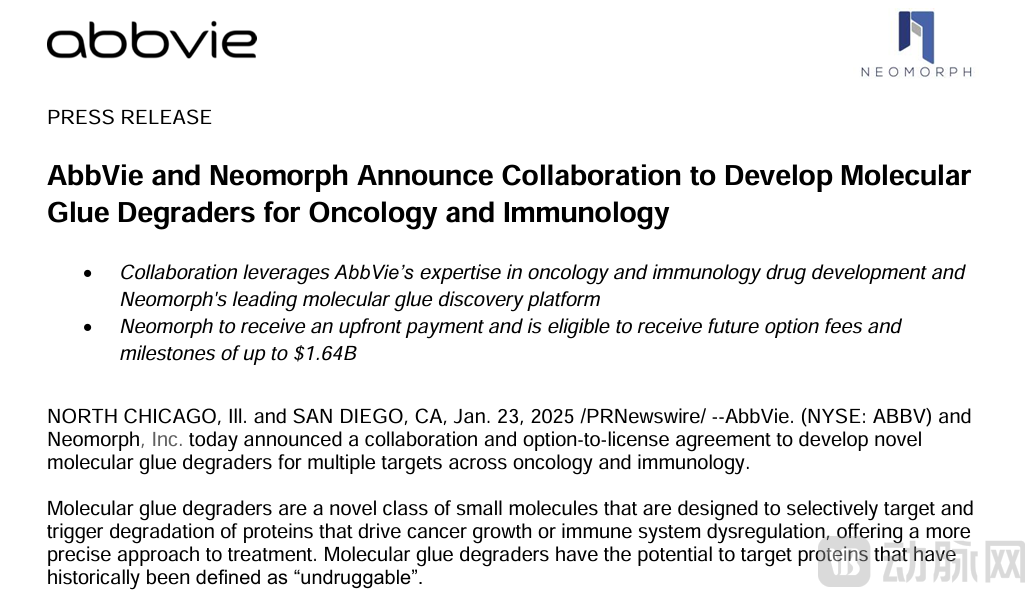
On January 23 local time, AbbVie and Neomorph jointly announced that they had reached a collaboration and option licensing agreement to co-develop novel molecular glue degraders targeting multiple oncology and immunology targets. Under the terms of the agreement, Neomorph will receive an upfront payment from AbbVie and is eligible to receive up to $1.64 billion (approximately RMB 11.9 billion) in option fees and milestone payments, as well as tiered royalties on net sales.
Source: Neomorph Official Website
Neomorph, Inc. was founded in 2020 as an innovative biotech company focused on the field of molecular glue degraders, discovering and developing drugs for "undruggable targets." The company was initially co-founded by venture capital firm Deerfield Management Company and scientific founders Phil Chamberlain, Eric Fischer, Benjamin Ebert, and Scott Armstrong. In the same year of its establishment, Neomorph announced a $109 million Series A financing round.
Regarding this collaboration, Steven Elmore, Vice President of Small Molecule Therapeutics and Platform Technology at AbbVie, stated, "Protein degraders represent a breakthrough advancement in the field of drug discovery, and AbbVie is committed to advancing this technology. We are excited to collaborate with Neomorph to develop novel molecular glue degraders, which could bring new and effective therapies for immune diseases and cancer."
Phil Chamberlain, Ph.D., Co-founder, President, and CEO of Neomorph, stated, "At Neomorph, we have spent years building a unique and broadly applicable technology platform across the proteome. We are thrilled to partner with AbbVie, a global leader in oncology and immunology, and look forward to jointly discovering and addressing some of the most challenging and high-value targets."
In addition to this collaboration with AbbVie, Neomorph has gained favor from top multinational corporations (MNCs) in recent years. Just last year, the company successively reached major collaborations worth over $1 billion each with two MNCs, Novo Nordisk and Biogen.
In February 2024, Neomorph and Novo Nordisk entered into a collaboration to jointly discover, develop, and commercialize multiple molecular glue degraders. Neomorph will lead the discovery and preclinical activities for specific targeted drugs, while Novo Nordisk has obtained exclusive rights for further clinical development and commercialization of the collaboration projects. Under the agreement, Neomorph will receive an upfront payment, near-term milestone payments, and R&D funding. Neomorph is also eligible to receive milestone payments with a total potential value of up to $1.46 billion (approximately RMB 10.5 billion), as well as tiered royalties.
In October 2024, Neomorph and Biogen entered into a collaboration to jointly discover and develop molecular glue degraders for the treatment of Alzheimer's disease, rare neurological disorders, and immunological conditions. Biogen and Neomorph will collaborate to identify, validate, and optimize small molecule molecular glue degraders targeting several high-priority targets, with Biogen advancing the further development and potential commercialization of clinical candidates. Under the agreement, Neomorph will receive an upfront payment and is eligible for milestone payments totaling up to $1.45 billion (approximately RMB 10.343 billion).
Interestingly, in 2024, these two collaborations were respectively announced by Novo Nordisk and Biogen, marking their first foray into the molecular glue degrader field. Moreover, to date, Neomorph remains the only publicly known molecular glue company to have partnerships with two multinational corporations (MNCs). The recognition of Neomorph by MNCs in the molecular glue degrader space is evident.
In fact, this is AbbVie's second collaboration in the molecular glue field in recent years. The first collaboration was in April 2022, when AbbVie announced an exclusive strategic partnership with Plexium to develop and commercialize novel targeted protein degradation (TPD) therapies for neurological diseases. Under the agreement, Plexium is responsible for the preclinical research of the collaborative projects, and AbbVie paid Plexium an undisclosed upfront fee. In addition to tiered royalties at the commercialization stage, Plexium is also eligible to receive additional milestone payments and product development fees.
In recent years, including the aforementioned MNCs, BI, Merck, Johnson & Johnson, BMS, Roche, MSD, Eli Lilly, Sanofi, Bayer, Takeda, Eisai, and other multinational corporations (MNCs) as well as large pharmaceutical companies have been aggressively expanding into the molecular glue field. The fundamental reason these MNCs are betting on this area is that, although molecular glue is highly ideal, very few molecular glue degraders have been discovered so far. Their discovery has largely been accidental, lacking systematic discovery and design strategies. Therefore, large enterprises hope to bet on new technology platforms to accelerate the discovery of molecular glue.
Not only are overseas giants scrambling to compete in this field, but domestic innovative companies are also laying out plans for molecular glue. For instance, Jia Yue Pharma, Biaoxin Biotech, Dagene Bio, InnoCare Pharma, Zhengda Tianqing, Kangpu Biotech, StarRising NeoBiologics, Fendy Pharma, Globi Biotech, Youji Pushi, BeyondSpring Pharmaceuticals, Shengrui Zehua, Shanghai Chaoyang, Yinocon, and Aureo Pharma, among other Chinese companies, have all established molecular glue drug pipelines or built platforms for molecular glue drug discovery.
Among them, a number of China-based molecular glue innovator companies have gained recognition from MNCs and embarked on their overseas journey.For example, in May 2024, Jiayue Pharmaceuticals reached a global exclusive licensing agreement with U.S.-based Erasca for the Pan-RAS(ON) inhibitor JYP0015 at $3.45 billion; in the same month, Degron Biotech partnered with Takeda Pharmaceutical to utilize its GlueXplorer platform to discover, validate, and optimize molecular glue degraders targeting specific disease targets selected by Takeda, with a potential total transaction value of up to $1.2 billion.
In addition to the aforementioned overseas companies, progress in China's molecular glue field has also been extremely rapid. Several companies, including KANGPU Biopharmaceuticals, BIAOxin Bio, and GEB Biotech, have announced significant advancements in the past year. Currently, multiple molecular glue drug pipelines in China have been approved to enter the clinical research stage. This means that in the field of molecular glue, which multinational pharmaceutical companies are vying to develop, Chinese innovative companies have not been absent and are standing in the global first tier.
Although the field of molecular glue degraders still faces numerous challenges, with the intensive exploration by MNCs and biotech companies, the application scope of molecular glue degrader drugs will continue to expand, extending from oncology to autoimmune diseases, neurodegenerative diseases, and more, offering patients access to a wider range of medications. In summary, AbbVie has successfully fired the first shot of a major 2025 collaboration in molecular glue. We look forward to molecular glue continuing its strong momentum throughout the rest of 2025!
References:
"MNC Spends $100 Billion on Shopping Spree, This Track is on Fire"