

ROR1: A Promising Receptor Tyrosine Kinase Target in Hematologic Malignancies – Prospectus Highlights
Jan 26, 2025 17:11
CST Updated
17:11

MSD
Pharmaceutical R&D and Manufacturer
Basic Information of ROR1
Structure and Function: ROR1 is a member of the receptor tyrosine kinase (RTK) family, with immunoglobulin-like domains (IG), Frizzled (FZD), and Kringle (KRD) domains extracellularly, and a tyrosine kinase domain (TRD), proline-rich domain (PRD), and two serine/threonine-rich domains intracellularly. It is involved in cell differentiation and tissue/organ formation during embryonic development, downregulated in adult tissues, but reactivated in various malignant tumors, where it is associated with tumor cell survival, proliferation, migration, and drug resistance. Signal Pathway: ROR1 activates downstream signaling pathways such as MAPK/ERK, STAT3, and NF-κB by binding to WNT proteins like WNT5a, influencing cell proliferation, survival, epithelial-mesenchymal transition (EMT), and drug resistance. Additionally, ROR1 also interacts with pathways such as PI3K/AKT/mTOR, BMI-1, and YAP/TAZ.
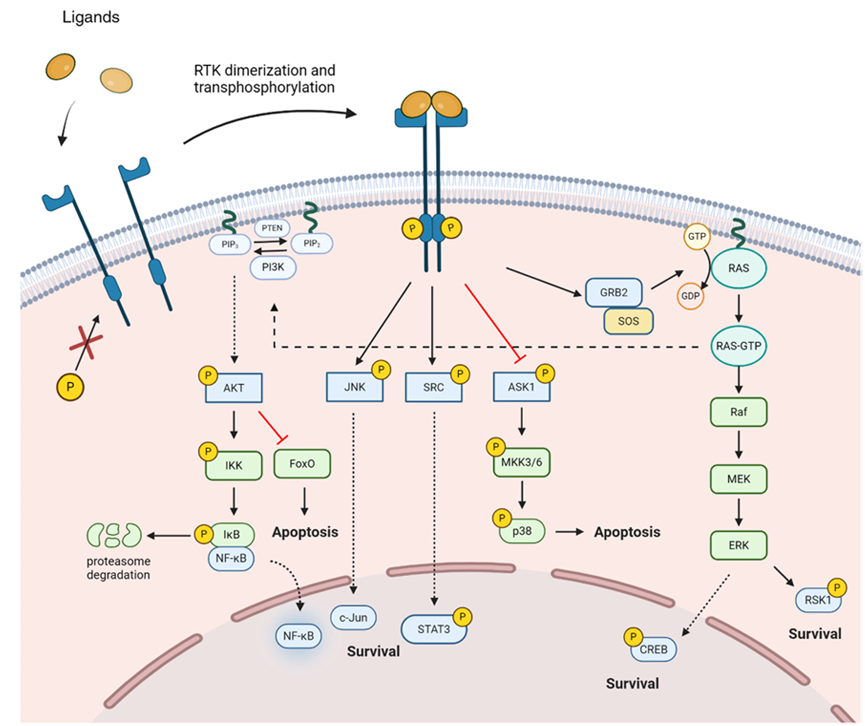
Chronic Lymphocytic Leukemia (CLL): Since 2001, it has been considered a specific marker of CLL, with its expression increasing as the disease progresses. It is associated with disease progression and poor prognosis, promoting tumor cell survival, proliferation, migration, and drug resistance by activating related pathways through binding with Wnt5a, inhibiting apoptosis protein expression, and increasing pro-apoptotic protein expression. In CLL, ROR1 is associated with BCL2 expression. The deletion (13q) leads to the loss of miRNA-15a and miRNA-16-1, causing overexpression of ROR1 and BCL2. A high percentage of CLL patients are ROR1 positive, but approximately 5% of cases show very low expression levels. CLL patients with high ROR1 expression have shorter median treatment-free survival and overall survival and are associated with resistance to venetoclax. Mantle Cell Lymphoma (MCL): ROR1 is highly expressed in MCL and is associated with an increased rate of cell proliferation, such as promoting MCL cell growth by forming a complex with CD19. Silencing the ROR1 gene can inhibit cell growth and increase cell death. MCL is a rare B-cell non-Hodgkin lymphoma characterized by chromosomal translocations, and treatment methods vary depending on patient factors, including chemotherapy, immunotherapy, and targeted therapy, etc.212223. Diffuse Large B-Cell Lymphoma (DLBCL): ROR1 expression is associated with poor prognosis in DLBCL and is more commonly seen in primary refractory DLBCL, Richter syndrome, and transformed follicular lymphoma. Knockdown of ROR1 inhibits the growth of DLBCL cells. DLBCL is a common type of non-Hodgkin lymphoma with high heterogeneity. Common treatment methods include R-CHOP chemotherapy and rituximab, but some patients still experience relapse or are refractory, necessitating new therapeutic targets and strategies2425. Acute Myeloid Leukemia (AML): Approximately 35% of AML patients express ROR1 in their cells, and it is also expressed in AML cell lines such as THP1, MV4-11, and NB4, suggesting that ROR1 therapy may be effective for AML.
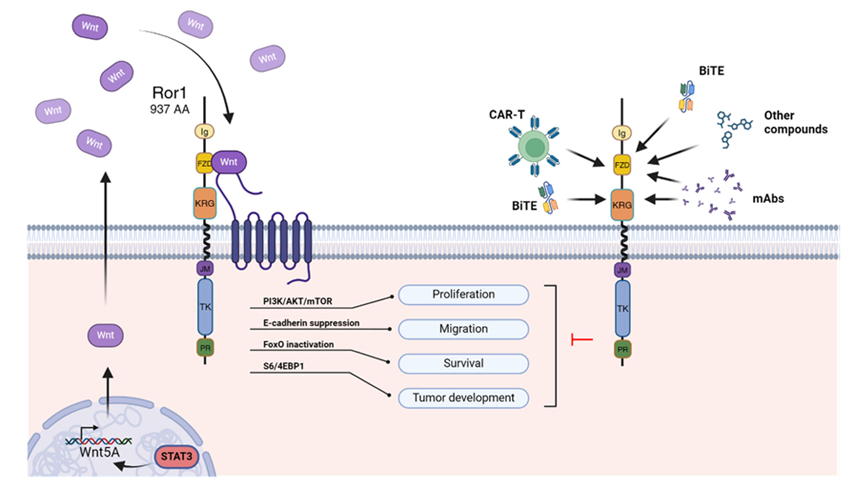
Small Molecule Inhibitor: Such as KAN0441571C and KAN0439834, which can target the extracellular or intracellular domains of ROR1, block its activity and related signaling pathways, and have shown apoptosis-inducing effects in tumor cells such as CLL, MCL, and DLBCL. Some drugs can increase tumor cell apoptosis and inhibit their survival when used in combination with other drugs in preclinical studies. Monoclonal Antibody: Such as cirmtuzumab (UC-961) and anti-ROR1 mAbs, which can induce cytotoxicity and inhibit its signaling by binding to ROR1. Cirmtuzumab has shown certain efficacy in CLL and MCL patients, reducing the number of tumor cells, and exhibits synergistic effects when used in combination with venetoclax. However, mAbs targeting ROR1 display varying levels of cytotoxicity in CLL treatment, with some antibodies showing higher toxicity in primary CLL samples. ADCSuch as zilovertamab vedotin (ZV), huXBR1-402-G5-PNU, and CS5001, which exert cytotoxic effects by conjugating anti-ROR1 antibodies with cytotoxic drugs to target tumor cells and release the drug for killing. ZV has been tested in clinical trials for various lymphomas and solid tumors, showing certain antitumor activity and manageable safety. These ADCs have demonstrated inhibitory effects on the proliferation of ROR1-positive tumor cells in preclinical studies and early clinical trials. CAR-T Cells and BiTECAR T-cell therapy uses genetically engineered T cells targeting ROR1, demonstrating a cytolytic effect on tumor cells in the treatment of CLL and MCL. However, due to ROR1 expression in some normal tissues, potential toxicity may exist. BiTEs represent a novel immunotherapy approach that simultaneously binds CD3 on T cells and ROR1 on tumor cells, harnessing the immune system for specific tumor cell killing. For instance, BiTEs targeting ROR1 and CD3 have shown antitumor activity in preclinical studies with lower toxicity. These methods provide new immunotherapy options for the treatment of hematologic malignancies.
ROR1 is overexpressed in various hematological malignancies and is associated with tumorigenesis, progression, and drug resistance, making it a potential therapeutic target. Multiple therapeutic strategies targeting ROR1 are under development and in clinical trials, including small molecule inhibitors, monoclonal antibodies, ADCs, CAR T cells, and BiTEs, some of which have demonstrated promising efficacy and safety. Future research directions include further exploration of the biological functions and signaling pathways of ROR1, optimization of treatment strategies, such as combination therapies, development of novel drugs, etc., to enhance therapeutic efficacy, overcome drug resistance, and reduce toxicity, providing more effective treatment options for patients with hematologic malignancies.