

Neurotech Firm Niantong Intelligence Secures Tens of Millions in Pre-A+ Round to Accelerate AI-Driven Medical Applications
NIANTONG INTELLIGENCE
Developer, Manufacturer, and Seller of Limb Rehabilitation Devices
VCBeat learned that Shanghai Niantong Intelligent Technology Co., Ltd. (hereinafter referred to as "Niantong Intelligence"), a brain-computer interface company, has recently completed a Pre-A+ round of financing worth tens of millions of yuan. This round of financing was led by Shanghai Da Ling Hao Wan Ce Yuan Venture Capital Fund and Shanghai Dong Rui Investment, with follow-up investments from existing shareholders Shenzhen Changyingxin Investment Co., Ltd. and Six-Harmony Ventures.
According to Shu Xiaokang, Chairman & General Manager of NIANTONG INTELLIGENCE, the company's brain-controlled exoskeleton rehabilitation system product (eCon-Hand Brain-Computer Interface Active Rehabilitation Training System) has entered the final stage of applying for a Class III medical device registration certificate from the NMPA. The financing funds will be used to accelerate the market expansion and implementation of this product. On the other hand, the company plans to further expand the disease coverage of its brain-computer interface artificial intelligence medical devices, and the funds will be utilized to expedite product development and clinical research efforts.
NIANTONG INTELLIGENCE, incubated at Shanghai Jiao Tong University in 2016, is a high-tech enterprise specializing in EEG and related technology research and development, providing innovative solutions for the diagnosis and treatment of brain diseases. The core members of the team have participated in national 973 Program projects and key R&D program projects, making it one of the earliest teams in China to explore the clinical application of brain-computer interfaces. Currently, NIANTONG INTELLIGENCE has a vibrant R&D technical team with an average age of only 31. Among them, R&D personnel account for more than half of the team. In addition to having a solid engineering technology background, NIANTONG INTELLIGENCE also realizes "medical-engineering integration" through in-depth technical cooperation with multiple universities and scientific research institutes such as Shanghai Jiao Tong University and deep clinical cooperation with outstanding domestic medical institutions such as Huashan Hospital Affiliated to Fudan University and Ruijin Hospital Affiliated to Shanghai Jiao Tong University School of Medicine, accelerating the transformation of scientific research results and market promotion.
In 2024, NIANTONG INTELLIGENCE made achievements in multiple fields: The eCon-Hand brain-computer interface active rehabilitation training system developed by the company completed the first GCP clinical study of a rehabilitation brain-computer interface in China and entered the registration application stage; it was approved for the Shanghai "Science and Technology Innovation Action Plan" elderly care technology support project, becoming the only brain-computer interface enterprise in this project approval; it successfully developed a high-lead multimodal physiological monitoring system, which is expected to serve the precise diagnosis of various neurological diseases.
Currently, stroke remains one of the major chronic diseases threatening the health of residents in China. Stroke is characterized by the "five highs": high incidence, high recurrence rate, high disability rate, high mortality, and high economic burden. It is the leading cause of disability in China today, often resulting in limb paralysis, speech disorders, swallowing difficulties, cognitive impairment, consciousness disorders, and mental depression, severely affecting the quality of life of patients and imposing a tremendous burden on families and society.
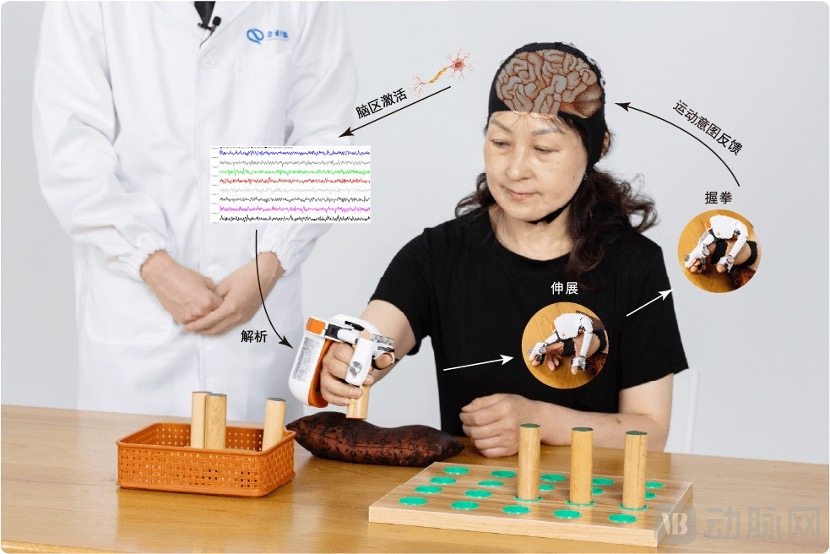
In the past, the rehabilitation of stroke patients often relied on rehabilitation physicians, with a long rehabilitation process and heavy burden on patients. NIANTONG INTELLIGENCE has developed the eCon-Hand Brain-Computer Interface Active Rehabilitation Training System for stroke patients. This system can accurately measure patients' EEG signals and, with the help of artificial intelligence technology, convert the brain's motor intentions into motion control commands for paralyzed limbs, providing patients with a more effective and economical active rehabilitation treatment model. According to reports, clinical trial results show that this system can more efficiently assist patient recovery, with a significantly higher treatment efficacy rate compared to traditional rehabilitation techniques.
The rapid advancement of products into clinical settings is related to NIANTONG INTELLIGENCE's understanding of "brain-computer interfaces." Emphasized by Shu Xiaokang, Chairman and General Manager of NIANTONG INTELLIGENCE, "In my view, the core of brain-computer interfaces lies in EEG signal measurement and AI algorithm recognition, a typical application of artificial intelligence technology in medical scenarios. Both NIANTONG INTELLIGENCE and the entire industry are exploring technological breakthroughs in EEG acquisition and AI algorithms. The company has developed non-invasive EEG acquisition devices covering 11 models with 1-128 channels, achieving the domestic production substitution for imported EEG acquisition equipment; meanwhile, we will continue to explore advancements in AI algorithms. The EEG field also requires integration with large AI models to achieve more accurate analysis results. In the future, the brain-computer interface sector may lean more towards AI development, focusing on algorithm innovation and the expansion of large-scale EEG data."
Currently, NIANTONG INTELLIGENCE has established clinical collaborations with more than 50 hospitals. In addition to gradually addressing stroke rehabilitation issues, NIANTONG INTELLIGENCE is also focusing on populations affected by autism, Alzheimer's disease, and disorders of consciousness. In the future, the company will further strengthen its efforts in the diagnosis and treatment of these brain-related conditions.
In the field of brain-computer interfaces, multiple favorable policy-level developments have emerged in quick succession. Various "Five-Year Plans" in Beijing, Shanghai, and other regions have listed brain-computer interfaces and artificial intelligence as key development directions. The "brain intelligence industry" has been explicitly identified as one of the future industries that Shanghai aims to prioritize; by the end of 2024, the National Healthcare Security Administration issued the "Guidelines for Establishing Rehabilitation Medical Service Price Projects (Trial)," further accelerating the expansion of AI-assisted technologies in the rehabilitation sector; recently, Shanghai's finance department established the Shanghai Future Industry Fund, with a scale of 10 billion yuan and a duration of 15 years, which will "focus on supporting future industries such as future manufacturing, future information, future materials, future energy, future space, and future health," with brain-computer interfaces being a typical case within "future health."
The positive momentum of industry development will undoubtedly further boost brain-computer interface companies such as NIANTONG INTELLIGENCE to reach new heights.
Regarding this round of financing, Shu Xiaokang stated, "The rapid completion of this round of financing is related to many advantages of the company: The company was the first to complete GCP clinical trials for rehabilitation brain-computer interfaces and is also the only enterprise in China to enter the application stage for a Class III registration certificate for rehabilitation brain-computer interfaces. The company has been deeply involved in the brain-computer interface field for many years, maintaining close cooperation with top domestic universities and hospitals, and has a well-established medical-engineering collaboration mechanism. In 2022, non-invasive brain-computer interfaces for limb function rehabilitation were listed as one of the five key future industry directions in the 'Action Plan for Shanghai to Build a High Ground for Future Industrial Innovation and Develop Future Industrial Clusters.' What we are doing aligns perfectly with the government's key focus areas, which is both an opportunity and a responsibility."
About Dalinghao Bay Origin Venture Capital Fund
"Greater Zero Bay" is one of the key承载areas for Shanghai to build a globally influential science and technology innovation center, as well as one of the three pilot areas for future industries. Centered around the innovative ecosystem of universities like Shanghai Jiao Tong University, it serves as the core source and承载area for闵行's high-level technological self-reliance and the development of advanced industrial innovation. The Greater Zero Bay Source Venture Capital Fund, jointly initiated by闵行District and Lingang Group as cornerstone investors, is an industry-guiding fund and a crucial financial empowerment platform to accelerate the transformation of scientific and technological achievements within the region. With the mission of accelerating the productization, industrialization, and commercialization of hard-core technological innovations, the fund focuses on future industries such as future health, future intelligence, future energy, future space, and future materials. It fully leverages its advantages in industry, finance, policy, and services, concentrating resources to support invested companies and drive industrial development.
About Dongrui Investment
Shanghai Dongrui Investment, headquartered in Xuhui District, Shanghai, was jointly established by Donghao Lansheng Exhibition Group Co., Ltd. and Shanghai Ruili Investment Fund Management Co., Ltd. It is an industrial investment platform that integrates industry and finance and promotes synergy, relying on several major state-owned groups as shareholders, including Shanghai Donghao Lansheng Group, Shanghai United Media Group, Shanghai Industrial Group, and Shanghai International Group. The company's managed funds cover investment fields such as exhibitions and events, high-end equipment, aerospace, artificial intelligence, and semiconductors.