Septic infection after artificial joint replacement is a very serious complication. Although the infection rate has dropped from about 10% in the early days to the current 1%–3%, due to the increasingly widespread use of artificial joint replacement and the growing number of procedures, the number of patients with concurrent infections is also gradually increasing.Once patients develop infections, their survival chances will drop significantly, even lower than those of cancer.Patient. For exampleAfter Unicompartmental Knee ArthroplastyPatient OccurrenceProsthesis survival 5 years after initial infection treatmentThe survival rate is 49%. By 2030, infections following artificial joint replacement surgeries will cost the U.S. healthcare system up to $1.8 billion. Clinically, 60-70% of early and delayed periprosthetic joint infections are caused by contamination during surgery.If avoiding infections in artificial joint replacement surgery becomes a continuing necessityTackle a clinical issue.Onkos SurgicalDeveloped a coating with antibacterial functions ---NanoCept, and use it for its joint replacementSwitching products. Last yearNanoCeptAlready received FDA approval and completed the first clinical surgery this year.
 "Limb salvage and revision surgeries are challenging, with complication rates much higher than most orthopedic procedures. Every time I take a patient to the operating room, the risk of implant infection is always on my mind, especially for cancer patients, as they are more susceptible to infections. NanoCept technology represents a significant advancement for me and my colleagues in preventive measures aimed at mitigating potentially devastating complications associated with intraoperative bacterial contamination of implants. It has the potential to create a paradigm shift in implant selection and will be a valuable tool that surgeons now have, possibly aiding in addressing unresolved clinical issues."---Steven Gitelis Rush University Medical Center
"Successfully completing these initial surgeries is a key achievement and significant milestone in our strategy to deploy NanoCept technology across our entire product portfolio. We believe NanoCept is a platform technology that will greatly expand our reach and capabilities in the broad orthopedic market, and we are actively working to expand regulatory approvals beyond ELEOS to include implants for orthopedic reconstruction in oncology, trauma, and other orthopedic revision surgeries."
---Patrick Treacy, CEO and Co-founder of Onkos Surgical
NanoCept
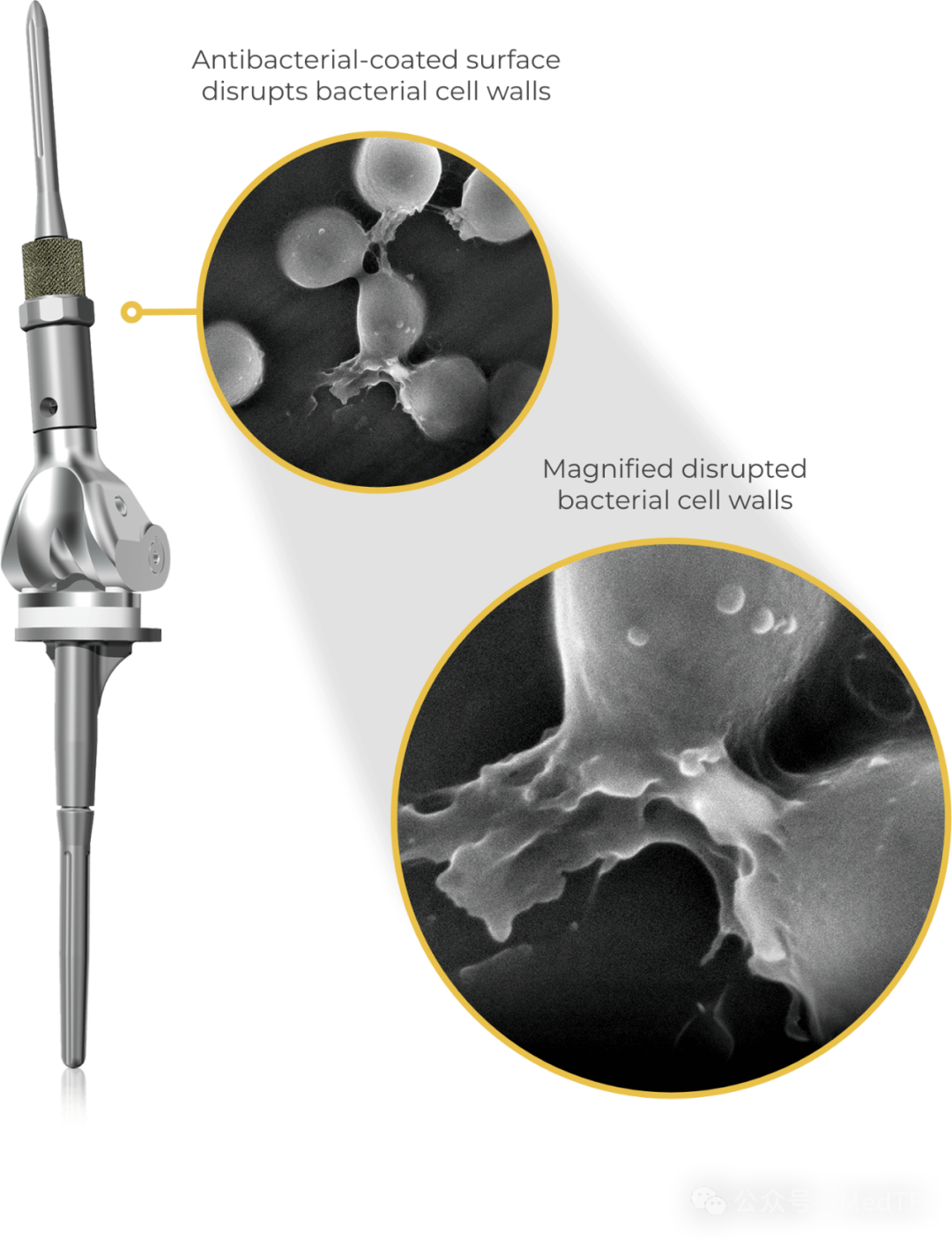
NanoCeptIt is the first antibacterial coating technology that can protect implants from bacterial invasion during pre-implantation surgery. It can be covalently bonded to the surface of bone implants, achieving a permanent antibacterial effect.
NanoCeptThe thickness on the surface of the implant is extremely thin, only 70 nanometers thick (1/1000 the thickness of a human hair). Therefore, the coatingNanoCeptThe bone implant does not affect the normal use of the implant.
- Demonstrated excellent safety and biocompatibility in preclinical in vivo and in vitro studies;
- Provides broad-spectrum efficacy (common bacteria in operating rooms)Killing rate up to 99.999%)
- Avoiding Bacterial Resistance Issues Through Non-Eluting Nanoscale Surfaces
Onkos SurgicalIs a leader in innovative solutions for complex orthopedic diseases. Through our novel product portfolio, surgeons can gain better insights into patient-specific clinical challenges and are empowered to plan and execute more precise reconstructions. Our personalized approach supports the latest innovations in improving patient outcomes and experiences, including the use of antimicrobial implant coatings, virtual surgical planning, 3D anatomical modeling and printing, implant design, and workflow optimization.