

Nearly $100M Raised to Overcome RNAi Brain Delivery Hurdles; Potential First-in-Class Depression Therapy Advances to Phase 3

Atalanta Therapeutics
Biological New Drug Developer
▎WuXiEdited by Kant Content Team
Breaking Through the RNAi Therapeutics Brain Delivery Bottleneck, Newcomer Completes $97 Million Series B Financing
Atalanta Therapeutics Announces $97 Million Series B Financing to Support Phase 1 Clinical Trials of RNAi Therapeutics for KCNT1-Related Epilepsy and Huntington's DiseaseThe company's unique and innovative di-siRNA drug design has demonstrated widespread distribution in the brain and spinal cord, as well as significant persistence in the brain in preclinical studies. A single administration of di-siRNA showed gene silencing potential lasting 6 months or longer., which may allow for once or twice yearly dosing in the clinical setting.

Atalanta Therapeutics' R&D pipeline includes multiple RNAi therapies for treating central nervous system diseases. Among them, ATL-201 is an investigational therapy for treating KCNT1-related epilepsy. KCNT1-related epilepsy is a condition caused byKCNT1Early-onset epilepsy caused by gain-of-function mutations in genes. Children often experience severe and frequent epileptic seizures, which cannot be effectively controlled by existing anti-epileptic drugs, and are often accompanied by developmental delays and intellectual disabilities.ATL-201 is designed to reduce KCNT1 levels and normalize neuronal excitability. Preclinical studies have shown that ATL-201 significantly reduces seizures, improves behavior, and demonstrates good durability and tolerability.
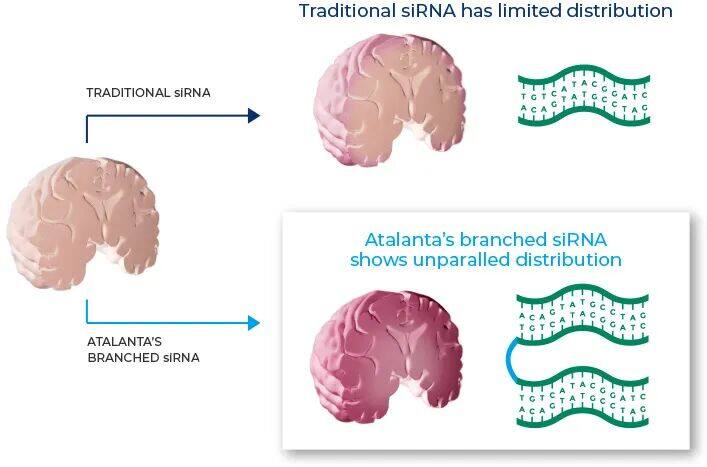
▲Atalanta Therapeuticsdi-siRNADesign Improvement in Drug Distribution Within the Brain (Image Source: Atalanta Therapeutics Official Website)
Another Candidate DrugATL-101 is designed to silenceHTTGene Therapy for Huntington's Disease.Huntington's disease is a progressive neurodegenerative disorder caused byHTTCaused by the amplification of specific sequences in genes, leading to a gradual deterioration of the patient's physical, cognitive, and mental abilities. Preclinical studies have shown that a single dose of ATL-101 can significantly reduce levels in deep brain regions.HTTGene expression, with effects lasting up to six months and demonstrating excellent tolerability.
Development of Potential "First-in-Class" Weight Loss Therapy, Newcomer Completes $65 Million Series A Financing
Recently, Helicore Biopharma announced its emergence from stealth mode and the completion of a $65 million Series A financing round. This round was co-led by Versant Ventures and OrbiMed, with participation from Longitude Capital and Wellington Management.

Helicore Focuses on Developing Potential “First-in-Class”Glucose-dependent insulinotropic polypeptide(GIP) antagonist, used for treating obesity and related health issues.Its most advanced candidate therapy in development, HCR-188, is an anti-GIP monoclonal antibody currently in clinical development. The company’s pipeline also includes GIP-targeting antibody-drug conjugates, GLP-1 drugs, and combination therapies, aimed at addressing specific subpopulations of obesity patients.
Helicore's R&D strategy leverages insights gained from human genetics, proprietary preclinical data, and third-party clinical studies. Individuals with GIP or GIP receptor loss-of-function mutations may be less prone to obesity due to reduced triglyceride uptake mediated by the GIP signaling pathway in adipocytes.HCR-188 in combination with GLP-1 drugs demonstrated a preferential reduction in fat over lean mass in preclinical studies, potentially offering higher quality weight loss compared to GLP-1 drugs alone.
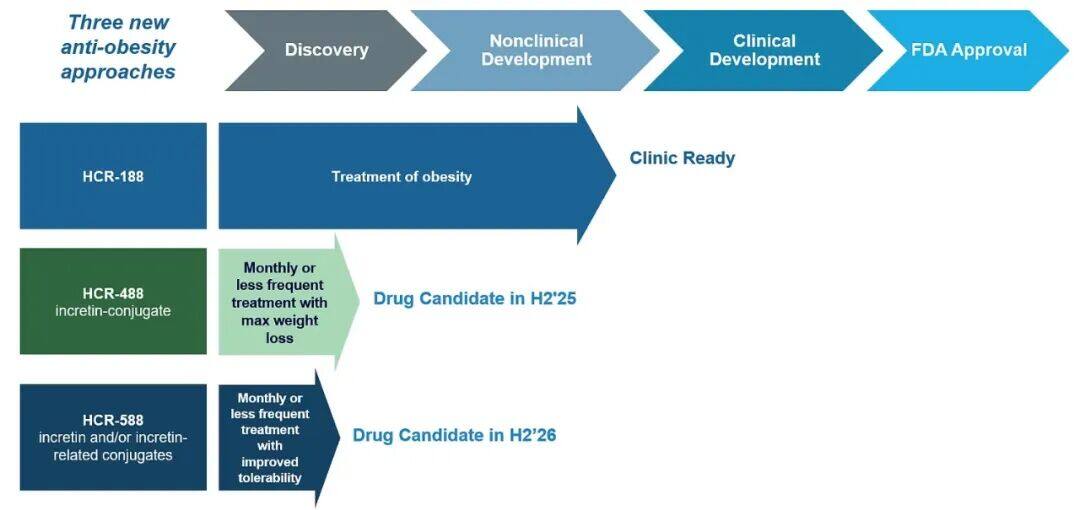
▲Helicore Biopharma's R&D Pipeline (Source: Helicore Biopharma's Official Website)
Moreover, by binding to GIP in the periphery, HCR-188 may block GIP from entering the central system, preventing GIP signaling in the brain, potentially restoring leptin sensitivity, reducing food intake and fat accumulation while promoting satiety. Inhibiting GIP also offers cardiometabolic benefits, particularly when used in combination with GLP-1 drugs.
The first human clinical trial of HCR-188 is expected to obtain top-line data in the second half of 2025. Helicore's R&D activities are supported by Versant's discovery engine, Ridgeline, in the field of protein engineering.
Potential "First-in-Class" Depression Therapy Advances to Phase 3 Clinical Trials
Neurocrine Biosciences recently announced the initiation of a pivotal Phase 3 clinical trial to evaluate the efficacy and safety of the investigational therapy osavampator (previously known as NBI-1065845) as an adjunctive treatment for depression. The company also announced an update to its development agreement with Takeda for the co-development of osavampator, securing exclusive development rights for osavampator in all regions outside of Japan.

Osavampator is a potential "first-in-class" AMPA receptor positive allosteric modulator (PAM).Published in 2024Phase 2 Clinical TrialSAVITRI's topline data show that patients treated with osavampator demonstrated statistically significant improvements in the Montgomery-Åsberg Depression Rating Scale (MADRS) total score at both Day 28 (primary endpoint) and Day 56 (secondary endpoint).

▲To learn more about the application of cutting-edge technologies in the biopharmaceuticals industry, please long-press and scan the QR code above to access "WuXi Live Studio" and watch live discussions and exciting replays on related topics.


Share,PointLike,In View,Focusing on Global Biomedical Health Innovation