

Novartis' Investigational Radiopharmaceutical [225Ac]Ac-PSMA-617 Receives IND Approval in China for Metastatic Castration-Resistant Prostate Cancer

Novartis
Drug Development and Manufacturing
On February 6, according to the CDE official website, the clinical trial application for [225Ac]Ac-PSMA-617 Injection submitted by Novartis was accepted (acceptance number: JXHL2500015). [225Ac]Ac-PSMA-617 (AAA817) is a radiopharmaceutical conjugate (RDC) targeting PSMA, indicated for prostate cancer.
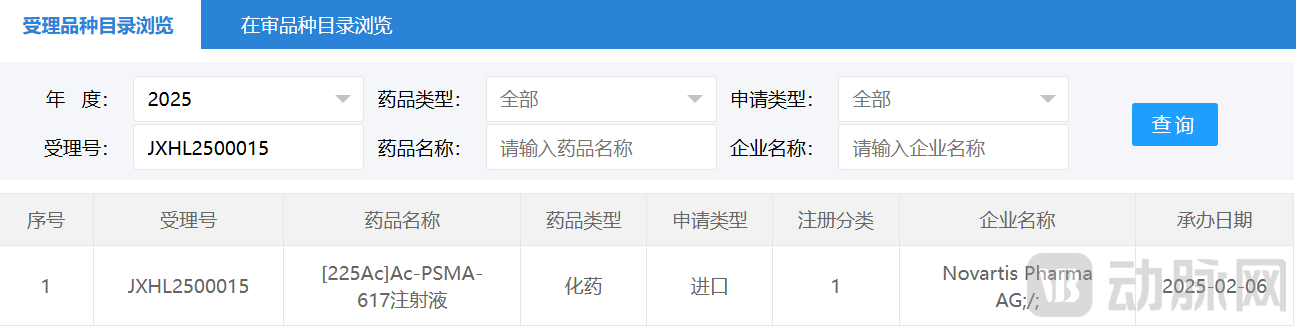
Source: CDE Official Website
Currently, AAA817 is progressing rapidly in overseas clinical trials. Novartis has registered a Phase II/III clinical trial for Ac-PSMA-617 (AAA817) on the ClinicalTrials website. According to available information, the drug is being explored for its efficacy in PSMA-positive metastatic castration-resistant prostate cancer (mCRPC) patients who have received androgen receptor inhibitors and taxane-based drugs and have experienced disease progression during or after treatment with 177Lu-PSMA. The trial is expected to enroll 432 patients.
AAA817 is an Ac-255 labeled RDC targeting PSMA. RDC, also known as Targeted Radionuclide Therapy (TRT), works by combining tumor-specific ligands with radionuclides to selectively kill tumors. This approach utilizes targeted molecules labeled with radioactive isotopes for disease treatment, delivering precise radiation therapy to lesions within the body.
RDC is the only drug in clinical practice that can achieve integrated diagnosis and treatment. Its characteristic lies in the ability to form an integrated diagnostic and therapeutic product by only changing the radionuclide part while keeping the related targeting moiety and linker similar. This allows for precise targeting, linking with lutetium [Lu-177] or actinium [Ac-225] to create therapeutic products, saving research and development costs and making it more convenient for doctors to administer precise medication to patients. This is currently the only field in clinical practice that can realize the concept of integrated diagnosis and treatment.
The rapid advancement of the AAA817 pipeline is attributed to the aforementioned principle. The ligand structure of AAA817 is identical to that of Novartis' marketed product Pluvicto (177Lu-PSMA-617), with the key difference being the use of the radionuclide Ac-255. As Novartis' key RDC product, Pluvicto has achieved remarkable success in treating mCRPC. The drug was approved by the FDA for marketing in March 2022 and received approval from the CDE for domestic marketing in November 2024. In 2024, Pluvicto generated sales of $1.392 billion, representing a year-over-year increase of 42%.
Compared with the β particles emitted by Pluvicto's Lu-177, the α particles emitted by AAA817's Ac-255 have higher linear energy transfer, which can induce clustered DNA damage, such as double-strand DNA breaks and base chemical modifications, and this type of damage is difficult for cells to repair. Moreover, α particles have a shorter range, measuring only micrometers in tissue. Therefore, targeted α therapy has the potential to eradicate cancer cells while minimizing damage to normal tissues, potentially enhancing the effectiveness of PSMA-targeted radioligand therapy.
Currently, AAA817 is in Phase I/II clinical trials outside of China. According to Phase I/II data, among 40 patients with advanced prostate cancer, AAA817 led to a prostate-specific antigen (PSA) reduction of over 50% in 63% of patients, with an average tumor control duration of 9 months.
The registration of AAA817 on the ClinicalTrials website indicates that this pipeline is about to enter Phase II/III clinical trials, becoming the fastest advancing asset among Novartis' radiopharmaceuticals in development. It is expected to follow in the footsteps of Lutathera and Pluvicto, Novartis’ two leading RDC radiopharmaceuticals, and become the next RDC "blockbuster."
AAA817: Besides Being a Highly Anticipated RDC Star Pipeline, Its Loaded α Nuclide Ac-255 is Also Worth Attention. Ac-225 has a half-life of 9.9 days, ranking high among α nuclide drugs, and the formulated Ac-225 radiopharmaceutical can have a shelf life of up to 120 hours. Moreover, Ac-225 drugs show promising therapeutic potential for tiny tumor lesions widely distributed throughout the body and can be used for conditions such as pancreatic cancer, prostate cancer, neuroendocrine tumors, and leukemia.
According to incomplete statistics, globally, there are approximately 20 Ac-225 nuclear medicine pipelines entering clinical trials. According to the global market research by Clairvoyance Research in 2022, the annual demand for Ac-225 is expected to reach about 17Ci by 2025 and 523Ci by 2031. It is not difficult to see that, as an α nuclide with high linear energy transfer, appropriate half-life, short particle range, and good coordination ability, Ac-225 has already become one of the hottest R&D areas in the field of α nuclides.
Spotting this hotspot, MNCs have aggressively entered the Ac-225 field in recent years. For example, in December 2023, BMS acquired Rayzebio, a star company in nuclear medicine, for $4.1 billion; in March 2024, AstraZeneca acquired Fusion, a novel radiopharmaceutical company, for $2.4 billion; in May 2024, Novartis acquired Mariana Oncology, a nuclear medicine biotech company, for $1.75 billion; in May 2024, Eli Lilly collaborated with Aktis Oncology to develop innovative nuclear medicines for $1.16 billion; and in January 2025, Dongcheng Pharmaceuticals' joint venture Qi Kang Medical signed a strategic licensing agreement with Eckert & Ziegler for €10 million. Behind all these cases looms the presence of Ac-225.
Currently, the FDA has not yet approved radiopharmaceuticals based on the Ac-225 isotope, and any MNC entering this field could potentially emerge as the ultimate winner. Among the numerous MNCs and large pharmaceutical companies布局Ac-225, Novartis, the "big brother" in nuclear medicine, faces its strongest competitor in BMS.
BMS's RYZ101 (acquired through the purchase of Rayzebio) is currently the most advanced Ac-225 drug, having entered Phase III clinical trials. However, the pipeline was forced to pause in June 2024 due to a shortage of the Ac-225 radionuclide but resumed trials in July 2024. BMS has now postponed the reading of the Phase III trial results for RYZ101 from 2025 to 2026. If the Phase III clinical trial of RYZ101 is successful, BMS will take the lead over Novartis in introducing the first approved Ac-225 radiopharmaceutical therapy to the clinic.
Overall, in the field of nuclear medicine, Novartis has rapidly built up its radioligand therapy technology platform through acquisitions in recent years and owns two blockbuster products, Lutathera and Pluvicto, securing its leading position in nuclear medicine. Meanwhile, in the Chinese market, IPO companies such as Dongcheng Pharmaceutical, Grand Pharmaceutical, and China Isotope & Radiation Corporation have been expanding rapidly. New players like Lanatcheng, Grand Pharmaceutical, Nuoyu Pharmaceutical, Xiantong Pharmaceutical, Fulllink Pharmaceutical, and Hexin Pharmaceutical have also joined the fray, making the nuclear medicine market highly prosperous.
Radiopharmaceuticals have already demonstrated their advantages in the market, such as precise targeting, powerful killing effects, limited damage, and integrated diagnosis and treatment, gradually becoming the next significant wave of innovation in cancer treatment. In the future, how Novartis will continue its successful market presence in the radiopharmaceutical field remains to be seen over time. Meanwhile, we also look forward to the accelerated rise of China's nuclear medicine industry to catch up with and surpass overseas multinational corporations (MNCs).
References:
1. Key Points | Safety and Efficacy of 225Ac-PSMA-617 in the Treatment of Metastatic Castration-Resistant Prostate Cancer
2. "Nuclear Medicine Industry White Paper: Reviewing Nearly 7,000 Pipelines Globally, Competing in Target, Ligand, and Radionuclide Innovation"
3. "Novartis: New Generation 'Blockbuster' Radiopharmaceutical Receives IND Acceptance in China for Prostate Cancer Treatment"