

Nearly Half of Patients Achieve Complete Remission: Roche's Breakthrough Therapy Gazyva Shows Superior Efficacy in Phase 3 Lupus Nephritis Trial Published in The New England Journal of Medicine

Roche
Oncology Drug Research, Development, and Manufacturing

Genentech
Pharmaceutical R&D Manufacturer
▎WuXiEdited by Kant Content Team
Today, Genentech, a subsidiary of Roche, announced that the detailed analysis of the Phase 3 clinical trial REGENCY for the anti-CD20 antibody therapy Gazyva (obinutuzumab) in treating patients with active lupus nephritis has been published in The New England Journal of Medicine. The data shows,Gazyva Combined with Standard Therapy Meets Primary Endpoint of the Trial, Significantly Improving Complete Renal Response (CRR) Rate in PatientsThe company is sharing these data with regulatory agencies, including the U.S. FDA and the European Medicines Agency. The press release noted,Gazyva is the first anti-CD20 monoclonal antibody to demonstrate CRR benefits in a randomized Phase III clinical trial for lupus nephritis.

The test data shows,Among patients receiving Gazyva in combination with standard treatment (mycophenolate mofetil and glucocorticoids), 46.4% achieved CRR at 76 weeks, compared to 33.1% of those receiving standard treatment alone (difference: 13.4%, 95% CI, 2.0%–24.8%; p=0.0232).At the same time, significant improvements in complement levels and reductions in anti-double-stranded DNA antibody levels indicate clinically meaningful improvements in both disease activity and inflammation.
Key secondary endpoints showed that at Week 76, patients receiving Gazyva in combination with standard therapy were more likely to achieve CRR and successfully reduce the use of glucocorticoids compared to those receiving standard therapy alone. Additionally, a higher proportion of patients treated with Gazyva plus standard therapy showed improvement in proteinuria levels. These endpoints are all important indicators for achieving better control of lupus nephritis. The safety profile of Gazyva is consistent with its well-established safety data observed in hematologic cancer indications.
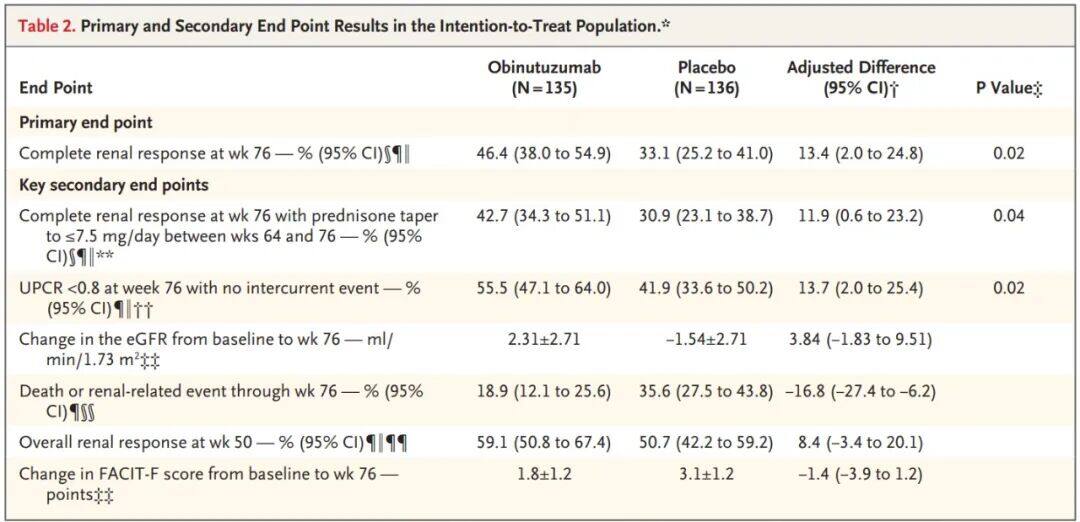
▲Primary and Secondary Endpoint Data of Gazyva in the Phase 3 Clinical Trial REGENCY (Image Source: Reference [2])
Lupus nephritis is a potentially life-threatening autoimmune disease that affects approximately 1.7 million people worldwide, primarily women. Even with various treatment options available today, up to one-third of patients still progress to end-stage renal disease within 10 years, at which point only dialysis or kidney transplantation are viable options, and the risk of death remains extremely high.
Gazyva is a humanized monoclonal antibody against CD20, a protein expressed by certain types of B cells. In lupus nephritis, pathogenic B cells drive persistent inflammation, leading to kidney damage. By depleting these pathogenic B cells with Gazyva, the underlying cause of lupus nephritis can be targeted., to help better control the disease, protect the kidneys from further damage, and potentially prevent or delay disease progression to end-stage renal disease. This was previously based on data from the Phase 2 clinical trial NOBILITY,The U.S. FDA has granted Gazyva Breakthrough Therapy Designation for the treatment of lupus nephritis.。

In recent years,The treatment strategy of deeply depleting B cells for autoimmune diseases has made significant progress in multiple clinical trials.In February last year, The New England Journal of Medicine published aA Landmark Research Achievement。The first 15 patients with severe autoimmune diseases who received CD19-targeted CAR-T therapy continued to maintain remission or showed significant symptom reduction at a median follow-up of 15 months, and had ceased the use of all immunosuppressive and anti-inflammatory medications.CD19 is a common antigen expressed on the surface of B cells. CAR-T cell therapy targeting CD19 has demonstrated remarkable efficacy in treating B-cell hematologic malignancies. In 2024, several companies dedicated to developing CAR-T cell therapies announced R&D programs using CAR-T therapy for autoimmune diseases, including systemic lupus erythematosus (SLE), myasthenia gravis, multiple sclerosis, and other disease types.

Beyond CAR-T therapies targeting B cells,Bispecific antibody therapies targeting B cells also show potential in the research for treating autoimmune diseases.Published in The New England Journal of Medicine in September last yearTwo StudiesResults show that patients with refractory autoimmune diseases treated with Tecvayli (teclistamab), a bispecific antibody targeting B-cell maturation antigen (BCMA) developed by Johnson & Johnson, experienced significant relief. Notably, in one SLE patient, SLE biomarkers decreased to normal or near-normal levels, with complete disappearance of mucocutaneous and musculoskeletal symptoms, achieving complete remission.
Looking forward to the development strategy of B-cell depletion bringing more treatment options and benefiting a wide range of patients with autoimmune diseases.

▲To learn more about the application of cutting-edge technologies in the biopharmaceuticals industry, please long-press and scan the QR code above to access "WuXi Live Studio" and watch live discussions and exciting replays on related topics.
Disclaimer: The content team of WuXi AppTec focuses on introducing the research progress in global biopharmaceuticals and health. This article is intended solely for the purpose of information exchange. The views expressed in the article do not represent the position of WuXi AppTec, nor does it imply that WuXi AppTec supports or opposes these views. This article is not a recommendation for treatment plans. For guidance on treatment options, please visit a正规 hospital.
Copyright Statement: This article is from the content team of WuXi AppTec. Individuals are welcome to share it on their social media platforms, but unauthorized reproduction by media or institutions in any form to other platforms is prohibited. For authorization to reproduce, please reply "reprint" on the WeChat Official Account of "WuXi AppTec" to obtain the reprint guidelines.


Share,PointLike,In View, Focusing on Global Biomedical Health Innovation