BioGeometry Leverages Generative AI to Achieve 1000-Fold Enhancement in Neutralizing Antibody Activity Against JN.1 Variant

BioGeometry
Large Molecule Drug Developer
(Synthetic Biology Network) Recently,BioGeometry Collaborates with Zhu Jianwei's Team from the School of Pharmacy, Shanghai Jiao Tong University, based onGenerative AIA driven antibody optimization strategy that precisely optimizes the 8G3 antibody in a short period, achieving its neutralizing activity against the latest viral variant JN.1.1000-1500xThe leap.The relevant research findings have been officially published in the international top journal *Proceedings of the National Academy of Sciences* (PNAS).【1】,Following the optimization cases of CR3022 antibody, tumor antigen 5T4 nanobody, and more【2】, once again demonstrating the broad applicability and transformative potential of generative AI-driven antibody engineering.
Generative AI + Antibody Engineering
Precision Optimization of 8G3 Antibody, Neutralizing Activity Increased 1000-1500 Times
The rapid evolution of the viral genome and the continuous emergence of new variants increase the complexity of treatment., most of the early developed antibodies can no longer accurately identify and effectively bind to their targets, resulting in a significant decline in neutralization ability. Therefore, keeping up with the evolutionary patterns of the virus, optimizing existing antibodies, and accelerating the development of broad-spectrum, highly effective new antibodies have become crucial to addressing this challenge.
BioGeometry and Zhu Jianwei's team utilizeGeoBiologics Intelligent Protein Computing Platform, combined withGenerative AIAndGeometric Deep Learning, constructedAn Efficient Antibody Optimization Process. This method provides a reusable technical pathway, accelerating the design and screening of novel antibodies.
8G3 Antibody is a Broad-Spectrum Neutralizing Antibody Screened by Zhu Jianwei's Team from Early Recovered Patients, Demonstrating Strong Neutralization Ability Against BA.1 and Multiple Variants (Alpha, Beta, Gamma, Delta, Kappa, BA.1, BA.2, BA.5). However, its neutralization efficacy significantly decreases when faced with the later-emerging BA.2.75 and subsequent strains. Regarding the latestJN.1 VariantStrain(First discovered in August 2023, it is still listed by the WHO as a variant of concern)Variant VOC), where the potency drops to one-thousandth of its original level, rendering it almost completely ineffective.
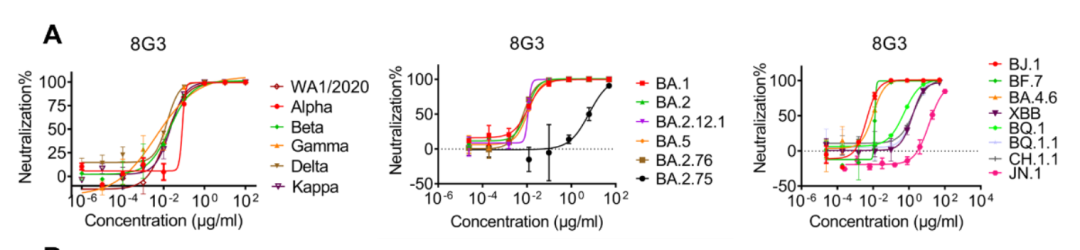
Neutralizing Activity of the Original 8G3 Antibody
Its neutralizing ability against JN.1 has significantly decreased.
In order to meet this challenge, BioGeometry relies onGeoBiologicsOne-stop intelligent protein computing platform for generative AI-driven systematic optimization of the 8G3 antibody. The research team adopted a two-round optimization strategy to precisely enhance the neutralizing activity of 8G3 and its affinity for the JN.1 strain:
First Round of Optimization: AI-Precise Screening of Single-Point Mutations
AI algorithm accurately identified 50 potential single-mutation molecules and screened out multiple mutation sites that significantly enhanced neutralizing activity, among whichThe best single-point mutation can increase neutralizing activity by 47 times.
Round 2 Optimization: AI-Driven Combinatorial Mutagenesis
Based on the first round of experimental data, BioGeometry further fine-tuned its self-developed GeoBiologics platform.Geometric Deep Learning Algorithm GearBind, accurately predict and recommend the bestCombination Mutation Scheme:
· Double-point mutation(101F+96V/96I) Enhances Neutralizing Activity100-300x。
· Four-point mutation Enhance Neutralizing Activity1000-1500x, reaching8.5 ng/ml, or evenBeyond 8G3's neutralization ability against the original strain。
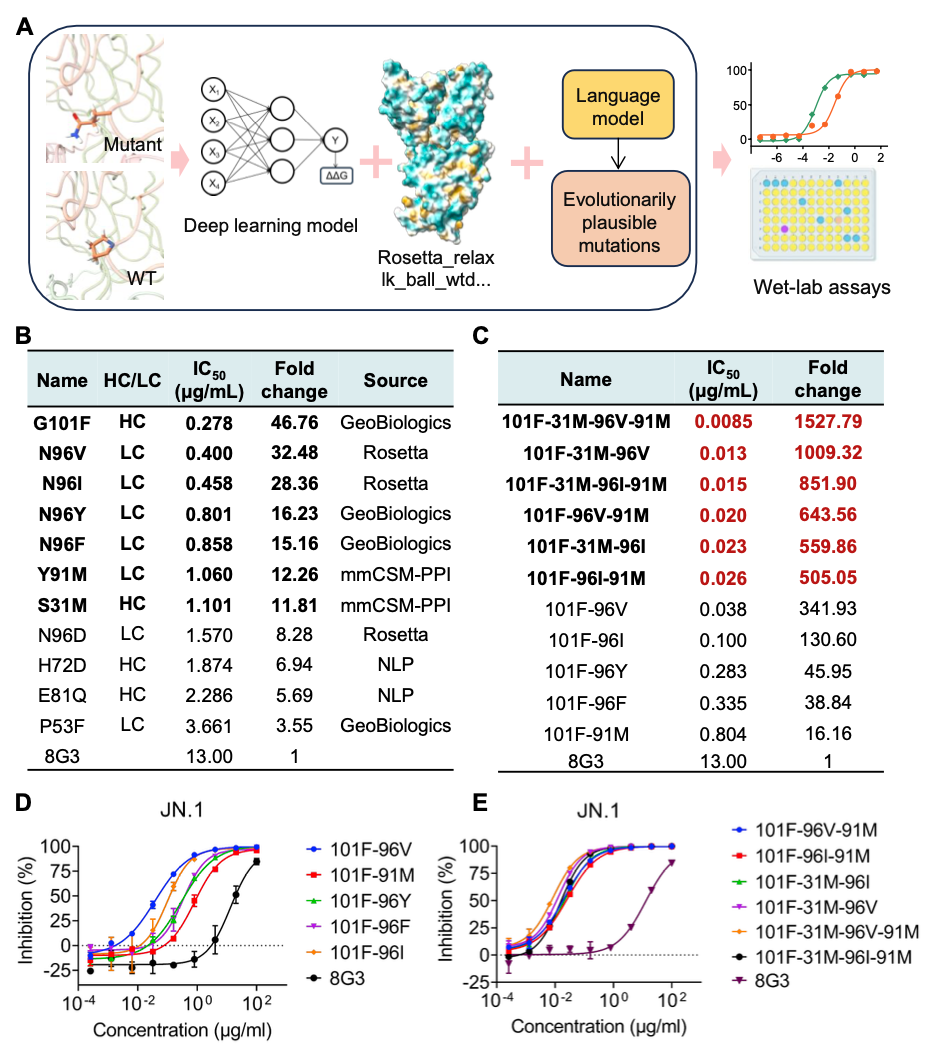
GeoBiologics Platform Efficiently Optimizes 8G3 Antibody, Increasing Its Neutralization Capability Against JN.1 by 1500 Times
The Excellent Performance of GearBind
It has long been traceable.
GearBind is an antibody affinity optimization model based on geometric graph neural networks.The research成果 has been published in another international top journal, 《Nature Communications》.【2】。
This model breaks through the limitations of traditional wet-lab screening and is able toWithin just 1-2 rounds of optimization, significantly enhance antibody affinity, reduce experimental time by 70%, and save 75% of experimental costs.。
The Core Innovation of GearBind
Multi-Relational Graph Neural Network
GearBind constructs a global interaction graph containing multi-level interactions at the antibody-antigen binding interface, capturing information across multiple scales such as atomic-level, residue-level, and amino acid-level, thereby accurately predicting the affinity changes of mutants.
Multi-Level Message Passing
A multi-level information transfer mechanism is adopted, comprehensively considering the structural and sequential proximity of proteins, enabling the model to learn antibody-antigen binding characteristics at three scales: atom, atom pair, and amino acid. It exhibits exceptional modeling capability, especially in cases involving side-chain rearrangement and conformational changes.
Contrastive Pretraining
GearBind uses contrastive learning technology and has been pre-trained on a large amount of unsupervised protein structure data, enabling it to not only accurately fit known antibodies but also generalize to unseen new antigen epitopes, enhancing the adaptability and scalability of antibody optimization.
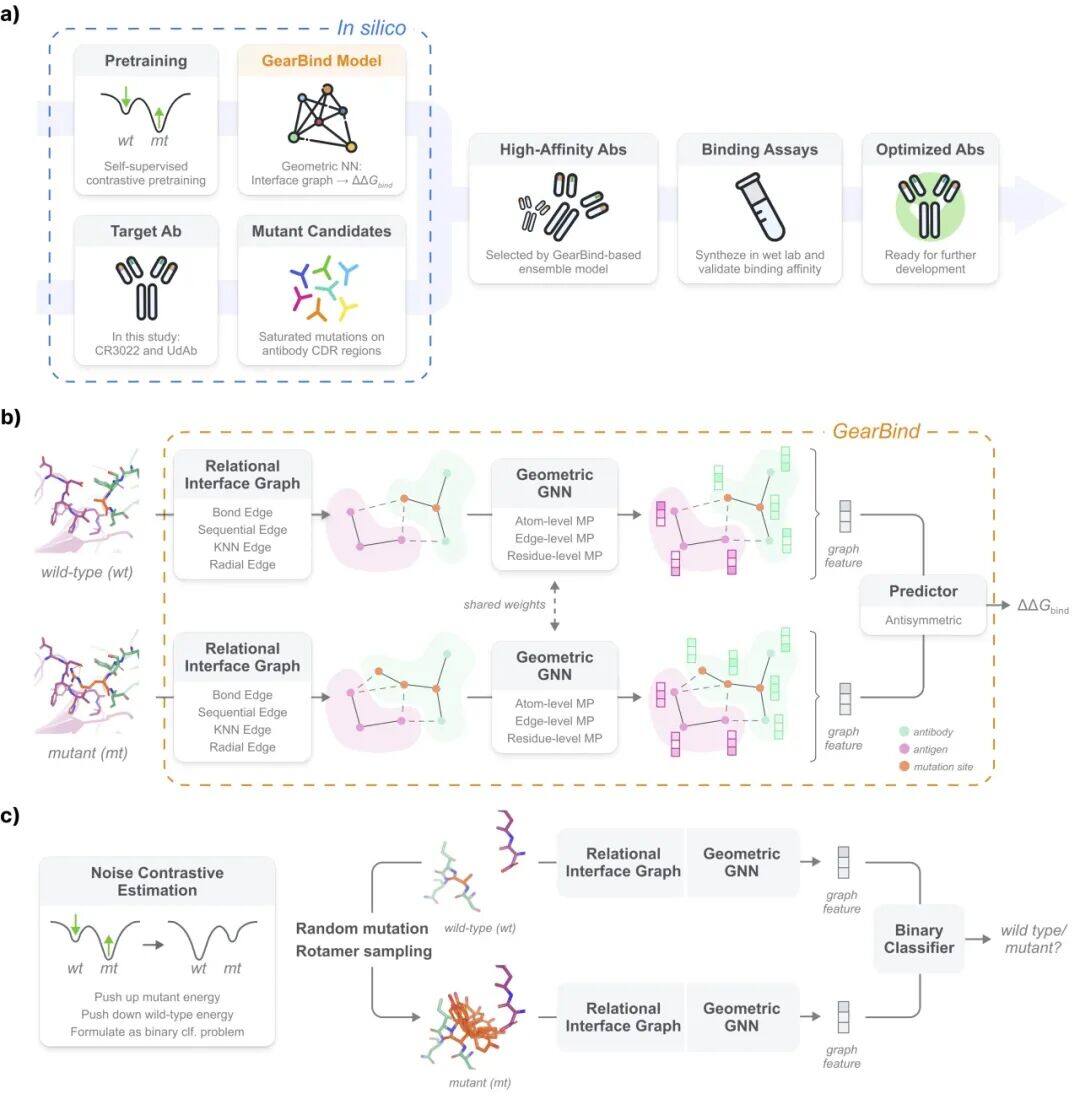
(Upper) GearBind Geometric Neural Network Architecture Diagram
(Lower) GearBind Pre-training Flowchart
The excellent performance of GearBind is not limited to 8G3 antibody optimization; it has long demonstrated strong application potential in various biopharmaceutical tasks.
For example, in targetingCR3022 Antibody Optimization ExperimentIn China, GearBind accurately predicted the affinity changes of mutants, with 9 out of 12 recommended point mutations achieving affinity improvement, boasting an accuracy rate as high as75%After validating only twenty mutants, further combinatorial optimization resulted in a final mutant that reduced the EC50 of the viral strain.7.6-17 times, Antigen binding affinity enhanced6.1 times, reachingLow nM Level, significantly enhancing the neutralizing ability of CR3022. In addition, inOptimization of Nanobodies for Tumor Antigen 5T4During the task, GearBind also demonstrated strong generalization capabilities, successfully reducing the EC50 with mutants screened on unseen antigenic epitopes.5.6 times。
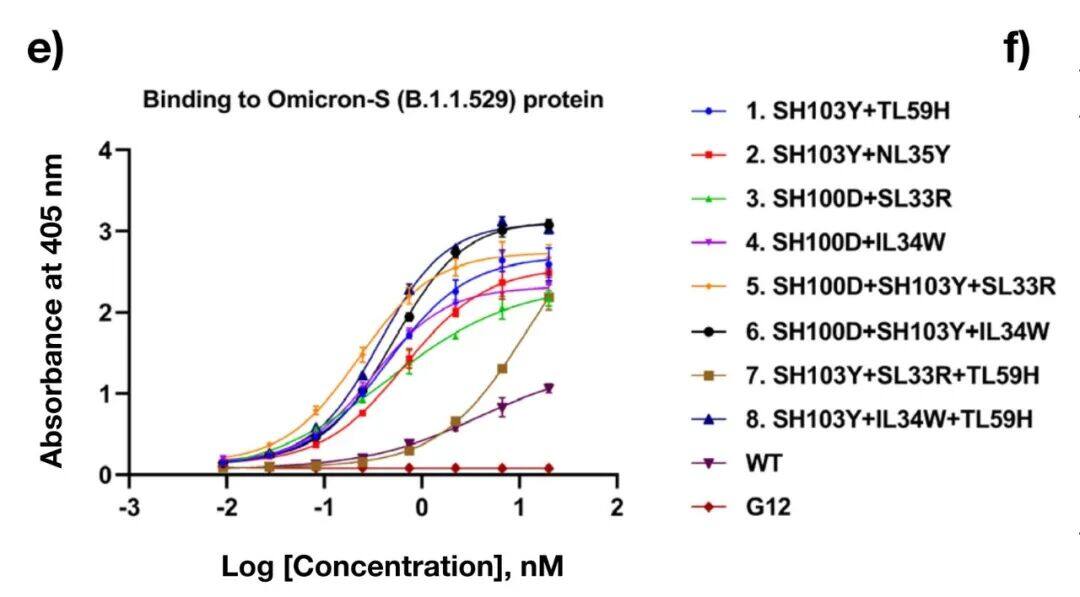
ELISA Binding Assay Results of Various CR3022 Mutants to Omicron Spike
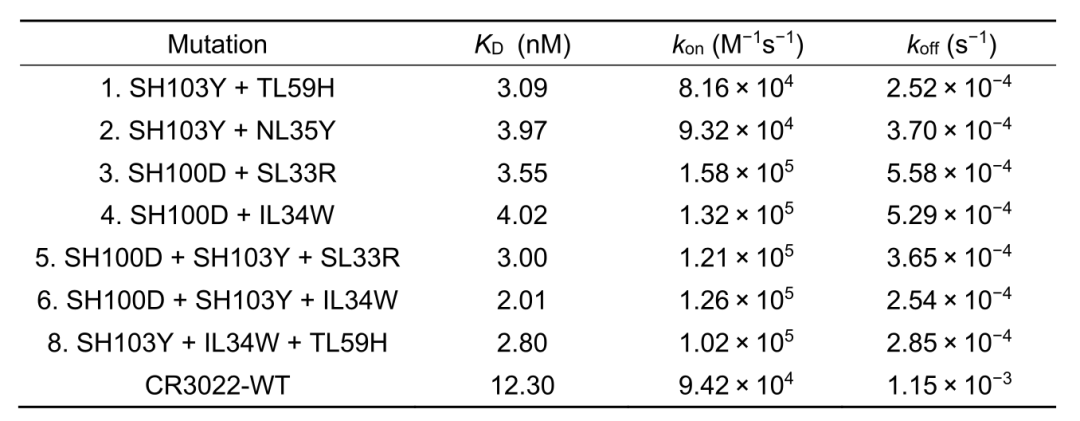
BLI Experimental Results of Each CR3022 Mutant on Omicron Spike
The interaction between proteins is at the core of biological systems, and affinity serves as the foundation for the function of many biomolecules. However, traditional affinity optimization processes heavily rely on wet-lab screening, requiring researchers to search for the optimal mutant within a vast space of mutation combinations. This process is not only time-consuming and labor-intensive but also highly costly. For instance, when considering only single-point mutations, the 60 amino acids in the CDR regions of a monoclonal antibody can generate over a thousand mutants. If extended to double-point, triple-point, or even more complex mutation libraries, the experimental workload will grow exponentially, making traditional optimization strategies insufficient for new antibody development.
This study shows that generative AI exhibits great potential in fields such as antibody optimization and biomanufacturing. By de novo designing and multifunctional optimizing proteins through generative AI, the structure and function of proteins can be precisely controlled to improve the affinity, stability, and broad-spectrum properties of antibodies. This technical framework helps to quickly respond to complex biological challenges, promote the development of intelligent biomanufacturing, and provide better support for human health.Efficient, Accurate, Reusable, and Scalable Strategies and Methodologies。
References:
【1】Y. Liao, H. Ma, Z. Wang, S. Wang, Y. He, Y. Chang, H. Zong, H. Tang, L. Wang, Y. Ke, H. Cai, P. Li, J. Tang, H. Chen, A. Drelich, B. Peng, J. Hsu, V. Tat, C.K. Tseng, J. Song, Y. Yuan, M. Wu, J. Liu, Y. Yue, X. Zhang, Z. Wang, L. Yang, J. Li, X. Ni, H. Li, Y. Xiang, Y. Bian, B. Zhang, H. Yin, D.S. Dimitrov, J. Gilly, L. Han, H. Jiang, Y. Xie, & J. Zhu, Rapid restoration of potent neutralization activity against the latest Omicron variant JN.1 via AI rational design and antibody engineering, Proc. Natl. Acad. Sci. U.S.A. 122 (6) e2406659122, https://doi.org/10.1073/pnas.2406659122 (2025).
【2】Cai, H., Zhang, Z., Wang, M. et al. Pretrainable geometric graph neural network for antibody affinity maturation. Nat Commun 15, 7785 (2024).
https://doi.org/10.1038/s41467-024-51563-8