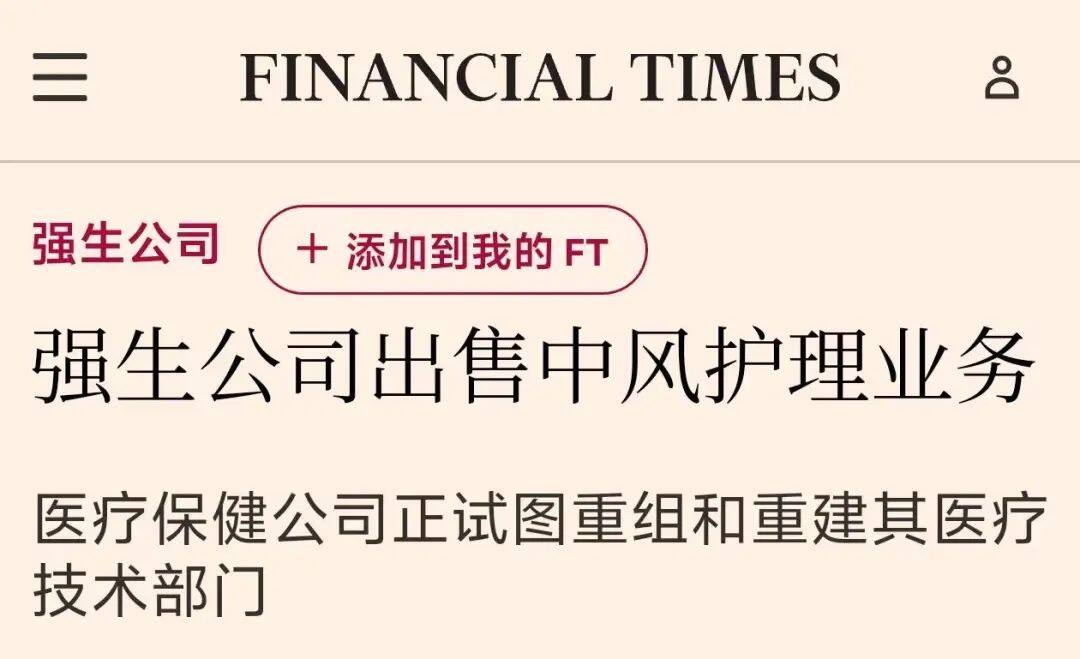
In February 2025, the Financial Times reported that Johnson & Johnson planned to sell its stroke treatment business, Cerenovus.Valuation between $1 billion (approximately RMB 7.3 billion) and $1.5 billion (approximately RMB 11 billion)Sources reveal that Johnson & Johnson has reached out to potential private equity and strategic buyers through advisors to gauge market interest in Cerenovus. While Johnson & Johnson has not yet directly responded to the rumors, this divestiture plan aligns closely with the company’s recent strategic restructuring direction.
Cerenovus:
Johnson & Johnson's "Legendary" Ace in the Stroke Field
Cerenovus is a brand under Johnson & Johnson MedTech that focuses on neurovascular business, dedicated to the research, development, and promotion of treatment solutions for ischemic and hemorrhagic strokes. Established in 2017, the business integrated Pulsar Vascular, a cerebral aneurysm device manufacturer previously acquired by Johnson & Johnson, and Neuravi, a neurovascular technology company. Its name originates from the Latin words "Cere" (new) and "Novus" (brain), symbolizing an innovative vision in the field of neurointervention.

Cerenovus' product line covers multiple key aspects of stroke treatment: In ischemic stroke treatment, mechanical thrombectomy devices, such as the CereGlide catheter, can quickly remove blood clots and restore blood supply to the brain; in hemorrhagic stroke treatment, embolization technologies, such as the TRUFILL™ Liquid Embolic System, effectively block the risk of aneurysm rupture. The core of its technology lies in minimally invasive intervention, which significantly reduces patient trauma and recovery time compared to traditional craniotomy.
Since its establishment, Cerenovus has continuously driven technological innovation, achieving remarkable progress in the neurovascular field. In 2016, Johnson & Johnson acquired brain aneurysm treatment technology through the acquisition of Pulsar Vascular, and subsequently combined Neuravi's thrombectomy technology to form a complete stroke solution. In 2023, Cerenovus launched a new generation of aspiration system, which gained clinical recognition for its efficiency and safety, further consolidating its market position.
Johnson & Johnson's Strategic Adjustment and Business Layout Transformation
It is reported that this sale is not the first time Johnson & Johnson has adjusted its business. In 2023, Johnson & Johnson announced the integration of its five major medical technology sub-brands (such as Ethicon and DePuy Synthes) under the unified "Johnson & Johnson Medical Technologies" brand to streamline its structure and enhance competitiveness. Additionally, in recent years, Johnson & Johnson has frequently optimized its business portfolio through acquisitions and divestitures. For instance, in 2024, it acquired Shockwave Medical for $13.1 billion to strengthen its position in cardiovascular intervention technologies while exiting the consumer products division. The sale of Cerenovus may become another significant move in its focus on core areas.
 Johnson & Johnson is currently the world's second-largest medical device company, second only to Medtronic. Since Joaquin Duato became the new CEO of Johnson & Johnson in 2022, the company has shown strong momentum in the medical device sector, vowing to reclaim its long-lost position as the top player in the industry. To this end, Johnson & Johnson has invested over 30 billion US dollars in mergers and acquisitions in recent years, mainly focusing on the cardiovascular field.
However, the sudden news of the sale of Cerenovus this time reflects multi-faceted considerations. From Johnson & Johnson's own strategic perspective, on the one hand, the acquisition of Shockwave Medical in 2024 has shifted resources towards cardiovascular interventional technology, which may lead toNon-core Business Contraction, Cerenovus may be divested as a result, suggesting limited future growth potential for the Cerenovus business. This indicates that Johnson & Johnson is doubling down on investments in innovation-intensive segments while divesting non-core assets that do not align with its long-term strategy. On the other hand, Johnson & Johnson has faced financial pressures in recent years due to litigation payouts (such as the talcum powder cases) and acquisition expenditures.Selling Assets Can Optimize the Balance SheetMoreover, after the unification of the medical technology brand, the divestment of redundant businesses will help improve operational efficiency.
Industry Competition Pattern and Market Impact
If the sale of Cerenovus is finalized, the neurovascular market landscape could undergo significant changes. Private equity firms may step in, integrating Cerenovus with small to medium-sized technology companies to create a new industry leader; giants like Medtronic and Stryker might also seize the opportunity to strengthen their neurointervention product lines, intensifying the industry's technological competition.

From the perspective of patients and medical institutions, Cerenovus's technology and services will not change in the short term. However, in the long term, if the new owner adjusts the direction of R&D investment, it may affect the iteration speed of innovative products.
Moreover, the spin-off of Cerenovus may be related to Johnson & Johnson's long-term sluggish market value.Johnson & Johnson currently has a market value of only $375.9 billion (a 10% drop from its peak in 2022), with annual sales reaching $88.8 billion. In contrast, Intuitive (market value of over $200 billion, sales of only $8.3 billion)., Johnson & Johnson shareholders are obviously dissatisfied with the current market performance. Similar to BD, once the business growth potential is low, shareholders will demand transactions to drive market value growth.
Global Stroke Treatment Market Size and Future Trends
According to industry analysis,Global Stroke Treatment Market Expected to Grow at a CAGR of 7.2%, Surpassing $45 Billion by 2030. Driving factors include:
- Aging intensifies:The incidence of stroke in people over 65 is three times higher than in other age groups;
- Technological Breakthrough:Innovations such as thrombectomy devices and AI-assisted diagnosis improve treatment success rates;
- Emerging Market Demand:Upgrading of medical infrastructure in countries such as China and India is promoting the establishment of stroke centers.
In the stroke treatment market, ischemic stroke devices dominate with a market share of over 60%. Particularly, mechanical thrombectomy devices are seeing strong market demand due to their significant therapeutic effects. Meanwhile, international medical giants such as Johnson & Johnson and Siemens are increasingly focusing on the development of neurointerventional robotics. It is expected that in the coming years, neurointerventional robotics will become a mainstream technology in the field of stroke treatment.
Johnson & Johnson’s divestiture of Cerenovus deeply reflects the medical giant’s reassessment and strategic adjustment toward high-growth sectors. Currently, fields such as cardiovascular and oncology interventions, with their high-profit returns, have attracted significant resource investment, becoming key areas of focus for major healthcare companies. In terms of acquisition strategies, medical enterprises are increasingly prioritizing technical complementarity between acquisition targets and existing product lines to maximize technological synergies rather than solely pursuing scale expansion.
Johnson & Johnson's Sale of Cerenovus: A Strategic Retreat and Industry Reshuffle. For patients, technological innovation remains the core of improving outcomes; for companies, balancing short-term gains with long-term strategies in a dynamic market will be the key to success. In the future, competition in the stroke treatment field will focus more on precision, minimally invasive procedures, and intelligent solutions. Undoubtedly, Johnson & Johnson’s next move is worth continued attention.
▲ Source of the article: Medical Device Innovation Network▲Please indicate the above source for reprint.Disclaimer: This article is intended solely for the purpose of information transmission and is for reference only. It does not constitute any advice on investment or treatment; please exercise caution. If it involves issues related to the content, copyright, or other aspects of the work, to protect the rights and interests of both parties, please contact us and we will handle it immediately. If any platform reprints this article, it must take responsibility for the content of the article itself. The Medical Device Innovation Network is not responsible for any secondary dissemination caused by the reprint.