

Eli Lilly Strikes First Nuclear Medicine Deal of the Year, Partnering with AdvanCell on Targeted Alpha Therapies

AdvanCell
Radiopharmaceuticals Manufacturer

Eli Lilly
Global Pharmaceutical R&D and Production Company
On February 10, 2025, it was reported that Eli Lilly and Company had reached cooperation agreements with OliX Pharmaceuticals and AdvanCell respectively for its Metabolic Associated Steatohepatitis (MASH) and radiotherapy, further expanding Eli Lilly's layout in related fields.
Among them, the agreement reached between Eli Lilly and AdvanCell will expand their strategic cooperation scope in the field of innovative cancer therapy research and development. The financial terms of the agreement were not disclosed. According to the new agreement, the two parties will integrate AdvanCell's proprietary Pb212 (lead-212) production technology and radionuclide development infrastructure, as well as Eli Lilly’s drug candidate projects and extensive drug development experience, to jointly promote the development of more targeted alpha radionuclide therapies and accelerate their clinical progress.
AdvanCell is dedicated to developing innovative cancer treatment solutions utilizing targeted alpha radionuclides. According to the press release, AdvanCell's technological development advantages and infrastructure for accelerating early clinical trials in Australia enable it to rapidly advance novel Pb212-containing radiotherapeutic drugs from the discovery phase to clinical trials.
Sanofi-backed, Just Completed $112 Million Financing
In fact, AdvanCell has just made a high-profile debut in the capital market.
On February 3, 2025, AdvanCell successfully completed its $112 million Series C financing round with the support of Sanofi Ventures. In addition to Sanofi Ventures, lead investors included SV Health Investors, Abingworth, and SymBiosis. Furthermore, Morningside, which led AdvanCell's $18 million Series B financing in 2022, as well as new investors such as Tenmile and Brandon Capital, also participated in this round.
According to the company's official announcement, the funds will be used to advance its leading candidate drug into clinical trials for prostate cancer. Currently, AdvanCell is recruiting patients for the highest dose cohort of its multi-center TheraPb Ph I/II dose-escalation clinical trial of ADVC001, a potential best-in-class targeted alpha therapy for metastatic prostate cancer. The trial aims to demonstrate the safety and efficacy of Pb-212-based radiopharmaceutical therapy.
212Pb can be obtained through separation and purification from the natural thorium series, irradiated nuclear fuel in reactors, separation and purification of aged (over 10 years) 232U, and by means of accelerators. The supply of 212Pb is mainly achieved through generators such as 224Ra/212Pb (the parent radionuclide suitable for a 212Pb generator in the thorium series), with principles and usage similar to 99Mo-99mTc generators, 68Ge-68Ga generators, and 90Sr-90Y generators. Notably, this form of supply, commonly referred to as a "cow," will make the 212Pb radionuclide more accessible.
However, the process of directly extracting 212Pb from a 228Th decay solution is troublesome, as the main difficulty lies in obtaining a sufficient activity level of the parent nucleus. Both the acquisition and separation processes are challenging due to the handling of long half-life 228Th, which currently can only be performed in an industrial environment. In contrast, since 220Rn is a gas (radon), acquiring 212Pb by capturing 220Rn places lower demands on the separation process for the parent nucleus. The key to obtaining 212Pb lies in having a stable source of high-activity 220Rn and efficient 220Rn collection technology.
Therefore, AdvanCell is precisely the local representative in Australia developing the technology process for obtaining 212-Pb by capturing 220Rn. ARTBIO, a U.S. company in the same field as AdvanCell, believes that once its first project enters the commercial stage, its production method is expected to scale up easily, with the potential to produce more than 20,000 doses of medication annually.
Since November 2020, AdvanCell has developed the world's first targeted alpha therapy based on 212Pb into clinical trials for metastatic prostate cancer. The core product, ADVC001, is designed to bind to PSMA, a clinically validated cell surface target that is highly expressed in prostate cancer. This patented candidate drug has been optimized for safety and efficacy and has demonstrated potential best-in-class properties in preclinical studies.
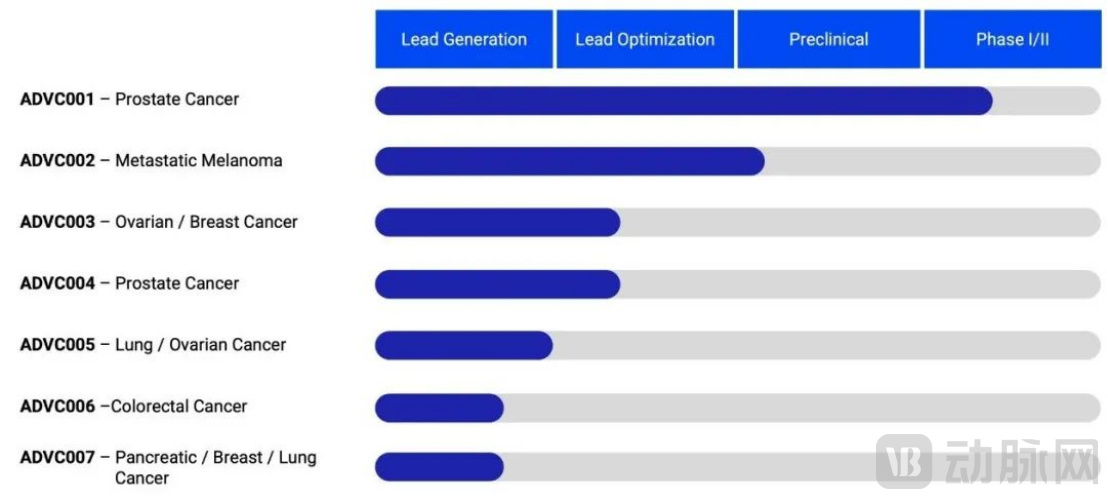
AdvanCell's ongoing ADVC001 Phase I/II trial is a multicenter, open-label study evaluating the safety and efficacy in PSMA-positive mCRPC patients. The primary objective of this trial is to assess safety and tolerability and determine the recommended Phase II dose. Secondary objectives include dose measurement, rPFS by RECIST and PSMA PET-CT, and PSA response. It is reported that multiple Phase I/II clinical trial sites for ADVC001 are now open for recruitment.
Eli Lilly Stirs Up the Billion-Dollar Battlefield
Eli Lilly and Company began to focus on nuclear medicine as early as 2006 and has become one of the most active investors in the nuclear medicine field in recent years.
In September 2023, Eli Lilly invested $175 million in Mariana Oncology, a radiopharmaceuticals R&D company. Just a month later, it acquired Point Biopharma, a radiopharmaceuticals biotechnology company, for $1.4 billion.
Entering the middle of 2024, Eli Lilly first announced in May a multi-target discovery collaboration agreement with Aktis Oncology to produce anti-tumor radiopharmaceuticals using Aktis' novel microprotein technology platform; subsequently, it also announced a strategic partnership with Radionetics Oncology to advance the development of Radionetics’ proprietary GPCR-targeted small molecule radiopharmaceuticals. According to the terms of the agreement, Radionetics received an upfront payment of $140 million.
Radiopharmaceuticals are considered the next golden track after ADC and GLP-1, prompting a group of multinational giants to accelerate their layout. This track is characterized by high barriers and strong regulation, with short half-life radionuclides imposing high demands on production, distribution, and other processes. Currently, pharmaceutical companies in China and abroad are speeding up their efforts in this area. The key lies in how to drive equipment innovation while pursuing drug innovation, enabling more precise application and judgment of radiopharmaceuticals, ultimately leading to continuous optimization of medical scenarios.
Eli Lilly's layout and R&D in the nuclear medicine field will also, in the foreseeable future, join forces with leading pharmaceutical companies like Novartis to usher in a new era of precision oncology diagnosis and treatment.