

ImaBiotech's Novel siRNA Therapy ER2001 Achieves First Patient Dosing in Phase I Clinical Trial, Marking a New Era for Huntington’s Disease Gene Therapy in China

ExoRNA
miRNA Nucleic Acid Drug Developer
"Phase I Clinical Study of ER2001 Injection for the Treatment of Early Manifest Huntington's Disease: A Randomized, Double-blind, Placebo-controlled Trial" received approval for clinical trial from the National Medical Products Administration (NMPA) in early June 2024 and has been granted ethical approval by the Ethics Committee of the First Affiliated Hospital of Sun Yat-sen University to proceed with the clinical study. The study is designed in two phases: dose escalation and dose expansion, with a planned enrollment of 15-27 participants in total. Among them, approximately 10 subjects will be enrolled in the Department of Neurology at the hospital to evaluate the safety and preliminary efficacy of ER2001 Injection.
February 11, 2025, morningThe first subject of this study has successfully received the first dose at the Department of Neurology, First Affiliated Hospital of Sun Yat-sen University, and is in good clinical condition., ushering in a new era of gene therapy for Huntington's disease in China.
ER2001 Injection is a novel nucleic acid drug developed by ExoRNA Bio (Nanjing) Co., Ltd. It delivers siRNA targeting the central nervous system to degrade the Huntington (HTT) gene, thereby reducing the expression of the pathogenic protein in Huntington's disease and achieving therapeutic effects for patients with Huntington's disease.
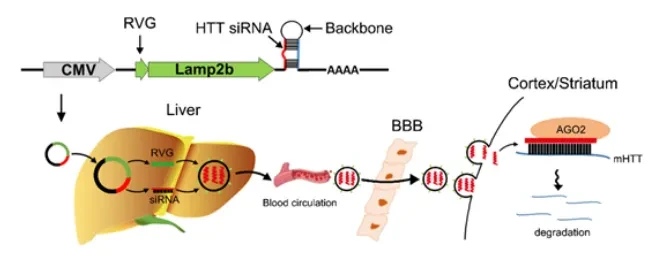
ExoRNA Bio's official website shows that preclinical experimental results have confirmed that after intravenous administration of ER2001 injection, it can cross the blood-brain barrier to reach the affected area and exert a therapeutic effect. Safety evaluation studies indicate that the proposed human dose is far below the maximum feasible dose in animals. The company has developed an in vivo self-assembling siRNA targeting the Huntington's disease gene mHTT, achieving effective treatment of the disease model. A plasmid encoding specific HTT siRNA is injected into the body, using the liver as a reactor to synthesize HTT siRNA and self-assemble into secretory exosomes. A short peptide derived from the rabies virus (RVG) is expressed on the exosome membrane, which mediates the crossing of the blood-brain barrier by binding to acetylcholine receptors on the surface of nerve cells, thereby delivering therapeutic HTT siRNA to brain cells. This achieves efficient brain delivery and uniform biodistribution of nucleic acid drugs in the brain, reducing the expression of mHTT protein and thus treating symptoms of Huntington's disease caused by toxic proteins.
About Huntington's Disease
Huntington's disease is a rare and fatal neurodegenerative disorder caused by the abnormal expansion of CAG triplet codon repeats in the first exon of the huntingtin (HTT) gene located on the short arm of chromosome 4. According to the Guidelines for the Diagnosis and Treatment of Rare Diseases (2019 Edition), the worldwide prevalence of Huntington's disease is approximately 2.7/100,000.
About ExoRNA Bio
ExoRNA Bio focuses on the development of drugs for diseases with unmet clinical needs, particularly in the field of synthetic biology self-assembled exosome nucleic acid drugs for central nervous system diseases, infections, and tumors. The company’s brand-new third-generation small nucleic acid delivery system is expected to break through the delivery bottleneck of nucleic acid drugs, achieving targeted delivery of novel multifunctional genetic components, and strives to build a world-leading platform-type nucleic acid innovative drug company.
E.N.D

Previous article recommendations:
A Chinese company focused on cell and gene therapy completes B+ round of financing
Building the "China Core" of Culture Media, a Leader in China-Produced Blood Substitutes
A Foreign Enterprise to Build Industrial Base for Cell Therapy Products in China
Gene Therapy Company Huayi Lejian Appoints New President
Dr. Liu Yongjun founded ExoRNA Bio to accelerate the R&D process of innovative immunotherapy drugs
China's Leading Culture Medium Company Acquires a CRO Company