Hansoh Pharma's B7-H3-Targeted ADC HS-20093 Nominated for Breakthrough Therapy Designation in China for Osteosarcoma
Hansoh Pharma
Pharmaceutical Research, Production, and Sales
▎WuXi AppTec Content Team Report
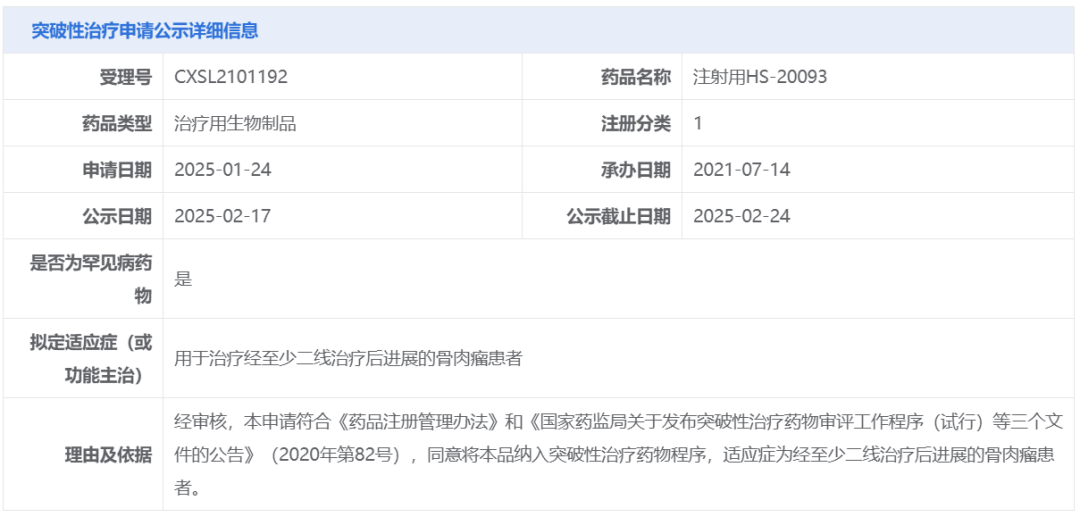
Screenshot source:CDE Official Website
Osteosarcoma mainly affects children and young adults and is the most common primary bone cancer, accounting for 20% to 40% of all bone cancers. Approximately 20% to 30% of patients with localized (non-metastatic) osteosarcoma and 80% of those with metastatic osteosarcoma experience recurrence or refractory disease. Treatment options are very limited for patients with recurrent or refractory osteosarcoma after first-line chemotherapy, with no clear standard of care. There is also an urgent clinical need for new treatment options for osteosarcoma patients who progress after prior second-line therapies.
HS-20093 is a novel B7-H3-targeted ADC, covalently linked by a fully human anti-B7-H3 monoclonal antibody and a topoisomerase inhibitor (TOPOi) payload. It is currently undergoing multiple Phase 1, Phase 2, and Phase 3 clinical trials in China for the treatment of lung cancer, sarcoma, head and neck cancer, and other solid tumors.In December 2023, Hansoh Pharma announced the granting ofGlaxoSmithKline (GSK)Global exclusive license (excluding mainland China, Hong Kong, Macao, and Taiwan) for the development, production, and commercialization of HS-20093.
In January 2025, GSK announcedGSK'227(HS-20093) has been granted Breakthrough Therapy Designation by the FDA. This FDA Breakthrough Therapy Designation was supported by Hansoh Pharma's ongoingARTEMIS-002 StudyData support. This is an ongoing Phase 2, open-label, randomized, multicenter clinical trial evaluating HS-20093/GSK'227 inRecurrent or Refractory Osteosarcoma and Other Unresectable Bone and Soft Tissue SarcomasEfficacy and safety in patients. The trial enrolled more than 60 patients, 42 of whom had osteosarcoma.
The results of ARTEMIS-002 were presented at the 2024 American Society of Clinical Oncology (ASCO) Annual Meeting. The study was divided into two cohorts: Cohort 1 enrolledPatients with advanced osteosarcoma who have progressed after standard treatment, randomly received 8.0mg/kg or 12.0mg/kg of HS-20093 treatment; Cohort 2 enrolledOther patients with bone and soft tissue sarcoma that is inoperable, lacks standard treatment options, or has failed/intolerant to standard treatment., receiving HS-20093 treatment at a dose of 12.0 mg/kg. The dosing regimen is intravenous injection once every 3 weeks (Q3W). The primary endpoint of the study is the objective response rate (ORR) assessed by investigators according to RECIST 1.1.
As of March 20, 2024, a total of 42 osteosarcoma patients have been enrolled in Cohort 1, with a median of 3 prior treatment lines. Among them, 35 patients (83.3%) had lung metastases; 38 patients had undergone at least one tumor assessment after baseline.The objective response rate (ORR) in the 12.0mg/kg group was 17.4%., Median Progression-Free Survival (PFS) Not Reached;The median PFS for the 8mg/kg group was 4.0 months.Cohort 2 enrolled a total of 20 patients with other bone and soft tissue sarcomas, with a median of 3 prior treatment lines. Among them, 18 patients (90%) had lung metastases.All 20 patients with other bone and soft tissue sarcomas were evaluable for efficacy, with an ORR of 25% and a median PFS of 7.1 months.In terms of safety, common ≥3 grade adverse events (incidence rate ≧10%) included decreased neutrophil count, decreased white blood cell count, decreased lymphocyte count, decreased platelet count, and anemia.
According to the conclusions drawn by the researchers, preliminary data from the Phase 2 small-sample study showed that HS-20093 demonstrated strong anti-tumor activity in patients with relapsed or refractory bone and soft tissue sarcoma who had received extensive prior treatment. The results surpassed historical data of existing standard treatments and exhibited good safety and tolerability. Clinical research data supports the continued development of HS-20093 for bone and soft tissue sarcoma.
In addition to targeting osteosarcoma, HS-20093/GSK'227 has previously received regulatory designations in China, the U.S., and Europe, including: In August 2024, the FDA granted GSK'227 Breakthrough Therapy Designation forExtensive-Stage Small Cell Lung Cancer (ES-SCLC) Progressed During or After Platinum-Based ChemotherapyPatient Treatment; In November 2024, China NMPA included HS-20093 in the breakthrough therapy drugs, with the proposed indication beingExtensive-Stage Small Cell Lung Cancer Progressed After Standard First-Line Treatment (Platinum-Based Doublet Chemotherapy Combined with Immunotherapy); In December 2024, the European Medicines Agency (EMA) granted GSK'227 Priority Medicines (PRIME) designation forRelapsed Extensive-Stage Small Cell Lung Cancer (ES-SCLC)Patient Treatment.
This article was compiled and edited by the WuXi AppTec content team based on publicly available information. Feel free to share it on your personal social media feed. For re-posting authorization or other collaboration inquiries, please contact wuxi_media@wuxiapptec.com.
Disclaimer: The content team of WuXi AppTec focuses on introducing the research progress in global biomedicine and health. This article is for information exchange only, and the views expressed in the article do not represent the position of WuXi AppTec, nor does it mean that WuXi AppTec supports or opposes the views in the article. This article is not a recommendation for treatment plans. If you need guidance on treatment options, please visit a regular hospital.