The U.S. Food and Drug Administration (FDA) has approved vaccines designed by GSK, Pfizer, and Moderna to protect high-risk populations from respiratory syncytial virus (RSV).These vaccines use the pre-fusion F (pre-F) protein as the immunogen.
On February 5, 2025, Zheng Zizheng, Xia Ningyao, and Zhang Jun from the School of Public Health, Xiamen University, jointly communicated inNature communications Published online with the title“A truncated pre-F protein mRNA vaccine elicits an enhanced immune response and protection against respiratory syncytial virus”Research paper.The study explored an mRNA vaccine based on the prefusion F protein, called LC2DM-lipid nanoparticle (LC2DM-LNP).
This vaccine is characterized by a truncated version of the pre-F protein anchored on the cell membrane. Studies in both young and aged female mice demonstrated that the LC2DM-LNP vaccine elicited robust neutralizing antibody titers. Moreover, LC2DM-LNP promoted a Th1-skewed T-cell immune response in female rodent models. Female cotton rats immunized with LC2DM-LNP showed strong immunity against RSV, with no signs of vaccine-enhanced respiratory disease (VERD) even in breakthrough infections. Importantly, when administered to pregnant female cotton rats, LC2DM-LNP ensured the transfer of pre-F-specific antibodies to offspring, providing protection against RSV without increasing pulmonary inflammation.This study suggests that LC2DM-LNP could be a candidate RSV vaccine for high-risk populations.
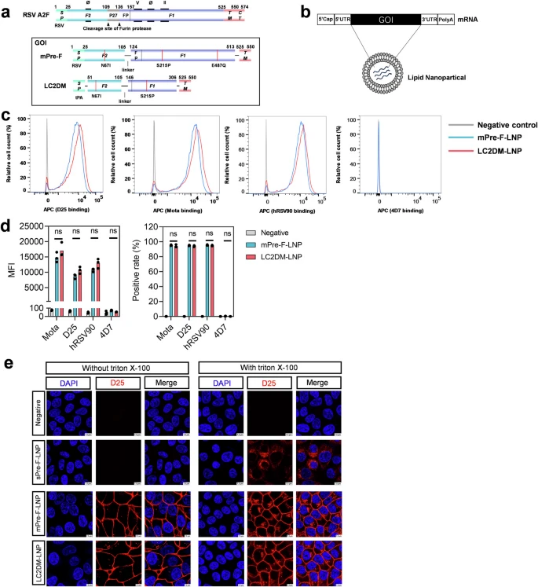
 Human Respiratory Syncytial Virus (RSV), a member of the Pneumoviridae family, is the leading cause of acute lower respiratory tract infections in children under 5 years old worldwide.Despite the significant health burden posed by RSV, vaccine development still faces challenges, most notably the failure of the FI-RSV vaccine in the 1960s, which not only failed to prevent the disease but also led to vaccine-enhanced respiratory disease (VERD). However, recent breakthroughs have been marked by the approval of RSV vaccines for older adults by GSK, Moderna, and Pfizer, with the latter also approved for use in pregnant women to protect infants.RSVF protein is a class I fusion glycoprotein responsible for viral entry into host cells, transitioning between two conformations: the metastable prefusion (pre-F) and the stable postfusion (post-F) forms.The pre-F conformation is an ideal vaccine target because the majority of neutralizing antibodies (nAbs) in human serum are directed against this form of the protein. The three RSV vaccines approved by the FDA utilize the pre-F conformation to achieve their efficacy.Severe RSV infections in newborns and the elderly are associated with the production of antibodies exhibiting low neutralizing activity.Therefore, further enhancing the neutralization capacity and quality of antibodies, especially in vulnerable populations, remains a key objective in vaccine development. A promising approach is immune focusing, which has been shown to improve antibody quality for other viruses. The RSVpre-F trimer consists of "stem" and "head" regions, with antigenic sites Φ and V located on the head, recognizable by potent nAbs. The surface of the pre-F protein, including sites Φ and V, is relatively small, indicating the presence of several non-neutralizing epitopes that may reduce the potency of the immune response. Kwong et al. explored "head-only" immunogens to focus the antibody response on site Φ, but these immunogens generated lower neutralization titers compared to those targeting the entire DS-Cav1 trimer. Thus, while focusing on critical antigenic sites may enhance antibody quality, it could potentially compromise overall immunogenicity, suggesting the need for further refinement.In addition to efficacy, a major obstacle in RSV vaccine development is the risk of VERD caused by Th-2 skewed immune responses.To mitigate this risk, the incorporation of Th-1-biased adjuvants is crucial, as non-replicating vaccines without such adjuvants may continue to pose a risk of VERD. This concern is particularly important in vulnerable populations such as infants, where only a limited number of Th-1-inducing adjuvants have been approved for use. Moreover, elderly individuals, who are more prone to severe RSV disease, often exhibit a Th-2-biased immune response with weaker RSV-specific CD8+ T-cell activity compared to younger individuals.Therefore, an ideal RSV vaccine must not only elicit high titers of nAb but also induce a robust Th1-skewed cellular immune response, providing broad and effective protection for all age groups.Recent advances in mRNA technology offer promising solutions for designing RSV vaccines. mRNA vaccines can induce both humoral and cellular immune responses and effectively express complex or unstable antigens. Additionally, mRNA vaccines for SARS-CoV-2 have demonstrated acceptable safety across various populations. Moderna's mRNA vaccine targeting the pre-F conformation for the elderly represents a significant milestone and highlights the potential of this approach in preventing RSV.However, there are concerns about the safety of mRNA vaccines in pediatric populations.A recent clinical trial of the Moderna mRNA vaccine in young children showed an imbalance in severe RSV-related lower respiratory tract infections between the vaccinated group and the placebo group in infants who had not been exposed to RSV, leading to a pause in the study and raising questions about VERD risks. It remains unclear whether these safety concerns are similar to those associated with the FI-RSV vaccine, as Moderna's mRNA vaccine uses a pre-F antigen to elicit high-affinity nAbs and induces a balanced Th1/Th2 helper T-cell response, theoretically addressing the primary hypothesis of VERD observed with FI-RSV. Given that mRNA vaccines for SARS-CoV-2 have not shown similar safety issues in children, the challenge is more likely to stem from the intrinsic complexity of RSV itself rather than the mRNA platform. Therefore, optimizing and redesigning the RSV antigen may represent a key next step in enhancing the safety and efficacy of mRNA vaccines for pediatric use.In this study, a modified pre-F protein, called LC2DM, was developed to enhance immunogenicity by focusing on effective epitopes on the cell membrane.LC2DM mRNA is encapsulated in lipid nanoparticles (LNPs) to prepare the vaccine formulation. In vivo studies in various animal models have shown that LC2DM-LNP elicits robust humoral and Th-1 skewed T-cell responses. Moreover, cotton rats vaccinated with LC2DM-LNP exhibited complete protection against RSV infection without signs of VERD. Importantly, the offspring of LC2DM-LNP-immunized cotton rats also demonstrated strong protection against RSV without evidence of exacerbated lung disease.These findings support the potential of LC2DM-LNP vaccine as a promising RSV candidate vaccine, especially for high-risk populations.。Figure 1 Design and expression characterization of truncated, membrane-anchored pre-F protein antigen(Excerpt fromNature communications )https://doi.org/10.1038/s41467-025-56302-1
—END—
Content is【iNature】Original article from WeChat Official Account,
Please indicate the source of the reprint.【iNature】
WeChat Group Addition
iNature has gathered 40,000 researchers and doctors in the life sciences. We have formed 80 integrated groups (16 PI groups and 64 PhD groups), and also established specialized professional groups in related fields (such as plants, immunity, cells, microbiology, gene editing, neuroscience, chemistry, physics, cardiovascular, oncology, etc.).Reminder: Please leave a note when joining the group (in the format of School + Major + Name; if you are a PI/Professor, please...Indicate thatPI/Professor, otherwise directlyDefault is a Ph.D. candidate, thank you)。You can add the editor's WeChat ID first (love_iNature), or long press the QR code to add the editor, then join the relevant group. Serious inquiries only.


Submission, Cooperation, and Reposting Authorization Matters
Please contact WeChat ID:13701829856Or email:iNature2020@163.com
If you think this article is good-looking, please click here!