

Johnson & Johnson Bets Big on Depression: Aiming to Become the CNS Leader with Caplyta and a Multi-Pronged Portfolio

Johnson & Johnson
Medical Device R&D and Manufacturer
The United States is experiencing the worst economic difficulties since 1970, according to Jamie Dimon, CEO of JPMorgan Chase, who is known as the "President of Wall Street."
In an environment of economic downturn, with rising unemployment, the most immediate result is often an increase in depressive emotions. Therefore, during times of economic depression, businesses that spread joy—such as cinemas and theaters—tend to become particularly popular.
Johnson & Johnson, the American pharmaceutical giant, shares a similar view with Jamie Dimon on the current economic situation. In the past two months, Johnson & Johnson has placed significant bets on the depression market, aiming to establish itself as a leader in the central nervous system (CNS) field through depression.
$14.6 Billion Mega-Acquisition
In order to build a solid moat in the depression field, Johnson & Johnson spent $14.6 billion to acquire Intra-Cellular.
Intra-Cellular is a biopharmaceutical company focused on the development of novel drugs for CNS, founded in 2001 by Nobel laureate Paul Greengard. Paul Greengard was awarded the Nobel Prize in 2000 for his significant contributions to the field of "signal transmission in the human nervous system," and Intra-Cellular serves as the industrial application platform for Paul Greengard's academic achievements.
From 2010 to 2014, Intra-Cellular achieved four levels of capital market leaps, completing Series A financing, Series B financing, Series C financing, and an IPO on NASDAQ. Based on the offering price at that time, Intra-Cellular was valued at approximately $525 million.
In terms of product development, Intra-Cellular's core product, lumateperone (brand name: Caplyta), is a first-in-class (FIC) small molecule drug. Its mechanism of action is unique, partially agonizing dopamine D1 and D2 receptors while antagonizing the 5-HT2A receptor, inhibiting DA and 5-HT transporters, and promoting the activation of the NR2B subunit of NMDA receptors. In vitro research data shows that lumateperone has approximately 60 times higher affinity for the 5-HT2A receptor than for the D2 receptor. Based on this unique mechanism of action and affinity profile, lumateperone demonstrates enhanced therapeutic potential in the treatment of schizophrenia, bipolar disorder, depressive disorders, and other neuropsychiatric conditions.
However, lumateperone was not originally developed by Intra-Cellular but was acquired from Bristol-Myers Squibb in 2005. After years of research and development, it was finally approved in the United States on December 20, 2019, for the treatment of schizophrenia and was approved in December 2021 for the treatment of bipolar depression in adults. Following Caplyta's approval, Intra-Cellular's stock price continued to rise, with its market value reaching nearly $10 billion at one point.
Despite a strong market response, Caplyta's commercial performance has been lackluster, with annual sales only recently surpassing $500 million five years after its launch, still in a challenging market expansion phase. However, following its approval for depression, Caplyta’s revenue growth has significantly accelerated, demonstrating strong market competitiveness.
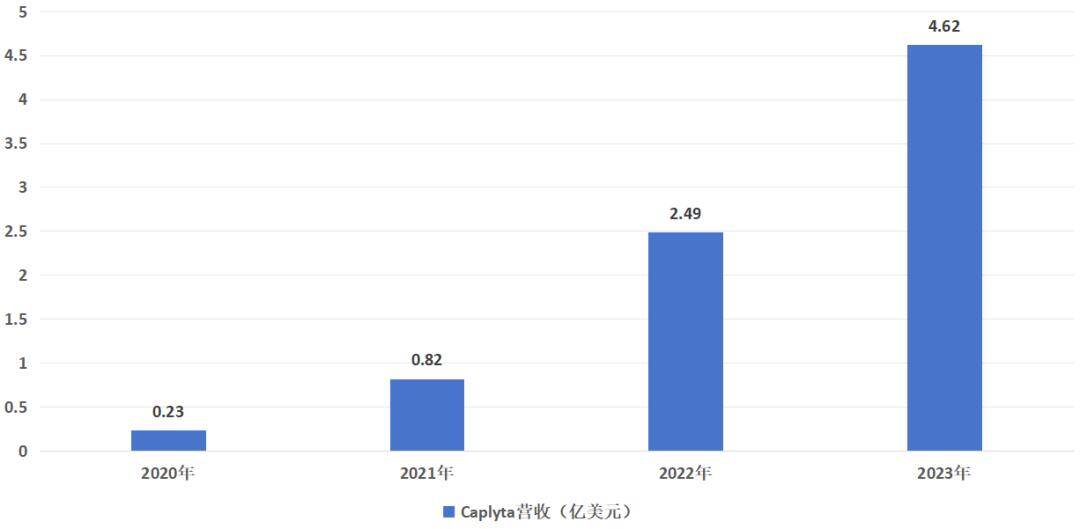
Figure: Caplyta Revenue Overview, Source: Jinduan Research Institute
For a startup like Intra-Cellular, it lacks the ability to make Caplyta a blockbuster, and its other R&D pipelines are also advancing rapidly with significant investment in R&D. Therefore, selling itself at a high price to a giant like Johnson & Johnson is undoubtedly a wise decision.
From Johnson & Johnson's perspective, after completely divesting the consumer health division, the company will fully focus on two major areas: innovative pharmaceuticals and medical technology. The key drug research and development efforts are concentrated in three fields: oncology, immunology, and neuroscience. However, compared to the two main pillars of oncology and immunology, the scale of the neuroscience business is relatively small. In 2024, Johnson & Johnson's neuroscience business generated $7.115 billion in revenue, accounting for only 12.5% of its innovative pharmaceuticals business, far lower than the 36.48% from oncology and 31.30% from immunology.
After acquiring Intra-Cellular, Johnson & Johnson will not only effectively supplement a series of CNS potential pipelines but also gain Caplyta, the most promising antidepressant drug to date.
02 Silently Building a Multi-dimensional Competitive System
After the completion of the acquisition, Caplyta's future development has become a focal point for all parties. As the CEO of Intra-Cellular stated in an internal letter, this is a rare opportunity for the company to reach another milestone.
Currently, CAPLYTA has been approved for two indications: the treatment of adult schizophrenia and depressive episodes associated with bipolar disorder. With these two major indications, CAPLYTA's sales revenue reached $462 million in 2023, representing an 86% year-over-year increase. In 2024, growth continued, with sales revenue in the first three quarters reaching $482 million, and full-year revenue is expected to reach up to $685 million, marking a 48% year-over-year increase.
Although the sales growth has relatively slowed down, in December 2024, Intra-Cellular submitted a new supplementary application to the FDA for Caplyta's third new indication, intended for use as an adjunctive treatment for Major Depressive Disorder (MDD).
The market value of MDD drugs far exceeds that of schizophrenia and bipolar disorder. According to the World Health Organization, the number of patients with depression worldwide exceeds 300 million, while the number of schizophrenia patients is approximately 21 million, and the number of bipolar disorder patients is around 50 million. Moreover, patients with depression often require long-term or even lifelong treatment, which means there is a stable market demand as long as the drugs are safe and effective.
Although Caplyta is applied as an adjunctive therapy rather than a core treatment drug, its significance in the treatment of depression cannot be overlooked. In terms of medical value, adjunctive therapy not only enhances treatment efficacy but also improves patients' quality of life. In clinical studies, the combination of certain adjunctive therapy drugs with traditional antidepressants increased treatment effectiveness from around 50% to 70%-80%, significantly improving patients' chances of recovery. Additionally, adjunctive therapy can shorten the treatment duration, alleviate symptoms more quickly, and reduce patient suffering.
As research on depression deepens, an increasing number of patients and doctors are seeking more effective combination treatment options. CAPLYTA’s adjunctive therapy aligns perfectly with this trend. In two global, double-blind, placebo-controlled Phase III studies, CAPLYTA, as an adjunct to antidepressant medications, demonstrated statistically and clinically significant improvements in depressive symptoms based on both clinician assessments and patient self-reports. In terms of safety, the results from both studies were consistent with existing clinical data, with no new safety concerns identified.
If CAPLYTA is approved as an adjunctive therapy, it will become the first drug approved for treating major depressive disorder and depressive symptoms associated with bipolar I and II disorders in over 15 years. It is expected to make waves in the field of depression treatment and become one of the most successful antidepressant drugs in history. Johnson & Johnson is confident in leveraging its strong commercialization team to make CAPLYTA a "blockbuster" product with a peak value of $5 billion.
In addition to purchasing CAPLYTA, a core drug for depression, Johnson & Johnson has been continuously deepening its presence in the depression treatment field.
On January 21 this year, the FDA approved Johnson & Johnson's supplemental New Drug Application (sNDA) for Spravato (esketamine) CIII nasal spray, making it the first and only monotherapy for treating adult patients with MDD who have had an inadequate response to at least two oral antidepressants. Another FIC drug from Johnson & Johnson, Seltorexant (OX2R antagonist), has also reached both primary and secondary endpoints in its Phase III clinical trial for adjunctive treatment of MDD.
These moves are enough to show that Johnson & Johnson is building a multi-dimensional competitive system for depression.
03 CNS Is Becoming the Next Hotspot
Johnson & Johnson's acquisition of Intra-Cellular is just a microcosm of the booming CNS field.
With the aging population, improved living standards, and changes in dietary habits, the incidence of CNS diseases such as schizophrenia, depression, and Alzheimer's disease is gradually increasing, becoming a major health and social challenge. At the same time, countries are actively promoting public education on central nervous system diseases, leading to a more scientific and comprehensive understanding among the public, and consequently, an increasing rate of patient visits.
Despite the significant growth in global demand for CNS drugs, compared to popular R&D fields such as oncology and autoimmune diseases, the path of drug development in the CNS field has been fraught with difficulties over the past few decades, showing relatively slow progress. In terms of the number of FDA-approved drugs and drug efficacy, there are still substantial unmet clinical needs in the CNS field. Take Alzheimer's disease and Parkinson’s disease as examples—current treatments can only delay disease progression to a certain extent but cannot cure the diseases fundamentally. Similarly, the treatment of schizophrenia is mainly limited to symptom relief, making it difficult to achieve a complete cure.
But from another perspective, compared to the fiercely competitive field of oncology drugs, the competition in the CNS drug sector is relatively moderate, with many untapped areas still available. This means that it is easier to achieve innovative breakthroughs in CNS drug projects, thereby creating opportunities for investors to obtain excess returns. For this reason, in recent years, driven by government support, venture capital, and new technologies, the CNS drug field has gradually entered a phase of reaping results, continuously giving rise to remarkable R&D achievements and market opportunities.
In the Alzheimer's disease field, Biogen/Eisai's Leqembi was approved in January 2023 for the treatment of early AD patients, becoming the world’s first drug able to slow the progression of AD; Lilly's Donanemab followed closely, gaining approval for marketing in July 2024, with Phase III clinical trials showing significant slowing of cognitive decline, forming direct competition with Leqembi.
In the field of schizophrenia treatment, in September 2024, the FDA approved the listing of BMS's new drug KarXT, which became the first new class of drug for treating schizophrenia in 50 years. In order to acquire this star drug, in December 2023, BMS spent $14 billion to acquire Karuna Therapeutics, the original research company of KarXT. This acquisition also became the second largest M&A case in terms of transaction volume that year.
In the field of depression treatment, besides CAPLYTA, AbbVie's Cariprazine was approved in December 2022 for adjunctive treatment of major depressive disorder, with full-year 2024 sales reaching $3.267 billion; Johnson & Johnson's Spravato (Esketamine) was recently approved as a monotherapy for treatment-resistant depression, achieving $1.077 billion in sales in 2024, representing a year-over-year increase of 56.4%.
As the development of treatment drugs for chronic diseases such as cardiovascular diseases and tumors is gradually becoming saturated, MNCs have once again turned their focus to the CNS field, which is becoming the next breakout point in the pharmaceutical track.
This article comes from the WeChat Official Account"MediShine", Author: Qing Li, published with the authorization of 36Kr.