Medtronic Reports Strong Q3 FY2025 Results with $8.29B Revenue, Driven by PFA and CGM Innovations

Medtronic
Medical Device Manufacturer
 Figure | Shutterstock
01
Medtronic Releases Q3 2025 Earnings Report
Strong growth in PFA, CGM, etc.
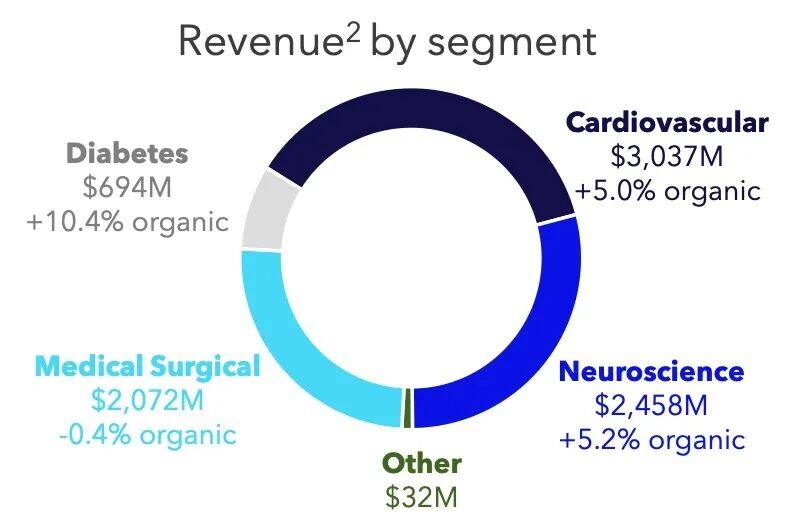
On February 18, Medtronic released 2025Q3Performance Report,Revenue increased by 2.5% year-over-year to US$8.29 billion (approximately RMB 60.4 billion)。

Specifically, three of Medtronic's four major businesses achieved growth,CardiovascularBusiness includesMachine growth of 5%, reaching 3.037 billion dollars; neuroscience business hasOrganic growth of 5.2%, reaching 2.458 billion USD; diabetes business organic growth of 10.4%, reaching 694 million USD.。
The performance of the medical surgical sector has seen a slightDecreased by 0.4%, revenue was$2.072 billion,Medtronic attributed the situation in the report toThe Impact of Some One-Time Procurement Models in the United States。
 Source: Medtronic Official Website
Medtronic Chairman and CEO Geoff Martha stated;"This quarter, we achieved strong profitability, benefiting from organic revenue growth in the mid-single digits for nine consecutive quarters, which significantly improved both our gross margin and operating profit margin. We are beginning to see the fruits of long-term investments in breakthrough innovations, such as pulsed field ablation technology, driving growth in the most attractive markets within the medical technology sector."”
As can be seen from the report, the positive impact of Medtronic's innovative products on performance has become significantly evident.
Thanks toPFA ProductsThe strong performance of Medtronic's cardiac ablation solutions business led to a revenue increase of approximately 20%; global growth in the brain modulation business was in the double digits, with growth in the U.S. market nearing 25%, mainly driven by BrainSense™ technology.Continuous Launch of Percept™ RC Deep Brain Stimulator (DBS); The performance boost of CGM for the diabetes business is also accelerating, itsMiniMed™ 780G Automated Insulin Delivery (AID) SystemContinued adoption in the U.S. market, with revenue growing at a mid-single-digit rate.
Medtronic expects,Organic revenue growth for fiscal year 2025 is expected to be in the range of 4.75% to 5%.
02
Intensified Internal Competition Among Giants
CGM, PFA Head-to-Head Competition
According to RootsAnalysis,The global PFA market scale in 2023 was US$105 million at the ex-factory level, and it is expected to reach US$5.5 billion by 2035.(2024E-2035E CAGR=39.1%), the global industry is in a stage of rapid growth.
As a pioneer in the PFA field, Boston Scientific also released its latest quarterly report recently.Sales of cardiovascular devices increased by 29% year-over-year to $2.94 billion, withFARAPULSE™ Device Revenue Exceeds $1 Billion, Treating Over 200,000 Patients。
Boston Scientific highlighted in the report that the fourth-quarter sales performance was outstanding, driven by the strong market acceptance of FARAPULSE™ in the United States, Europe, the Middle East, and Africa, as well as its successful launch in Japan and China.In 2024, the revenue of the FARAPULSE™ device exceeded 1 billion US dollars, and more than 200,000 patients were treated with this device.。
Johnson & Johnson's Varipulse pulsed field ablation platform received FDA approval in November of last year. According to its earnings report, Johnson & Johnson's cardiovascular revenue reached $7.707 billion in 2024, a year-on-year increase of 21.4%. In the strong segment of electrophysiology,Revenue of $5.267 billion in 2024, a year-on-year increase of 12.3%。
In January this year, Johnson & Johnson paused the external evaluation and commercial application of VARIPULSE™ in the United States, stating that it was investigating the causes of four reported stroke incidents following patient treatments during the external evaluation. Although temporarilyDeparture, but Johnson & Johnson recently announced,Will Resume Limited Market Release of VARIPULSE™ in the U.S. After Comprehensive Investigation。
Abbott has also recently joined this PFA war, itsGlobal IDE Enrollment for Volt™ PFA System Completed Ahead of Schedule; FOCALFLEX Pulsed Field Ablation Study Underway with Approximately 200 Patients Across 25 Sites in the U.S., Expected to Launch Soon。
The situation in the CGM field is also intense.According to data from灼识咨询, the global continuous glucose monitoring system market size increased from $17 billion in 2015 to $57 billion in 2020, with a compound annual growth rate of 28.2%.Expected to increase to USD 36.5 billion by 2030, with a compound annual growth rate of 20.3% from 2020 to 2030.。
According to Abbott's latest financial report,Its medical device business achieved global sales of over 5 billion US dollars in the fourth quarter, with an organic growth rate of 14.0% year-over-year. This growth was partly driven by the impressive sales performance of the FreeStyle Libre continuous glucose monitoring system.。
Notably, apart from the fierce competition for market share, the giants are also engaging in deep collaborations in niche technology sectors to accelerate the overall expansion of the industry.
The MiniMed™ 780G Automated Insulin Delivery (AID) system, which has added luster to Medtronic's performance this time, was previously announced to be integrated with Abbott's FreeStyle Libre 3 and its own smart insulin pen (InPen system).In November last year, Medtronic's InPen app officially received FDA approval.
Based on the extensive coverage characteristics of CGM, its vast potential market drives a large number of new players to accelerate their entry and continuously explore various细分 demands. For exampleSenseonics' Eversense 365It was approved by the FDA in September last year, significantly reducing the frequency of patients replacing devices.
As an old giant in the CGM field,Dexcom is setting its sights on the consumer healthcare track, launching an over-the-counter CGM called Stelo, with Abbott following suit by releasing its over-the-counter CGM, Lingo., both products have currently received FDA approval.
At this stage, the competition between medical device giants is becoming increasingly direct. While maintaining the foundation of their traditional advantageous businesses, the weight of high-growth innovative products on the scale of success and failure is becoming heavier.
- END -
Editor: Qin Jiu (nrzx0321)