AstraZeneca and MSD’s Selumetinib Submitted for New Indication in China Targeting Adult NF1 Patients with Inoperable Plexiform Neurofibromas

AstraZeneca
Biopharmaceutical Manufacturer
▎WuXi AppTec Content Team Report
Today (February 20), ChinaThe Center for Drug Evaluation (CDE) of the National Medical Products Administration (NMPA) has recently announced,AstraZeneca's submissionSelumetinib Sulfate CapsulesThe listing application has been accepted.Public information shows that Selumetinib was co-developed by AstraZeneca and MSD.MEK Inhibitor`, which has previously been approved for treatment in China`Pediatric patients aged 3 years and above with symptomatic, inoperable plexiform neurofibromas (PN) associated with Neurofibromatosis Type 1 (NF1)。Based on publicly available information, it can be speculated that the new indication submitted in China this time may be:Treatment of Symptomatic, Inoperable Plexiform Neurofibromas (PN) in Neurofibromatosis Type 1 (NF1)Adult Patients。
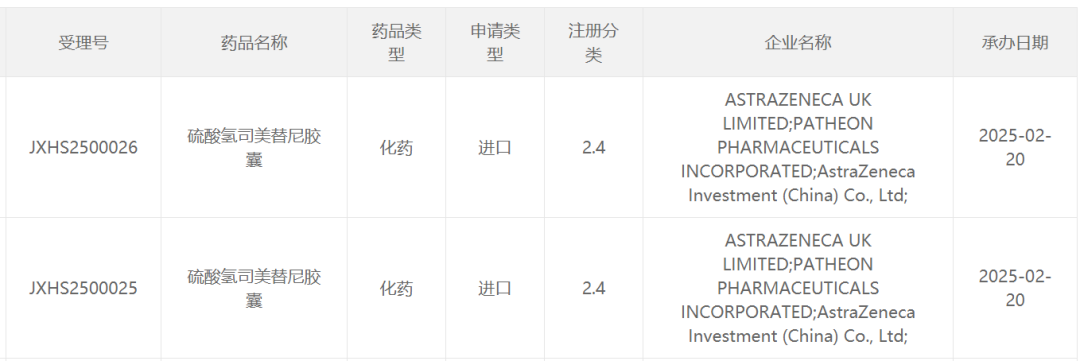
Screenshot source:CDE Official Website
Selumetinib is a kinase inhibitor that blocks specific enzymes (MEK1 and MEK2) involved in promoting cell growth. In NF1, these enzymes are overactive, leading to unregulated growth of tumor cells and the formation of so-called plexiform neurofibromas (PN). By blocking these enzymes,Selumetinib slows the growth of tumor cells, thereby slowing the growth of PN.
In July 2017, AstraZeneca and Merck announced a global strategic collaboration to jointly advance the development and commercialization of selumetinib.Selumetinib has been previously approved in the United States, the European Union (EU), Japan, and China for the treatment of pediatric patients with symptomatic, inoperable NF1-associated PN.

In November 2024, AstraZeneca and Merck jointly announced the positive topline results of the Phase 3 KOMET clinical trial. The KOMET study aims to evaluate selumetinib in patients with symptomatic, inoperable plexiform neurofibromas.Adult patients with NF1Efficacy and safety in China. The study results show,SelumetinibIn these adult patients, compared with placebo,Showed statistically significant and clinically meaningful improvement in the primary endpoint of objective response rate (ORR),Can significantly reduce the size of patients' tumorsIn the trial, ORR is defined as the percentage of patients with complete response (PN disappearance) or partial response (tumor volume reduction of at least 20%) confirmed by Independent Central Review (ICR) according to the Response Evaluation in Neurofibromatosis and Schwannomatosis (REiNS) criteria at Cycle 16 (each cycle is 28 days).
According to the official website of the Chinese Drug Clinical Trial Registration and Information Disclosure Platform, the KOMET study has also been conducted in China and has completed participant recruitment in China.
NF1 is a rare, incurable genetic disorder. NF1 is caused by the synthesis of neurofibromin protein.NF1Caused by genetic mutations. This gene mutation can disrupt the RAS/MAPK signaling pathway (RAS-RAF-MEK-ERK), leading to tumor growth. Approximately half of NF1 patients may develop plexiform neurofibromas, which can cause pain, nerve dysfunction, skeletal deformities, and in severe cases, can be life-threatening. Due to the fact that most NF1 patients are either inoperable or face high surgical risks and recurrence rates, there is an urgent need for drug treatments for NF1.
With the advancement of new drug development, there are increasingly more options for clinical treatment of NF1. For instance, just a few days ago (February 12), the U.S. FDAApprovalSpringWorks Therapeutics' MEK inhibitor mirdametinib has been approved for marketing in China, for the treatment of type 1 neurofibromatosis-related plexiform neurofibromas in patients aged 2 years and above.(NF1-PN) Adult and Pediatric Patients; Fosun Pharma's self-developed novel MEK1/2 selective inhibitor, Fumatinib (FCN-159), has also been submitted for marketing approval in China and included in the priority review for the treatment ofPlexiform Neurofibromas (PN) Associated with NF1 in Children Aged 2 Years and AboveIn addition, several approved drugs, such as anti-PD-1 monoclonal antibody drugs, are currently undergoing clinical exploration for the NF1 indication.
Looking Forward to More New DrugsGet approved for more indications as soon as possible to benefit more patients.
This article was compiled and edited by the WuXi AppTec content team based on publicly available information. Feel free to share it on your personal social media feeds. For authorization to repost or other collaboration inquiries, please contact wuxi_media@wuxiapptec.com.
Disclaimer: The content team of WuXi AppTec focuses on introducing the research progress in global biopharmaceuticals and health. This article is for information exchange only, and the views expressed in the article do not represent the position of WuXi AppTec, nor does it imply that WuXi AppTec supports or opposes these views. This article is not a recommendation for treatment plans. For guidance on treatment options, please visit a正规 hospital.