

Hansoh Pharmaceutical's Shenglolai (Pegmolesatide) Long-Acting Erythropoiesis Mechanism Study Published in Journal of Translational Medicine
Hansoh Pharma
Pharmaceutical Research, Production, and Sales
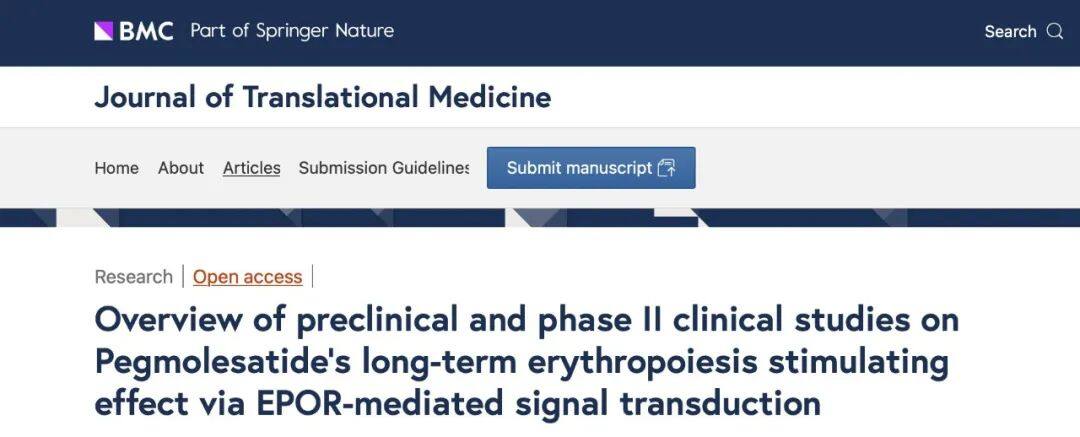
Recently, the long-acting mechanism study of Pemostim (trade name: Shengluolai) by Hansoh Pharma was published in the Journal of Translational Medicine (Web of Science real-time impact factor: 6.8).
As a long-acting agent, pemosedtinib adopts the third-generation branched polyethylene glycol (PEG) modification technology, which can significantly extend the drug's half-life. Its elimination half-life (t1/2) in chronic kidney disease (CKD) anemia patients is 58.3~74.9 hours [2]. To verify the long-term mechanism that allows pemosedtinib to achieve once-monthly dosing beyond the extended half-life, researchers have conducted multiple studies.
The long-acting erythropoiesis-stimulating mechanism study published in this issue of J Transl Med covers one in vitro experiment, one animal experiment, and two Phase II clinical trials targeting dialysis and non-dialysis CKD patients with anemia. The specific results are as follows.
In Vitro Study: Pemostim (培莫沙肽) Binds to the EPO Receptor More Stably and Durably
Surface Plasmon Resonance (SPR) results showed that, compared with conventional short-acting ESAs and darbepoetin alfa, pemodutide binds more stably to EPOR and has a longer retention time on EPOR, approximately 6.4 times that of rHuEPO (ESPO 3000). In vitro cell experiment results indicated that pemodutide can promote UT-7 cell proliferation, maintain cell survival, and inhibit cell apoptosis, as well as help sustain EPOR expression on the surface of UT-7 cells, thereby continuously promoting erythropoiesis.
This in vitro study is the first to validate that pemoxaprom binds more stably and persistently to the EPO receptor (EPOR) in vitro. By maintaining the expression of EPOR on the cell surface, it sustains the continuous activation of downstream signaling pathways to generate red blood cells, providing a strong theoretical basis for the long-acting erythropoiesis-stimulating effect of pemoxaprom.
Animal Experiment: Hemoglobin Continuously Increased for Up to 14 Days After a Single Dose in Mice, Providing Basis for Once-Monthly Dosing in Humans
In healthy mice, a single subcutaneous injection of Pemoxalin was found to significantly increase peripheral reticulocytes on day 4. Red blood cells, hemoglobin, and hematocrit showed a dose-dependent significant increase on day 6, which lasted until day 14. Since the clearance rate of Pemoxalin in rodents is much faster than that in humans, these experimental results provide a theoretical basis for once-monthly dosing in humans. The study also showed that, compared with short-acting ESA (ESPO 3000), Pemoxalin exhibited a more significant erythropoietic effect in mice.
Phase II Clinical Trial: Pemostatin has a PK-PD dual-prolonged effect and is well-tolerated.
In two Phase II clinical trials conducted among CKD anemia patients, both on dialysis and non-dialysis, participants received pemodepotet alfa at varying doses (0.025 mg/kg, 0.05 mg/kg, 0.08 mg/kg) with six administrations every four weeks. Results demonstrated that pemodepotet alfa effectively increased and maintained hemoglobin (HGB) levels in both dialysis and non-dialysis CKD anemia patients. The PK-PD dual-prolonged characteristics of pemodepotet alfa were reflected through HGB and reticulocyte counts, supporting its once-monthly dosing. The proportion of HGB responders and the reported adverse events further confirmed the favorable efficacy and safety profile of pemodepotet alfa in the study population.
In addition to the above-mentioned long-term mechanism research, the "Chinese Consensus on Guiding Renal Anemia Patients' Self-Management (2024 Edition)" released in January 2025 mentioned that the current medication adherence of renal anemia patients is relatively poor. This may be related to reasons such as conflicts with work schedules, concerns about drug interactions, difficulty swallowing large pills, and high injection frequency. Long-acting ESAs, including EPO mimetic peptides (Pegmocept), can extend the dosing interval and reduce the frequency of medication, thereby improving patient treatment adherence. Therefore, the long-term mechanism of Shengluolai will help enhance the compliance and self-management level of renal anemia patients, promote hemoglobin target achievement, and improve patient prognosis.